
用于佐剂配方的脂质纳米颗粒组合物调节四价流感疫苗接种小鼠流感病毒感染后的疾病。
Lipid nanoparticle composition for adjuvant formulation modulates disease after influenza virus infection in quadrivalent influenza vaccine vaccinated mice.
机构信息
Department of Microbiology, Icahn School of Medicine at Mount Sinai, New York, NY, United States.
Global Health and Emerging Pathogens Institute, Icahn School of Medicine at Mount Sinai, New York, NY, United States.
出版信息
Front Immunol. 2024 Apr 22;15:1370564. doi: 10.3389/fimmu.2024.1370564. eCollection 2024.
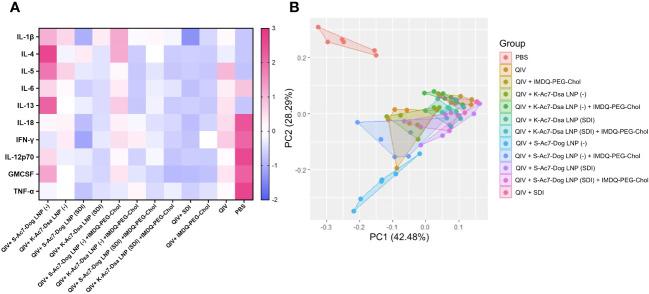
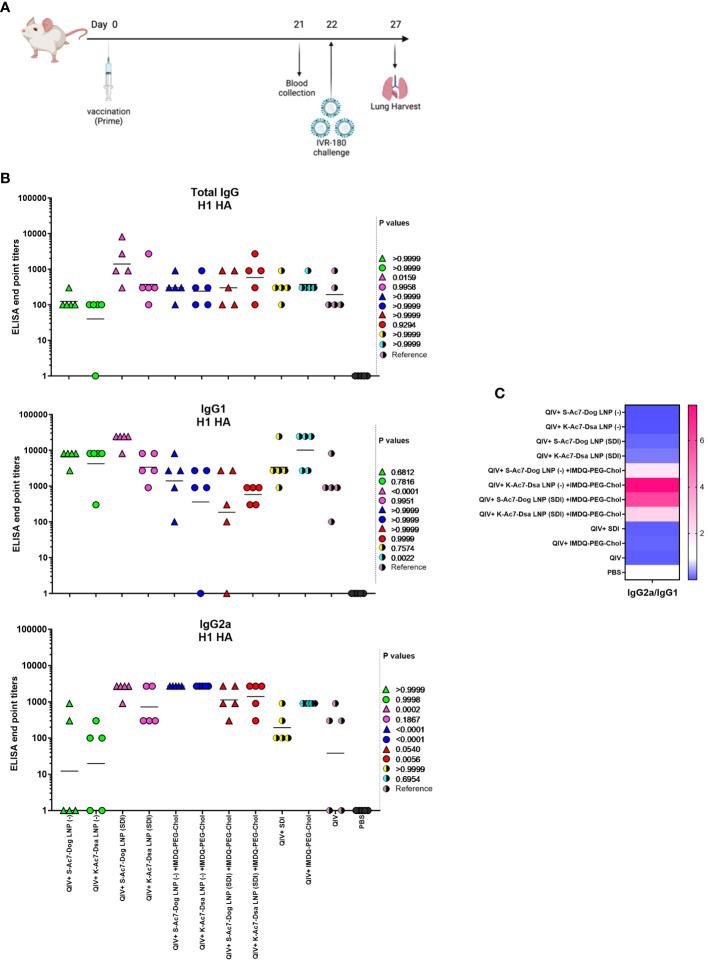
There are considerable avenues through which currently licensed influenza vaccines could be optimized. We tested influenza vaccination in a mouse model with two adjuvants: Sendai virus-derived defective interfering (SDI) RNA, a RIG-I agonist; and an amphiphilic imidazoquinoline (IMDQ-PEG-Chol), a TLR7/8 agonist. The negatively charged SDI RNA was formulated into lipid nanoparticles (LNPs) facilitating direct delivery of SDI RNA to the cytosol, where RIG-I sensing induces inflammatory and type I interferon responses. We previously tested SDI RNA and IMDQ-PEG-Chol as standalone and combination adjuvants for influenza and SARS-CoV-2 vaccines. Here, we tested two different ionizable lipids, K-Ac7-Dsa and S-Ac7-Dog, for LNP formulations. The LNPs were incorporated with SDI RNA to determine its potential as a combination adjuvant with IMDQ-PEG-Chol by evaluating the host immune response to vaccination and infection in immunized BALB/c mice. Adjuvanticity of IMDQ-PEG-Chol with and without empty or SDI-loaded LNPs was validated with quadrivalent inactivated influenza vaccine (QIV), showing robust induction of antibody titers and T-cell responses. Depending on the adjuvant combination and LNP formulation, humoral and cellular vaccine responses could be tailored towards type 1 or type 2 host responses with specific cytokine profiles that correlated with the protective responses to viral infection. The extent of protection conferred by different vaccine/LNP/adjuvant combinations was tested by challenging mice with a vaccine-matched strain of influenza A virus A/Singapore/gp1908/2015 IVR-180 (H1N1). Groups that received either LNP formulated with SDI or IMDQ-PEG-Chol, or both, showed very low levels of viral replication in their lungs at 5 days post-infection (DPI). These studies provide evidence that the combination of vaccines with LNPs and/or adjuvants promote antigen-specific cellular responses that can contribute to protection upon infection. Interestingly, we observed differences in humoral and cellular responses to vaccination between different groups receiving K-Ac7-Dsa or S-Ac7-Dog lipids in LNP formulations. The differences were also reflected in inflammatory responses in lungs of vaccinated animals to infection, depending on LNP formulations. Therefore, this study suggests that the composition of the LNPs, particularly the ionizable lipid, plays an important role in inducing inflammatory responses , which is important for vaccine safety and to prevent adverse effects upon viral exposure.
目前已获许可的流感疫苗有很多途径可以进行优化。我们在小鼠模型中用两种佐剂进行了流感疫苗接种测试: 麻疹病毒衍生的缺陷干扰(SDI)RNA,一种 RIG-I 激动剂;和一种两亲性咪唑并喹啉(IMDQ-PEG-Chol),一种 TLR7/8 激动剂。带负电荷的 SDI RNA 被制成脂质纳米颗粒(LNPs),有利于 SDI RNA 直接递送至细胞质,在细胞质中 RIG-I 感应会诱导炎症和 I 型干扰素反应。我们之前曾测试过 SDI RNA 和 IMDQ-PEG-Chol 作为流感和 SARS-CoV-2 疫苗的单独和联合佐剂。在这里,我们测试了两种不同的可离子化脂质,K-Ac7-Dsa 和 S-Ac7-Dog,用于 LNP 制剂。将 LNPs 与 SDI RNA 结合,通过评估免疫 BALB/c 小鼠接种疫苗和感染后的宿主免疫反应,来确定其作为 IMDQ-PEG-Chol 联合佐剂的潜力。用四价灭活流感疫苗(QIV)验证了 IMDQ-PEG-Chol 与空或 SDI 负载的 LNPs 的佐剂活性,显示出抗体滴度和 T 细胞反应的强烈诱导。根据佐剂组合和 LNP 制剂的不同,体液和细胞疫苗反应可以针对 1 型或 2 型宿主反应进行定制,具有特定的细胞因子谱,与病毒感染的保护反应相关。通过用与疫苗匹配的流感 A 病毒 A/Singapore/gp1908/2015 IVR-180(H1N1)株对小鼠进行攻毒,测试了不同疫苗/LNP/佐剂组合的保护程度。接受负载 SDI 的 LNP 或 IMDQ-PEG-Chol 或两者的组在感染后 5 天(DPI)时肺部的病毒复制水平非常低。这些研究提供了证据,表明疫苗与 LNPs 和/或佐剂的组合促进了抗原特异性细胞反应,有助于感染后的保护。有趣的是,我们观察到接受不同 K-Ac7-Dsa 或 S-Ac7-Dog 脂质的 LNP 制剂的不同组之间对疫苗接种的体液和细胞反应存在差异。在接种疫苗的动物肺部对感染的炎症反应中,也反映了这种差异,这取决于 LNP 制剂。因此,这项研究表明,LNPs 的组成,特别是可离子化脂质,在诱导炎症反应方面起着重要作用,这对于疫苗安全性和防止病毒暴露后的不良影响很重要。



 Zotero 插件