
靶向程序性死亡受体1(PD-1)的翻译后修饰以改善癌症免疫治疗
Targeting PD-1 post-translational modifications for improving cancer immunotherapy.
作者信息
Shi Jie, He Chuan, Chen Li, Xing Xixin, Wei Wenyi, Zhang Jinfang
机构信息
Department of Radiation and Medical Oncology, Medical Research Institute, Frontier Science Center of Immunology and Metabolism, Hubei Key Laboratory of Tumor Biological Behavior, Hubei Provincial Clinical Research Center for Cancer, Zhongnan Hospital of Wuhan University, Wuhan University, Wuhan 430071, Hubei, China.
Taikang Center for Life and Medical Sciences, Wuhan University, Wuhan 430071, Hubei, China.
出版信息
Cell Insight. 2025 Apr 10;4(3):100248. doi: 10.1016/j.cellin.2025.100248. eCollection 2025 Jun.
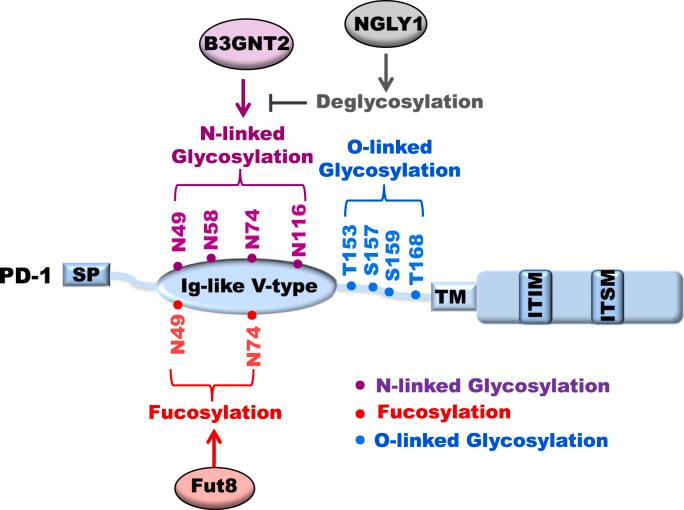
Programmed cell death protein 1 (PD-1) is a critical immune checkpoint receptor that suppresses immune responses largely through its interaction with PD-L1. Tumors exploit this mechanism to evade immune surveillance, positioning immune checkpoint inhibitors targeting the PD-1/PD-L1 axis as groundbreaking advancements in cancer therapy. However, the overall effectiveness of these therapies is often constrained by an incomplete understanding of the underlying mechanisms. Recent research has uncovered the pivotal role of various post-translational modifications (PTMs) of PD-1, including ubiquitination, UFMylation, phosphorylation, palmitoylation, and glycosylation, in regulating its protein stability, localization, and protein-protein interactions. As much, dysregulation of these PTMs can drive PD-1-mediated immune evasion and contribute to therapeutic resistance. Notably, targeting PD-1 PTMs with small-molecule inhibitors or monoclonal antibodies (MAbs) has shown potential to bolster anti-tumor immunity in both pre-clinical mouse models and clinical trials. This review highlights recent findings on PD-1's PTMs and explores emerging therapeutic strategies aimed at modulating these modifications. By integrating these mechanistic insights, the development of combination cancer immunotherapies can be further rationally advanced, offering new avenues for more effective and durable treatments.
程序性细胞死亡蛋白1(PD-1)是一种关键的免疫检查点受体,主要通过与PD-L1相互作用来抑制免疫反应。肿瘤利用这一机制逃避免疫监视,使靶向PD-1/PD-L1轴的免疫检查点抑制剂成为癌症治疗中的突破性进展。然而,这些疗法的总体有效性常常受到对潜在机制理解不全面的限制。最近的研究揭示了PD-1的各种翻译后修饰(PTM),包括泛素化、UFMylation、磷酸化、棕榈酰化和糖基化,在调节其蛋白质稳定性、定位和蛋白质-蛋白质相互作用方面的关键作用。同样,这些PTM的失调可导致PD-1介导的免疫逃逸并导致治疗抗性。值得注意的是,在临床前小鼠模型和临床试验中,用小分子抑制剂或单克隆抗体(MAb)靶向PD-1的PTM已显示出增强抗肿瘤免疫力的潜力。本综述重点介绍了关于PD-1的PTM的最新发现,并探讨了旨在调节这些修饰的新兴治疗策略。通过整合这些机制见解,可以进一步合理推进联合癌症免疫疗法的开发,为更有效和持久的治疗提供新途径。


 Zotero 插件