
非编码RNA在胃肠道间质瘤程序性细胞死亡途径和耐药性中的调控作用
Regulatory roles of non-coding RNAs in programmed cell death pathways and drug resistance in gastrointestinal stromal tumors.
作者信息
Ma Yuxuan, Wang Yuhao, Wang Shu, Wang Haoyuan, Zhao Yan, Peng Chaosheng, Liu Xin, Yang Jianjun
机构信息
Department of Digestive Surgery, Xijing Hospital of Digestive Diseases, Fourth Military Medical University, No. 127, Changlexi Road, Xi'an, 710032, Shaanxi Province, China.
State Key Laboratory of Holistic Integrative Management of Gastrointestinal Cancers and National Clinical Research Center for Digestive Diseases, Xijing Hospital of Digestive Diseases, Fourth Military Medical University, Xi'an, 710032, China.
出版信息
Clin Exp Med. 2025 May 10;25(1):150. doi: 10.1007/s10238-025-01667-2.
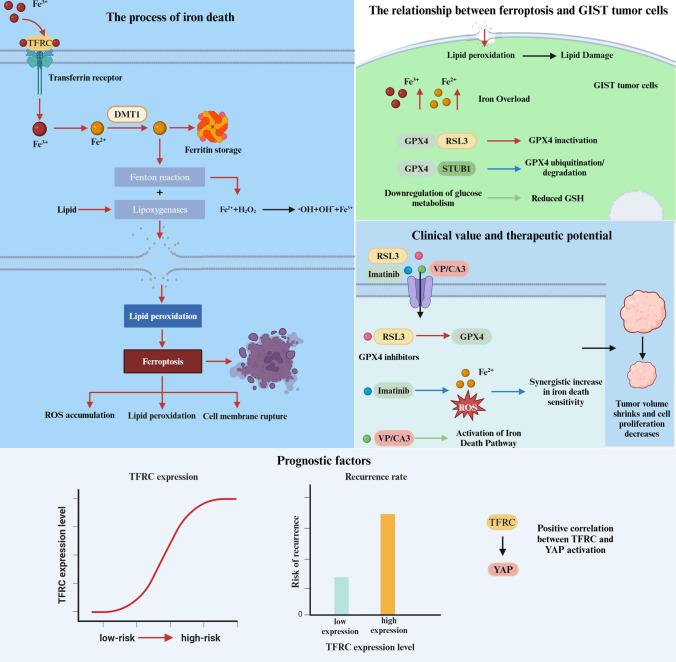
Gastrointestinal stromal tumors (GIST) are the most common mesenchymal tumors of the gastrointestinal tract, primarily driven by KIT or PDGFRA mutations. Programmed cell death (PCD), including apoptosis, autophagy, and ferroptosis, plays a crucial role in GIST pathogenesis, progression, and treatment response. Non-coding RNAs (ncRNAs) have emerged as key regulators of PCD pathways, influencing GIST proliferation, metastasis, and drug resistance, particularly in response to tyrosine kinase inhibitors (TKIs) such as imatinib. Apoptosis suppression is strongly associated with poor prognosis, while autophagy contributes to tumor dormancy and TKI resistance. Ferroptosis, a novel iron-dependent cell death pathway, represents a promising therapeutic target. Recent evidence suggests that ncRNAs modulate these PCD pathways through interactions with key molecular regulators such as miR-494, miR-30a, and lncRNAs, which affect signaling networks including PI3K/AKT, MAPK, and mTOR. Furthermore, ncRNAs have mediated secondary resistance to imatinib by promoting autophagic flux and altering ferroptosis sensitivity. Understanding the molecular interplay between ncRNAs and PCD in GIST provides novel insights into disease mechanisms and offers potential therapeutic strategies to overcome drug resistance. Targeting ncRNA-mediated regulation of apoptosis, autophagy, and ferroptosis may enhance treatment efficacy and improve patient outcomes. Future research should focus on elucidating the mechanistic roles of ncRNAs in PCD pathways to develop innovative diagnostic and therapeutic approaches for GIST.
胃肠道间质瘤(GIST)是胃肠道最常见的间充质肿瘤,主要由KIT或PDGFRA突变驱动。程序性细胞死亡(PCD),包括细胞凋亡、自噬和铁死亡,在GIST的发病机制、进展和治疗反应中起关键作用。非编码RNA(ncRNA)已成为PCD途径的关键调节因子,影响GIST的增殖、转移和耐药性,特别是对伊马替尼等酪氨酸激酶抑制剂(TKI)的反应。细胞凋亡抑制与预后不良密切相关,而自噬则导致肿瘤休眠和TKI耐药。铁死亡是一种新的铁依赖性细胞死亡途径,是一个有前景的治疗靶点。最近的证据表明,ncRNA通过与miR-494、miR-30a和lncRNA等关键分子调节因子相互作用来调节这些PCD途径,这些分子调节因子影响包括PI3K/AKT、MAPK和mTOR在内的信号网络。此外,ncRNA通过促进自噬通量和改变铁死亡敏感性介导对伊马替尼的继发性耐药。了解GIST中ncRNA与PCD之间的分子相互作用,为疾病机制提供了新的见解,并为克服耐药性提供了潜在的治疗策略。靶向ncRNA介导的细胞凋亡、自噬和铁死亡调节可能会提高治疗效果并改善患者预后。未来的研究应集中于阐明ncRNA在PCD途径中的机制作用,以开发针对GIST的创新诊断和治疗方法。




 Zotero 插件