
来自印度东部的一例人感染甲型禽流感(H9N2)病毒病例的鉴定、基因及病毒学特征分析
Identification & genetic & virological characterisation of a human case of avian influenza A (H9N2) virus from Eastern India.
作者信息
Majumdar Agniva, Potdar Varsha, Vipat Veena, Pawar Shailesh, Jadhav Sheetal, Choudhary Manohar Lal, Gaikwad Satish, Keng Sachin, Tare Deeksha, Chatterjee Ananya, Goswami Susmita, Hazra Sutapa, Bhardwaj Sumit Dutt, Vijay Neetu, Mukhopadhyay Labanya, Dutta Shanta, Gupta Nivedita
机构信息
Regional Virus Research and Diagnostic Laboratory, ICMR-National Institute for Research in Bacterial Infections (NIRBI), Kolkata, West Bengal, India.
Influenza Group, ICMR-National Institute of Virology, Pune, Maharashtra, India.
出版信息
Indian J Med Res. 2025 Mar;161(3):257-266. doi: 10.25259/IJMR_1376_2024.
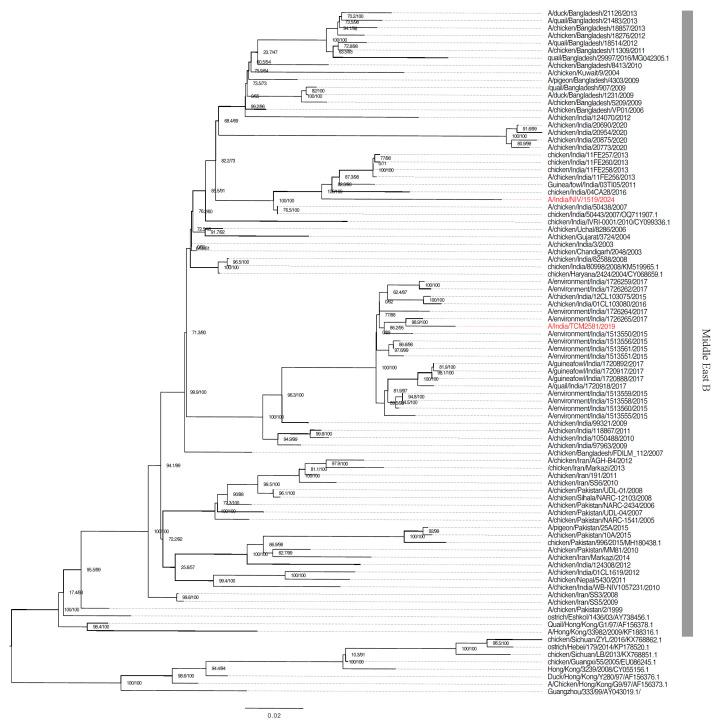
Background & objectives A three-year-old male child from West Bengal, India, with severe acute respiratory symptoms, was confirmed in the laboratory with LPAI H9N2 virus infection under the Indian Council of Medical Research (ICMR) - Pan India Acute Respiratory Infections (ARI) / Severe Acute Respiratory Infections (SARI) surveillance through the Virus Research and Diagnostic Laboratories network. Methods Common respiratory viruses were detected by real-time PCR, followed by subtyping of Influenza A for seasonal and avian viruses. The identified H9N2 virus was isolated and further characterised, including whole genome sequencing. Antibody response was performed in serum samples of the case and family members. Results Complete genome sequencing revealed a G1 lineage (Middle East B sub-lineage). Bayesian evolutionary analyses of the HA gene of Indian H9N2 poultry strains showed three clusters of multiple introductions at the estimated node age of 1999 based on the Human strain A/India/NIV/1519/2024(H9N2) and the other poultry viruses from India evolved with 4.49 × 10⁻³ substitutions per site per year. The isolated H9N2 virus showed a high EID50 titre of 108.25/200 µl with avian-type receptor specificity. The antibodies against the H9N2 virus were only detected in the study case and not in close contacts confirming limited human-to-human transmission. The virus was found to be sensitive to neuraminidase inhibitors oseltamivir and zanamivir. Interpretation & conclusions Systematic avian influenza surveillance in both birds and humans is required for the early detection of newly evolved viruses.
背景与目的 一名来自印度西孟加拉邦的3岁男童出现严重急性呼吸道症状,通过病毒研究与诊断实验室网络,在印度医学研究理事会(ICMR)的全印度急性呼吸道感染(ARI)/重症急性呼吸道感染(SARI)监测中,经实验室确诊感染低致病性禽流感H9N2病毒。方法 通过实时PCR检测常见呼吸道病毒,随后对甲型流感病毒进行季节性和禽流感病毒亚型分型。对鉴定出的H9N2病毒进行分离并进一步鉴定,包括全基因组测序。对病例及其家庭成员的血清样本进行抗体反应检测。结果 全基因组测序显示为G1谱系(中东B亚谱系)。基于人源毒株A/印度/NIV/1519/2024(H9N2)以及来自印度的其他禽源病毒,对印度H9N2禽源毒株的血凝素(HA)基因进行贝叶斯进化分析,结果显示在估计节点年龄为1999年时出现了三次多源引入的聚类,且每年每个位点的替换率为4.49×10-3。分离出的H9N2病毒显示出高半数鸡胚感染剂量(EID50)滴度,为108.25/200µl,具有禽源型受体特异性。仅在该研究病例中检测到针对H9N2病毒的抗体,密切接触者中未检测到,这证实了人际传播有限。该病毒对神经氨酸酶抑制剂奥司他韦和扎那米韦敏感。解读与结论 需要对鸟类和人类进行系统性禽流感监测,以便早期发现新进化的病毒。

 Zotero 插件