
印度流感及其他呼吸道病毒的多地点监测:2016 - 2018年
Multisite surveillance for influenza and other respiratory viruses in India: 2016-2018.
作者信息
Chadha Mandeep, Prabhakaran Aslesh Ottapura, Choudhary Manohar Lal, Biswas Dipankar, Koul Parvaiz, Kaveri K, Dar Lalit, Mamta Chawla Sarkar, Jadhav Santosh, Bhardwaj Sumit Dutt, Laserson Kayla, Saha Siddhartha, Potdar Varsha
机构信息
Indian Council of Medical Research-National Institute of Virology, Pune, India.
US Centers for Disease Control and Prevention (India Office), New Delhi, India.
出版信息
PLOS Glob Public Health. 2022 Nov 4;2(11):e0001001. doi: 10.1371/journal.pgph.0001001. eCollection 2022.
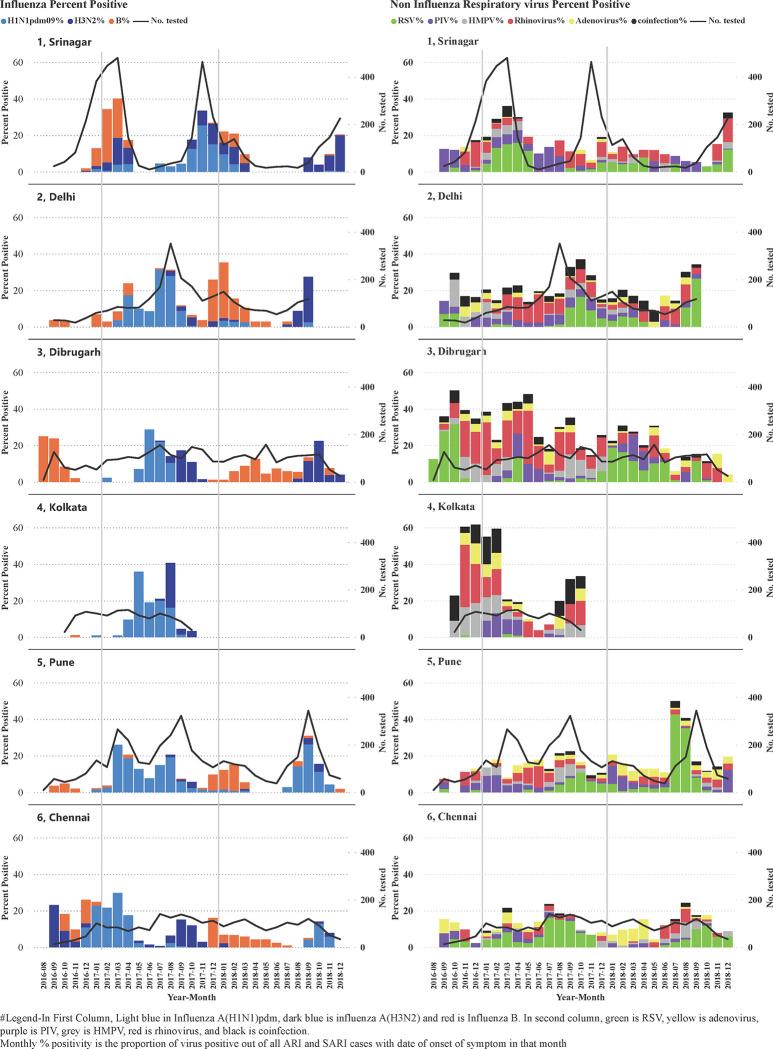
There is limited surveillance and laboratory capacity for non-influenza respiratory viruses in India. We leveraged the influenza sentinel surveillance of India to detect other respiratory viruses among patients with acute respiratory infection. Six centers representing different geographic areas of India weekly enrolled a convenience sample of 5-10 patients with acute respiratory infection (ARI) and severe acute respiratory infection (SARI) between September 2016-December 2018. Staff collected nasal and throat specimens in viral transport medium and tested for influenza virus, respiratory syncytial virus (RSV), parainfluenza virus (PIV), human meta-pneumovirus (HMPV), adenovirus (AdV) and human rhinovirus (HRV) by reverse transcription polymerase chain reaction (RT-PCR). Phylogenetic analysis of influenza and RSV was done. We enrolled 16,338 including 8,947 ARI and 7,391 SARI cases during the study period. Median age was 14.6 years (IQR:4-32) in ARI cases and 13 years (IQR:1.3-55) in SARI cases. We detected respiratory viruses in 33.3% (2,981) of ARI and 33.4% (2,468) of SARI cases. Multiple viruses were co-detected in 2.8% (458/16,338) specimens. Among ARI cases influenza (15.4%) were the most frequently detected viruses followed by HRV (6.2%), RSV (5%), HMPV (3.4%), PIV (3.3%) and AdV (3.1%),. Similarly among SARI cases, influenza (12.7%) were most frequently detected followed by RSV (8.2%), HRV (6.1%), PIV (4%), HMPV (2.6%) and AdV (2.1%). Our study demonstrated the feasibility of expanding influenza surveillance systems for surveillance of other respiratory viruses in India. Influenza was the most detected virus among ARI and SARI cases.
印度对非流感呼吸道病毒的监测和实验室检测能力有限。我们利用印度的流感哨点监测来检测急性呼吸道感染患者中的其他呼吸道病毒。2016年9月至2018年12月期间,代表印度不同地理区域的六个中心每周选取5至10例急性呼吸道感染(ARI)和严重急性呼吸道感染(SARI)患者作为便利样本。工作人员在病毒运输培养基中采集鼻和咽标本,并通过逆转录聚合酶链反应(RT-PCR)检测流感病毒、呼吸道合胞病毒(RSV)、副流感病毒(PIV)、人偏肺病毒(HMPV)、腺病毒(AdV)和人鼻病毒(HRV)。对流感病毒和呼吸道合胞病毒进行了系统发育分析。研究期间,我们共纳入16338例患者,其中包括8947例ARI患者和7391例SARI患者。ARI患者的中位年龄为14.6岁(四分位间距:4 - 32岁),SARI患者的中位年龄为13岁(四分位间距:1.3 - 55岁)。我们在33.3%(2981例)的ARI患者和33.4%(2468例)的SARI患者中检测到呼吸道病毒。2.8%(458/16338)的标本中检测到多种病毒。在ARI患者中,流感病毒(15.4%)是最常检测到的病毒,其次是HRV(6.2%)、RSV(5%)、HMPV(3.4%)、PIV(3.3%)和AdV(3.1%)。同样,在SARI患者中,流感病毒(12.7%)最常被检测到,其次是RSV(8.2%)、HRV(6.1%)、PIV(4%)、HMPV(2.6%)和AdV(2.1%)。我们的研究证明了在印度扩大流感监测系统以监测其他呼吸道病毒的可行性。流感病毒是ARI和SARI患者中检测到最多的病毒。

 Zotero 插件