
尿酸对人白细胞DNA的促氧化作用:一项体外和离体研究。
Prooxidant effect of uric acid on human leukocytic DNA: An in vitro and ex vivo study.
作者信息
Szeto Yim Tong Savio, Li Vincy Sze Wing, Pon Yuen Lam
机构信息
School of Medical and Health Sciences, Tung Wah College, Homantin, Hong Kong.
Department of Pathology, Tseung Kwan O Hospital, Hong Kong.
出版信息
Turk J Biol. 2025 Jan 2;49(2):175-184. doi: 10.55730/1300-0152.2735. eCollection 2025.
BACKGROUND/AIM: Uric acid is a major contributor to the total antioxidant capacity of human plasma. However, this endogenous substance's antioxidant and prooxidant properties have not yet been reported.
MATERIALS AND METHODS
In this study, the comet assay was employed in vitro to determine the effect of uric acid on DNA damage in human lymphocytes and leukocytic DNA damage in hyperuricemia patients with and without renal failure.
RESULTS
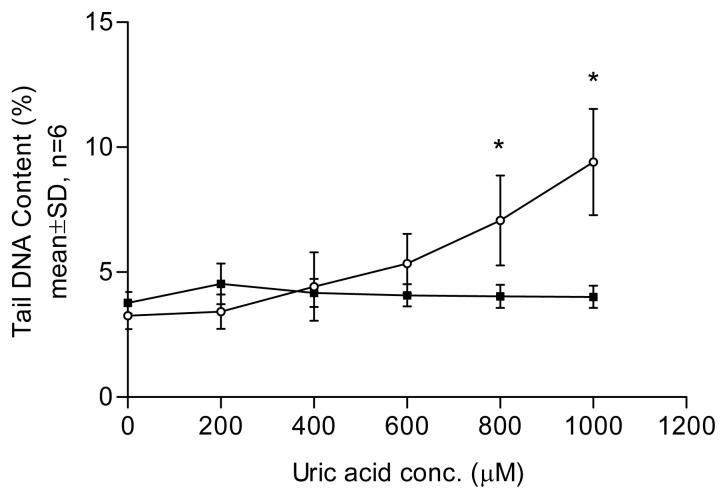
DNA damage in lymphocytes occurred at uric acid concentrations of ≥600 μM. Adding catalase to the uric acid solution diminished the damaging effect, indicating that hydrogen peroxide mediated the prooxidant activity. Moreover, adding Fe did not enhance the DNA damage, suggesting that the urate's prooxidant activity is independent of the Fenton reaction. The unstable nature of uric acid at nearly neutral and acidic pH levels resulted in autooxidation and the generation of hydrogen peroxide. Maintaining the stability of uric acid in vivo may lead to the consumption of antioxidants in the body and affect the antioxidant status. Hyperuricemia patients with and without renal failure had higher levels of leukocytic DNA damage compared to healthy individuals. However, there was no significant difference in leukocytic DNA damage between hyperuricemia patients with and without renal failure, which showed that the damaging effect was not due to renal failure. A correlation study suggested that serum uric acid level had a stronger correlation with DNA damage than the severity of renal failure as indicated by serum creatinine or urea.
CONCLUSION
Uric acid demonstrated prooxidant activity in both in vitro and in vivo studies, which was mediated by the production of hydrogen peroxide and independent of both the Fenton reaction and renal failure.
背景/目的:尿酸是人体血浆总抗氧化能力的主要贡献者。然而,这种内源性物质的抗氧化和促氧化特性尚未见报道。
材料与方法
在本研究中,采用彗星试验在体外测定尿酸对人淋巴细胞DNA损伤以及对有无肾衰竭的高尿酸血症患者白细胞DNA损伤的影响。
结果
当尿酸浓度≥600μM时,淋巴细胞出现DNA损伤。向尿酸溶液中添加过氧化氢酶可减弱损伤作用,表明过氧化氢介导了促氧化活性。此外,添加铁并未增强DNA损伤,提示尿酸盐的促氧化活性独立于芬顿反应。尿酸在近中性和酸性pH水平下的不稳定性质导致其自动氧化并产生过氧化氢。在体内维持尿酸的稳定性可能会导致体内抗氧化剂的消耗并影响抗氧化状态。与健康个体相比,有无肾衰竭的高尿酸血症患者白细胞DNA损伤水平更高。然而,有无肾衰竭的高尿酸血症患者白细胞DNA损伤无显著差异,这表明损伤作用并非由肾衰竭所致。一项相关性研究表明,血清尿酸水平与DNA损伤的相关性比血清肌酐或尿素所表明的肾衰竭严重程度更强。
结论
在体外和体内研究中,尿酸均表现出促氧化活性,其由过氧化氢的产生介导,且独立于芬顿反应和肾衰竭。



 Zotero 插件