
聚苯乙烯微塑料诱导小鼠甲状腺功能障碍:基因表达、氧化应激和组织病理学变化的研究
Polystyrene Microplastics-Induced Thyroid Dysfunction in Mice: A Study of Gene Expression, Oxidative Stress, and Histopathological Changes.
作者信息
Islam Md Sadequl, Kamruzzaman Md, Rima Umme Kulsum
机构信息
Department of Anatomy and Histology, Faculty of Veterinary and Animal Science, Hajee Mohammad Danesh Science and Technology University, Dinajpur, Bangladesh.
Department of Dairy and Poultry Science, Faculty of Veterinary and Animal Science, Hajee Mohammad Danesh Science and Technology University, Dinajpur, Bangladesh.
出版信息
Vet Med Sci. 2025 May;11(3):e70393. doi: 10.1002/vms3.70393.
BACKGROUND
Polystyrene microplastics (PS-MPs) are pervasive pollutants impacting animals across ecosystems, including livestock and wildlife, through contaminated food, water, and air. MPs may disrupt endocrine function, particularly affecting the thyroid gland, which is essential for metabolism and development.
OBJECTIVES
This study investigates the effects of PS-MPs on thyroid function in mice, offering insights relevant to veterinary care by examining changes in gene expression and biochemical markers.
METHODS
PS-MPs of 5 µm diameter were prepared in distilled water after probe sonication. Sixty male Swiss albino mice were divided into three groups: a control group and two treatment groups receiving 0.1 mg and 0.2 mg PS-MPs via oral gavage for 28 days. Mice were anesthetised, and thyroid tissues were collected for histopathological, biochemical, and gene expression analyses. Biochemical tests included catalase, superoxide dismutase, reactive oxygen species, and hormone levels. Histopathology and gene expression (TSHR and TPO) of thyroid-related genes were examined to assess PS-MPs induced effects.
RESULTS
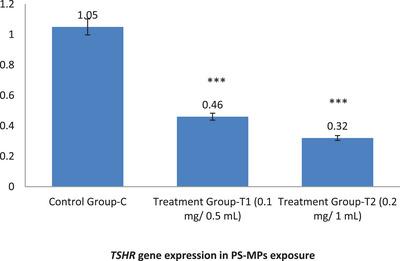
Exposure to PS-MPs in mice led to significant increases in calcium, thyroxin, free T3, free T4, ALP, AST, ALT, and amylase levels, alongside elevated oxidative stress markers. Conversely, the levels of TSH, calcitonin, magnesium and phosphate decreased. Histopathological analysis showed abnormal thyroid follicle development, decrease parafollicular cells, with colloid loss, haemorrhage, and necrosis. Gene expression analysis revealed a marked reduction in TSHR and TPO levels in PS-MPs treated groups, indicating thyroid dysfunction. These findings highlight the profound impact of PS-MPs on thyroid gland function in mice.
CONCLUSION
These findings underscore the potential risks that PS-MPs pose to thyroid health, with potential consequences for other veterinary species. As environmental contamination rises, veterinarians may encounter more endocrine disorders linked to PS-MPs, emphasising the need for further research and preventive measures.
背景
聚苯乙烯微塑料(PS-MPs)是普遍存在的污染物,通过受污染的食物、水和空气影响包括家畜和野生动物在内的整个生态系统中的动物。微塑料可能会扰乱内分泌功能,尤其会影响对新陈代谢和发育至关重要的甲状腺。
目的
本研究调查PS-MPs对小鼠甲状腺功能的影响,通过检查基因表达和生化标志物的变化,为兽医护理提供相关见解。
方法
直径为5μm的PS-MPs在经过探头超声处理后于蒸馏水中制备。60只雄性瑞士白化小鼠被分为三组:一个对照组和两个处理组,通过灌胃法分别给予0.1mg和0.2mg PS-MPs,持续28天。对小鼠实施麻醉后,收集甲状腺组织用于组织病理学、生化和基因表达分析。生化测试包括过氧化氢酶、超氧化物歧化酶、活性氧和激素水平。检查甲状腺相关基因的组织病理学和基因表达(促甲状腺激素受体和甲状腺过氧化物酶)以评估PS-MPs诱导的影响。
结果
小鼠接触PS-MPs导致钙、甲状腺素、游离T3、游离T4、碱性磷酸酶、天冬氨酸转氨酶、丙氨酸转氨酶和淀粉酶水平显著升高,同时氧化应激标志物升高。相反,促甲状腺激素、降钙素、镁和磷酸盐水平降低。组织病理学分析显示甲状腺滤泡发育异常,滤泡旁细胞减少,伴有胶体丢失、出血和坏死。基因表达分析显示,PS-MPs处理组中促甲状腺激素受体和甲状腺过氧化物酶水平显著降低,表明甲状腺功能障碍。这些发现突出了PS-MPs对小鼠甲状腺功能的深远影响。
结论
这些发现强调了PS-MPs对甲状腺健康构成的潜在风险,以及对其他兽医物种可能产生的后果。随着环境污染加剧,兽医可能会遇到更多与PS-MPs相关的内分泌紊乱病例,这凸显了进一步研究和采取预防措施的必要性。


 Zotero 插件