
在东帝汶维持活跃的医院微生物实验室服务的成本效益。
Cost-effectiveness of maintaining an active hospital microbiology laboratory service in Timor-Leste.
作者信息
Lim Cherry, Maung Swe Myo Maung, Devine Angela, Oakley Tessa, Champlin Karen, Sone Oo Pyae, Sarmento Nevio, Da Costa Barreto Ismael, Givney Rodney C, Yan Jennifer, Francis Joshua R, Cooper Ben S
机构信息
Centre for Global Health Research, Nuffield Department of Medicine, University of Oxford, Oxford, United Kingdom.
Mahidol Oxford Tropical Medicine Research Unit, Faculty of Tropical Medicine, Mahidol University, Bangkok, Thailand.
出版信息
Lancet Reg Health Southeast Asia. 2025 Apr 30;36:100582. doi: 10.1016/j.lansea.2025.100582. eCollection 2025 May.
BACKGROUND
Maintaining an active hospital microbiology laboratory allows definitive antibiotic treatment for bacterial infections to be given in a timely manner. This would be expected to improve patient outcomes and shorten length of hospital stay. However, many hospitals in low- and middle-income countries lack access to microbiology services, and the cost-effectiveness of an active microbiology service is unknown.
METHODS
We constructed a decision tree model and performed a cost-effectiveness analysis to determine whether maintaining an active microbiology laboratory service would be cost-effective in Timor-Leste, a lower middle-income country. The model was informed by local microbiology data, local patient treatment costs, results of an expert elicitation exercise and data from literature reviews.
FINDINGS
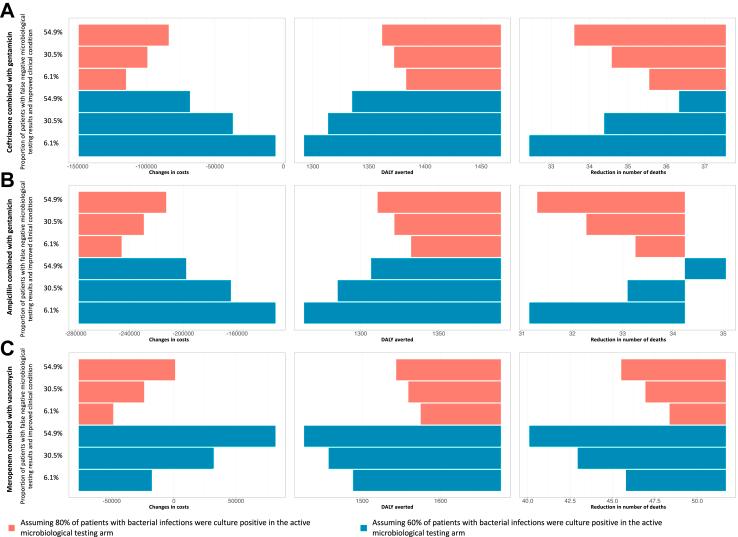
Compared with no active microbiology laboratory, average patient care costs would be reduced by $165,469 (IQR: $134,834-200,902) for every 1000 hospitalised patients with suspected bloodstream infection. Maintaining an active microbiology laboratory was estimated to reduce deaths by between 34 and 51 per 1000 hospitalised patients. Similar results were found under various one-way sensitivity analyses. Accordingly, our results indicate that there is a high probability that maintaining an active microbiology laboratory is a cost-effective intervention that would both improve patient outcomes and reduce net costs (due to reduced intensive care admissions) compared to no microbiological testing, especially for the hospitalised paediatric patients with suspected primary bacteraemia.
INTERPRETATION
Our findings indicate that investment in the maintenance and expansion of local diagnostic capacity is likely to be cost-effective in resource-limited settings.
FUNDING
This project is funded by the Department of Health and Social Care (DHSC)'s Fleming Fund using UK aid.
背景
维持一个活跃的医院微生物实验室能够及时为细菌感染提供确切的抗生素治疗。这有望改善患者预后并缩短住院时间。然而,许多低收入和中等收入国家的医院无法获得微生物学服务,且活跃的微生物学服务的成本效益尚不清楚。
方法
我们构建了一个决策树模型并进行成本效益分析,以确定在低收入中等收入国家东帝汶维持一个活跃的微生物实验室服务是否具有成本效益。该模型依据当地微生物学数据、当地患者治疗成本、专家意见征集结果以及文献综述数据构建。
研究结果
与没有活跃的微生物实验室相比,每1000名疑似血流感染的住院患者的平均患者护理成本将降低165,469美元(四分位距:134,834 - 200,902美元)。据估计,维持一个活跃的微生物实验室可使每1000名住院患者的死亡人数减少34至51人。在各种单向敏感性分析中也发现了类似结果。因此,我们的结果表明,与不进行微生物检测相比,维持一个活跃的微生物实验室很有可能是一种具有成本效益的干预措施,既能改善患者预后又能降低净成本(由于重症监护入院人数减少),尤其是对于疑似原发性菌血症的住院儿科患者。
解读
我们的研究结果表明,在资源有限的环境中,投资维持和扩大当地诊断能力可能具有成本效益。
资金来源
该项目由卫生和社会保健部(DHSC)的弗莱明基金利用英国援助资金资助。


 Zotero 插件