
新生鞭毛基体在……中通过杆状组件固定。 (你提供的原文似乎不完整,“in”后面缺少具体内容)
Nascent flagellar basal bodies are immobilized by rod assembly in .
作者信息
Dunn Caroline M, Foust Daniel J, Gao Yongqiang, Biteen Julie S, Shaw Sidney L, Kearns Daniel B
机构信息
Department of Biology, Indiana University, Bloomington, Indiana, USA.
Department of Chemistry, University of Michigan, Ann Arbor, Michigan, USA.
出版信息
mBio. 2025 Jun 11;16(6):e0053025. doi: 10.1128/mbio.00530-25. Epub 2025 May 21.
UNLABELLED
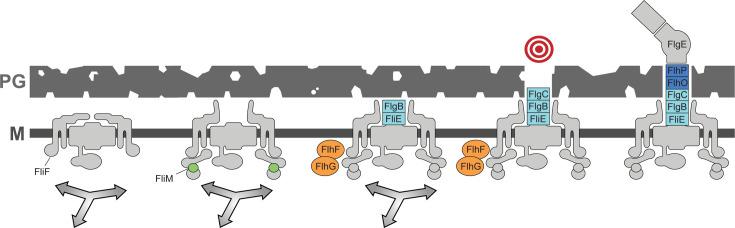
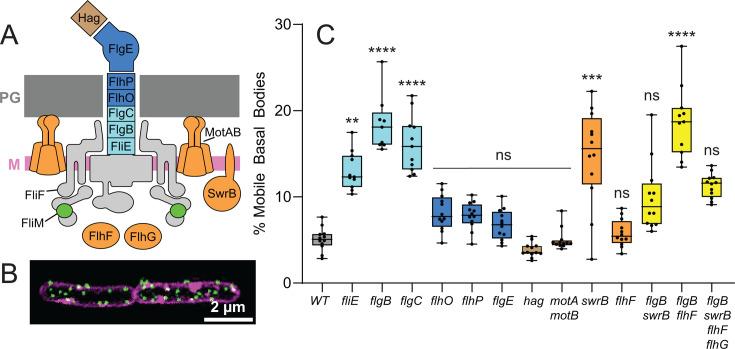
Flagella are complex, trans-envelope nanomachines that localize in species-specific patterns on the cell surface. Here, we study the localization dynamics of the earliest stage of basal body formation in using a fluorescent fusion to the C-ring protein FliM. We find that basal bodies do not exhibit dynamic subunit exchange and are largely stationary at steady state, consistent with flagellar assembly through the peptidoglycan (PG). However, rare mobile basal bodies were observed, and the prevalence of mobile basal bodies is elevated both early in basal body assembly and when the rod is mutated. Thus, basal body mobility is a precursor to patterning, and we propose that rod polymerization probes the PG superstructure for pores of sufficient diameter to permit rod transit. Furthermore, mutation of the rod disrupts basal body patterning in a way that phenocopies mutation of the cytoplasmic flagellar patterning protein FlhF. We infer that rod synthesis and the cytoplasmic regulators coordinate flagellar assembly by interpreting a grid-like pattern of pores, pre-existent in the PG.
IMPORTANCE
Bacteria insert flagella in a species-specific pattern on the cell body, but how patterns are achieved is poorly understood. In bacteria with a single polar flagellum, a marker protein localizes to the cell pole and nucleates the assembly of the flagellum at that site. assembles ~25 basal bodies over the length of the cell in a grid-like pattern and lacks proteins required for their polar targeting. Here, we show that basal bodies are mobile soon after assembly and become immobilized when the flagellar rod transits the peptidoglycan (PG) wall. Moreover, defects in the flagellar rod lead to a more-random distribution of flagella and an increase in polar basal bodies. We conclude that the peritrichous patterning of flagella of is different from the polar patterning of other bacteria, and we infer that the rod probes the PG for holes that can accommodate the machine.
未标记
鞭毛是复杂的跨包膜纳米机器,以物种特异性模式定位于细胞表面。在这里,我们使用与C环蛋白FliM的荧光融合来研究[细菌名称]中基体形成最早阶段的定位动力学。我们发现[细菌名称]基体不表现出动态亚基交换,在稳态时基本静止,这与通过肽聚糖(PG)进行鞭毛组装一致。然而,观察到了罕见的可移动基体,并且在基体组装早期以及杆部发生突变时,可移动基体的发生率都会升高。因此,基体移动性是模式形成的前体,我们提出杆部聚合会探测PG超结构中直径足够大的孔,以允许杆部穿过。此外,杆部的突变会破坏基体模式形成,其方式类似于细胞质鞭毛模式形成蛋白FlhF的突变。我们推断杆部合成和细胞质调节因子通过解读PG中预先存在的网格状孔模式来协调鞭毛组装。
重要性
细菌以物种特异性模式在细胞体上插入鞭毛,但模式形成的方式却知之甚少。在具有单个极鞭毛的细菌中,一种标记蛋白定位于细胞极并在该位点启动鞭毛组装。[细菌名称]在细胞长度上以网格状模式组装约25个基体,并且缺乏将它们靶向极的所需蛋白质。在这里,我们表明[细菌名称]基体在组装后不久是可移动的,并且当鞭毛杆穿过肽聚糖(PG)壁时会固定下来。此外,鞭毛杆的缺陷会导致鞭毛分布更加随机,并且极基体增加。我们得出结论,[细菌名称]鞭毛的周生模式不同于其他细菌的极生模式,并且我们推断[细菌名称]的杆部会探测PG以寻找可容纳该机器的孔。


 Zotero 插件