
通过整合人类血浆蛋白质组和基因组鉴定脓毒症潜在治疗药物靶点:一项孟德尔随机化研究
Identification of potential therapeutic drug targets for sepsis by combining the human plasma proteome and genome: a Mendelian randomization study.
作者信息
Zhou Wenyu, Lin Zhi, Deng Huimin, Jin Tian, Zheng Li, Chen Yuanli, Yang Hao, Lv Xin
机构信息
Department of Anesthesiology, First Affiliated Hospital of Anhui Medical University, Hefei, China.
Department of Anesthesiology, Shanghai Pulmonary Hospital, School of Medicine, Tongji University, Shanghai, China.
出版信息
J Thorac Dis. 2025 Apr 30;17(4):2576-2593. doi: 10.21037/jtd-2025-590. Epub 2025 Apr 27.
BACKGROUND
Currently, sepsis has an extremely high mortality rate and no specific treatment. Mendelian Randomization (MR) can utilize genetic variants as instrumental variables (IVs) to infer causal relationships between protein biomarkers and sepsis. We conducted a proteome-wide MR study to identify biological markers and therapeutic targets associated with sepsis.
METHODS
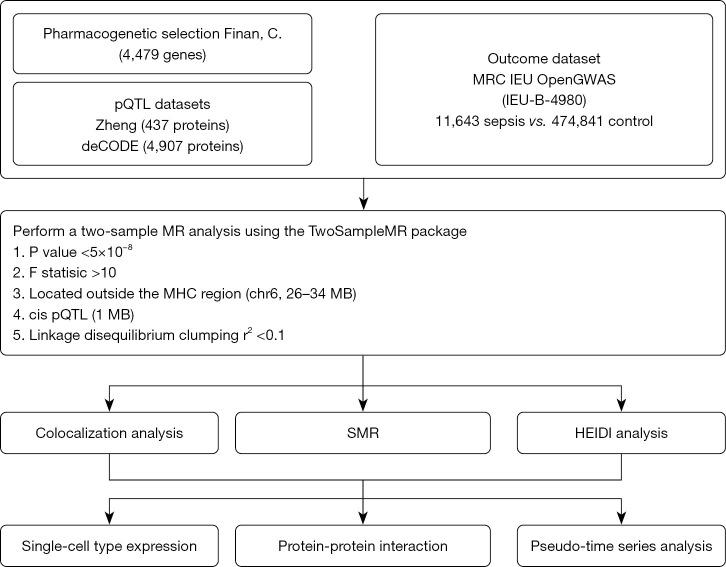
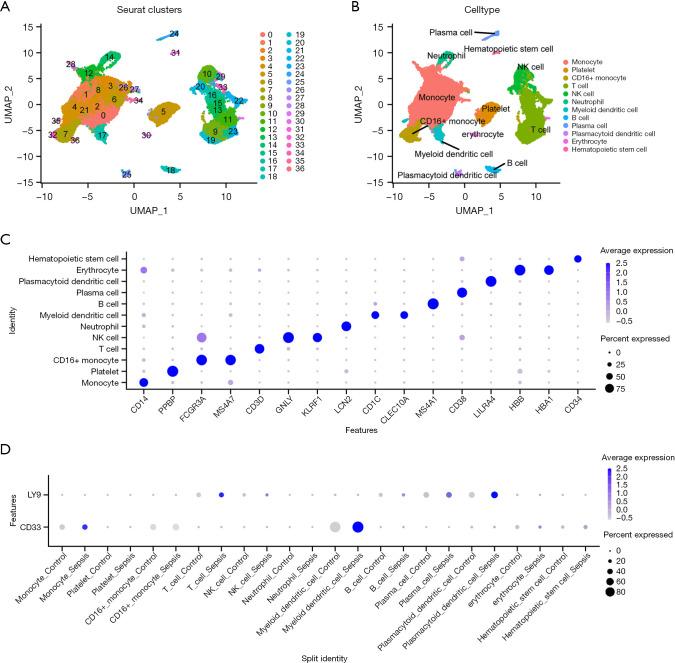
The protein quantitative trait locus (pQTL) were analyzed using two data sources: 734 proteins from Zheng ; and 4,907 proteins from the deCODE database. The causal relationship between the candidate proteins and sepsis was then verified by a two-sample MR analysis, colocalization analysis, and summary data-based Mendelian randomization (SMR) analysis. A protein-protein interaction (PPI) analysis, transcriptome difference analysis, single-cell expression analysis, and druggability assessment were also performed to detect specific cell types and rank therapeutic targets.
RESULTS
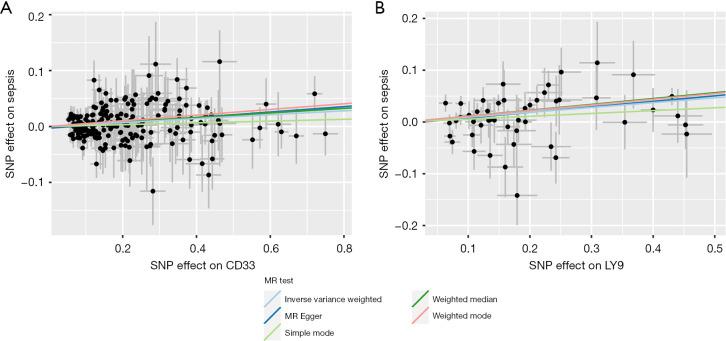
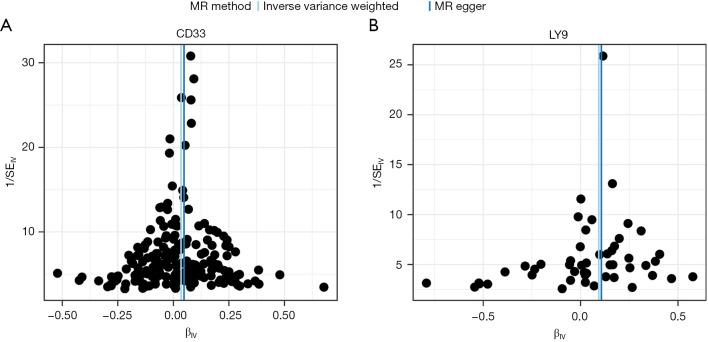
Elevated levels of CD33 [odds ratio (OR) 1.04, 95% confidence interval (CI): 1.02-1.05, P=0.006] and LY9 (OR 1.10, 95% CI: 1.05-1.15, P=0.01) were associated with an increased risk of sepsis, which were considered convincing evidence. CD33 is predominantly seen in acute myeloid leukemia (AML) and Alzheimer's disease (AD), and relevant related drugs are currently in development. While LY9 is predominantly seen in multiple sclerosis, but information on its related drugs is lacking. Both proteins may be potential targets for sepsis.
CONCLUSIONS
This study identified several protein biomarkers associated with the risk of sepsis, provided novel insights into the etiology of sepsis, and identified promising targets (CD33 and LY9) for the development of therapeutic drugs for sepsis.
背景
目前,脓毒症死亡率极高且尚无特效治疗方法。孟德尔随机化(MR)可利用基因变异作为工具变量(IVs)来推断蛋白质生物标志物与脓毒症之间的因果关系。我们开展了一项全蛋白质组MR研究,以识别与脓毒症相关的生物标志物和治疗靶点。
方法
使用两个数据源分析蛋白质定量性状位点(pQTL):来自郑的734种蛋白质;以及来自deCODE数据库的4907种蛋白质。然后通过两样本MR分析、共定位分析和基于汇总数据的孟德尔随机化(SMR)分析来验证候选蛋白质与脓毒症之间的因果关系。还进行了蛋白质-蛋白质相互作用(PPI)分析、转录组差异分析、单细胞表达分析和药物可及性评估,以检测特定细胞类型并对治疗靶点进行排序。
结果
CD33水平升高[比值比(OR)1.04,95%置信区间(CI):1.02 - 1.05,P = 0.006]和LY9水平升高(OR 1.10,95% CI:1.05 - 1.15,P = 0.01)与脓毒症风险增加相关,这被视为确凿证据。CD33主要见于急性髓系白血病(AML)和阿尔茨海默病(AD),目前相关药物正在研发中。而LY9主要见于多发性硬化症,但缺乏其相关药物的信息。这两种蛋白质可能都是脓毒症的潜在靶点。
结论
本研究识别了几种与脓毒症风险相关的蛋白质生物标志物,为脓毒症的病因学提供了新见解,并确定了脓毒症治疗药物开发的有前景靶点(CD33和LY9)。



 Zotero 插件