
1990年至2021年中国14岁及以下儿童传染病负担与趋势:基于2021年全球疾病负担研究的系统分析
The burden and trends of infectious diseases among children aged 14 and below in China from 1990 to 2021: a systematic analysis from the 2021 global burden of disease study.
作者信息
Miao Chun Guo, Le Gui Rong, Miao Si Yan, Liu Zhi Xin
机构信息
Department of Pediatrics, The People's Hospital of Dongxiang, Fuzhou, China.
Jiangxi Medical College, Nanchang University, Nanchang, China.
出版信息
Front Public Health. 2025 May 9;13:1541751. doi: 10.3389/fpubh.2025.1541751. eCollection 2025.
BACKGROUND
Infectious diseases remain one of the leading causes of death among children worldwide. This study aims to analyze the burden and trends of infectious diseases among children aged 0-14 years in China from 1990 to 2021, and evaluate their gender- and age-specific impacts.
METHODS
This study utilizes data from the Global Burden of Disease (GBD) 2021 to analyze mortality, incidence, disability-adjusted life years (DALYs), age-standardized mortality rates (ASMR), age-standardized incidence rates (ASIR), and age-standardized DALY rates (ASDR) for infectious diseases in Chinese children. Statistical analysis was performed using R and ggplot2.
RESULTS
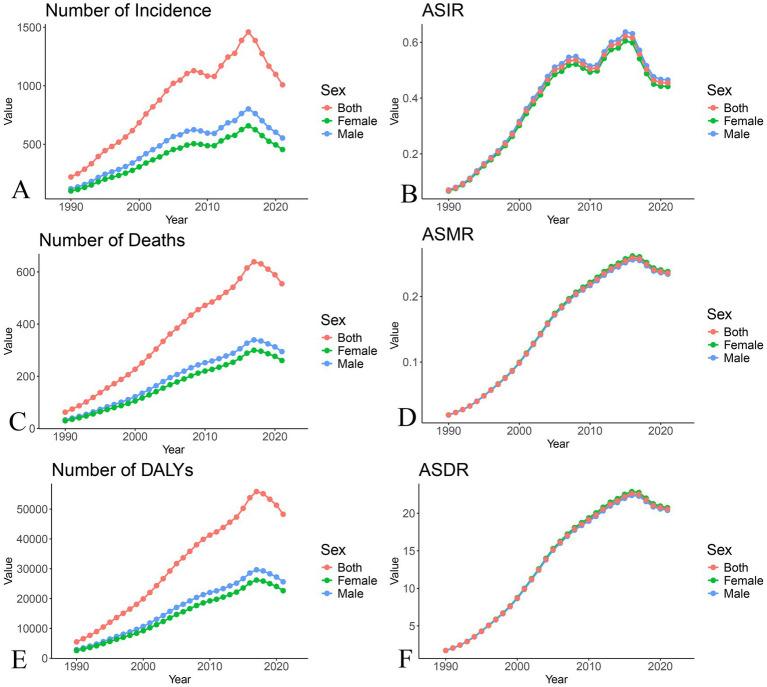
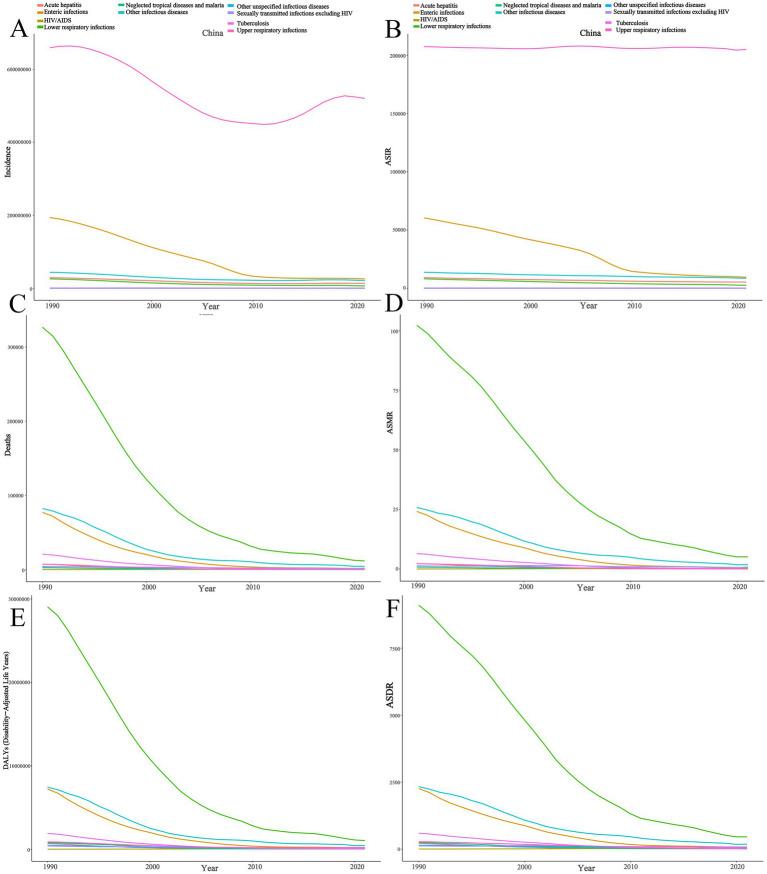
From 1990 to 2021, China observed substantial declines in pediatric infectious disease burdens. Acute hepatitis mortality decreased from 7,349 deaths (95% UI:5,987-9,059) to 87 (EAPC: -13.78), with a fivefold reduction in ASMR. Enteric infections exhibited the steepest decline: incidence dropped by 86% (EAPC: -6.72), and ASDR fell from 2,257 to 67/100,000. HIV/AIDS deaths rose from 62 to 555 (EAPC:8.28), though post-2018 declines emerged. By 2021, lower respiratory infections remained the leading cause of death (ASMR:5.11/100,000), while upper respiratory infections had the highest incidence. Females showed faster reductions in enteric (EAPC: -7.44 vs. -6.20) and lower respiratory infections (EAPC: -10.39 vs. -9.76). Children under 5 faced the highest burden, particularly for lower respiratory infections (ASMR:13.02/100,000).
CONCLUSION
The overall burden of infectious diseases among children in China has declined, especially for enteric infections and acute hepatitis. The burden of pediatric HIV/AIDS has also decreased in recent years, though adolescent HIV/AIDS education remains a key area of concern. Children under 5 continue to represent the highest burden group. While China's infectious disease control measures and immunization programs have played a vital role, further strengthening policies to address ongoing challenges is essential for effectively reducing the burden of infectious diseases and achieving the Healthy China 2030 goals.
背景
传染病仍是全球儿童主要死因之一。本研究旨在分析1990年至2021年中国0至14岁儿童传染病的负担及趋势,并评估其性别和年龄特异性影响。
方法
本研究利用全球疾病负担(GBD)2021的数据,分析中国儿童传染病的死亡率、发病率、伤残调整生命年(DALY)、年龄标准化死亡率(ASMR)、年龄标准化发病率(ASIR)和年龄标准化DALY率(ASDR)。使用R和ggplot2进行统计分析。
结果
1990年至2021年,中国儿童传染病负担大幅下降。急性肝炎死亡率从7349例死亡(95%不确定区间:5987 - 9059)降至87例(年度百分比变化:-13.78),ASMR下降了五倍。肠道感染下降最为显著:发病率下降了86%(年度百分比变化:-6.72),ASDR从2257降至67/10万。艾滋病毒/艾滋病死亡人数从62例增至555例(年度百分比变化:8.28),不过2018年后出现下降。到2021年,下呼吸道感染仍是主要死因(ASMR:5.11/10万),而上呼吸道感染发病率最高。女性在肠道感染(年度百分比变化:-7.44对-6.20)和下呼吸道感染(年度百分比变化:-10.39对-9.76)方面的下降速度更快。5岁以下儿童负担最重,尤其是下呼吸道感染(ASMR:13.02/10万)。
结论
中国儿童传染病总体负担有所下降,尤其是肠道感染和急性肝炎。近年来儿童艾滋病毒/艾滋病负担也有所下降,不过青少年艾滋病毒/艾滋病教育仍是关键关注领域。5岁以下儿童仍是负担最重的群体。虽然中国的传染病控制措施和免疫规划发挥了至关重要的作用,但进一步加强政策以应对持续挑战对于有效减轻传染病负担和实现《健康中国2030》目标至关重要。

 Zotero 插件