
血尿素氮与血清白蛋白比值作为心房颤动患者28天死亡率的预后标志物:一项回顾性队列研究。
Blood urea nitrogen to serum albumin ratio as a prognostic marker for 28-day mortality in atrial fibrillation: a retrospective cohort study.
作者信息
Huang Yun, Wang Guangdong, Xiang Xia, Mei Jun, Zhang Chunyan, Zhang Yaxin
机构信息
Department of International Medical Center, Foshan First People's Hospital, Foshan, Guangdong, China.
Department of Respiratory and Critical Care Medicine, First Affiliated Hospital of Xi'an Jiaotong University, Xi'an, Shanxi, China.
出版信息
Front Cardiovasc Med. 2025 May 9;12:1533575. doi: 10.3389/fcvm.2025.1533575. eCollection 2025.
BACKGROUND
The blood urea nitrogen to serum albumin ratio (BAR) has emerged as a potential prognostic marker. This study investigated its association with clinical outcomes in patients with atrial fibrillation (AF).
METHODS
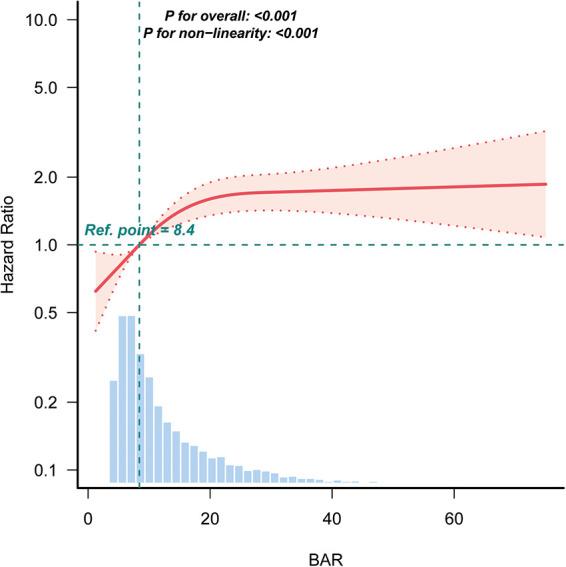
A retrospective cohort analysis was performed using data from the MIMIC-IV 2.2 database, including 4,977 patients diagnosed with AF. The primary outcome was 28-day mortality. Cox proportional hazards models were applied to evaluate the association between BAR and mortality, and restricted cubic spline (RCS) analysis was used to explore potential non-linear relationships.
RESULTS
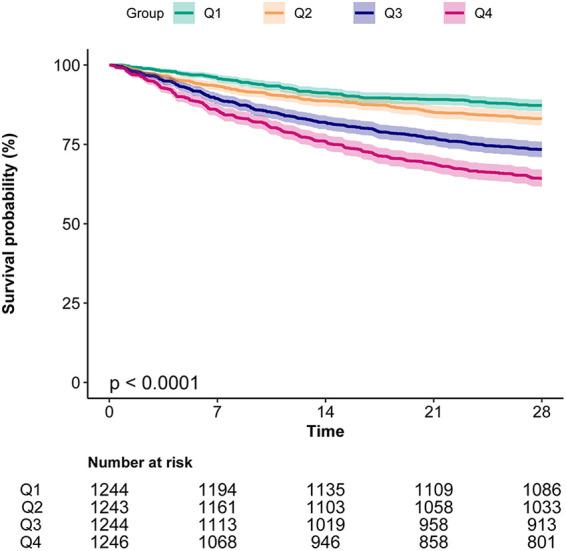
Of the 4,977 patients analyzed, the 28-day mortality rate was 22.99%. Higher BAR levels were significantly associated with increased risk of mortality. Each one-unit increase in BAR was associated with a 2% higher risk of 28-day mortality (HR 1.02, 95% CI 1.01-1.03). Compared with the lowest quartile (Q1), patients in the highest quartile (Q4) had a significantly increased risk (HR 1.78, 95% CI 1.42-2.22). ROC analysis showed an area under the curve (AUC) of 0.65 for BAR in predicting 28-day mortality. Subgroup analyses confirmed the consistency and robustness of these findings across diverse clinical strata.
CONCLUSIONS
BAR is an independent predictor of 28-day mortality in patients with AF. Higher BAR levels are strongly associated with worse outcomes, underscoring its potential utility as a risk stratification tool in this population.
背景
血尿素氮与血清白蛋白比值(BAR)已成为一种潜在的预后标志物。本研究调查了其与心房颤动(AF)患者临床结局的关联。
方法
使用MIMIC-IV 2.2数据库的数据进行回顾性队列分析,纳入4977例诊断为AF的患者。主要结局为28天死亡率。应用Cox比例风险模型评估BAR与死亡率之间的关联,并使用受限立方样条(RCS)分析探索潜在的非线性关系。
结果
在分析的4977例患者中,28天死亡率为22.99%。较高的BAR水平与死亡风险增加显著相关。BAR每增加一个单位,28天死亡风险增加2%(HR 1.02,95%CI 1.01-1.03)。与最低四分位数(Q1)相比,最高四分位数(Q4)的患者风险显著增加(HR 1.78,95%CI 1.42-2.22)。ROC分析显示,BAR预测28天死亡率的曲线下面积(AUC)为0.65。亚组分析证实了这些发现在不同临床分层中的一致性和稳健性。
结论
BAR是AF患者28天死亡率的独立预测因子。较高的BAR水平与较差的结局密切相关,强调了其作为该人群风险分层工具的潜在效用。



 Zotero 插件