
利用聚辣根过氧化物酶增强信号开发用于食源致病菌检测的免疫分析方法。
Development of Immunoassays for Foodborne Pathogenic Bacteria Detection Using PolyHRP for Signal Enhancement.
作者信息
Zhang Yijia, Pan Junkang, He Qiyi, Xu Zhihao, Hammock Bruce D, Li Dongyang
机构信息
College of Biosystems Engineering and Food Science, Zhejiang University, Hangzhou 310058, China.
Zhejiang Key Laboratory of Intelligent Sensing and Robotics for Agriculture, Zhejiang University, Hangzhou 310058, China.
出版信息
Biosensors (Basel). 2025 May 15;15(5):318. doi: 10.3390/bios15050318.
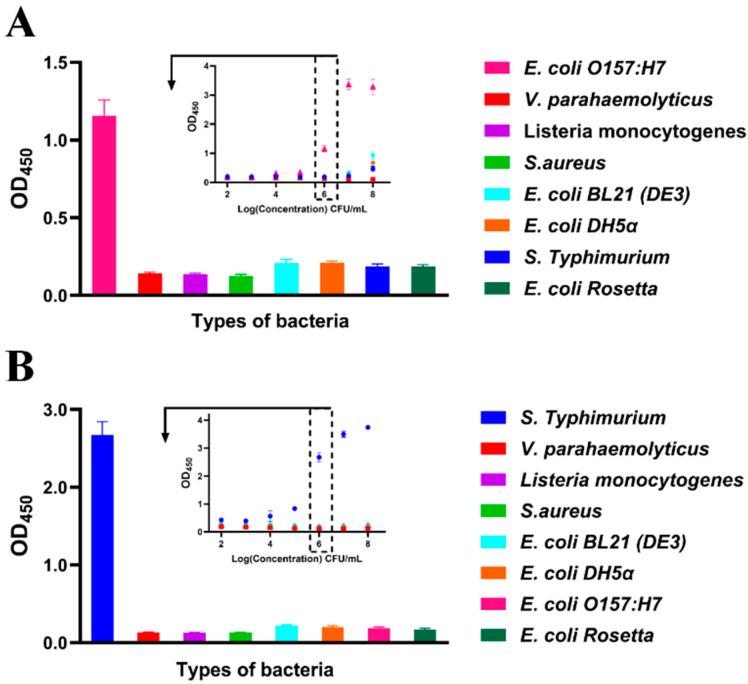
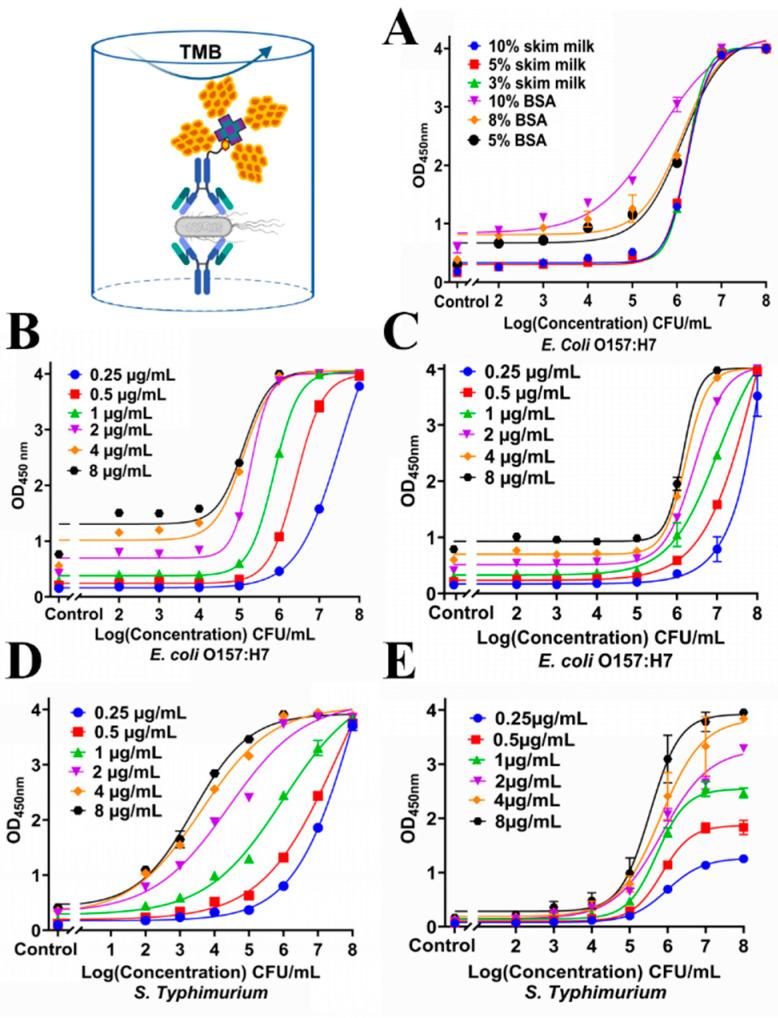
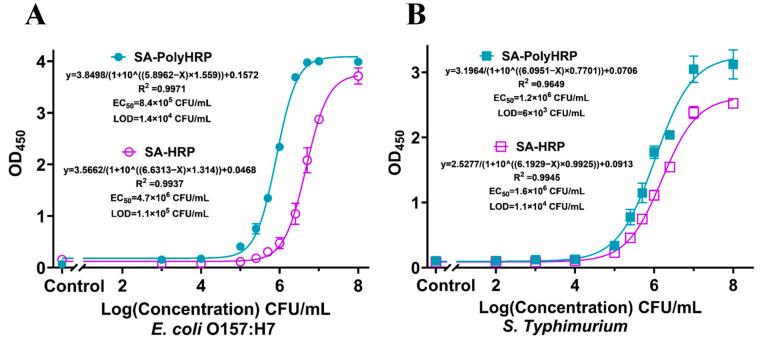
The rapid and accurate detection of foodborne pathogens is essential for ensuring food safety. O157:H7 ( O157:H7) and () are major foodborne pathogenic bacteria that pose significant public health risks, highlighting the need for effective detection methods. In this study, highly sensitive double-antibody sandwich-based enzyme-linked immunosorbent assays (ELISAs) were developed for the rapid detection of O157:H7 and , utilizing a streptavidin-polymerized horseradish peroxidase (SA-PolyHRP)-based signal enhancement system. Systematic optimization was performed on key parameters, including the capture antibody concentration, detection antibody, and blocking agent. Compared to the method using SA-HRP, substitution with SA-PolyHRP significantly improved detection sensitivity, achieving limits of detection (LODs) of 1.4 × 10 CFU/mL for O157:H7 and 6.0 × 10 CFU/mL for , with sensitivity enhancements of 7.86-fold and 1.83-fold, respectively. Specificity tests confirmed no cross-reactivity with non-target or closely related pathogenic strains. The matrix effect was effectively mitigated through 10-fold and 100-fold dilutions for O157:H7 and , respectively. Both pathogens were successfully detected in beef samples spiked with 5 CFU after 5 h of incubation. This study demonstrates the effectiveness of PolyHRP-based signal enhancement for the highly sensitive and specific detection of foodborne pathogens, offering a promising approach for rapid food safety monitoring and public health protection.
快速准确地检测食源性病原体对于确保食品安全至关重要。O157:H7和(此处原文缺失相关内容)是主要的食源性病原体,对公众健康构成重大风险,这凸显了有效检测方法的必要性。在本研究中,开发了基于双抗体夹心的高灵敏度酶联免疫吸附测定(ELISA)法,用于快速检测O157:H7和(此处原文缺失相关内容),采用基于链霉亲和素聚合辣根过氧化物酶(SA-PolyHRP)的信号增强系统。对包括捕获抗体浓度、检测抗体和封闭剂在内的关键参数进行了系统优化。与使用SA-HRP的方法相比,用SA-PolyHRP替代显著提高了检测灵敏度,O157:H7的检测限(LOD)达到1.4×10 CFU/mL,(此处原文缺失相关内容)的检测限达到6.0×10 CFU/mL,灵敏度分别提高了7.86倍和1.83倍。特异性测试证实与非靶标或密切相关的致病菌株无交叉反应。通过分别对O157:H7和(此处原文缺失相关内容)进行10倍和100倍稀释,有效减轻了基质效应。在接种5 CFU的牛肉样品中孵育5小时后,成功检测到了这两种病原体。本研究证明了基于PolyHRP的信号增强在食源性病原体高灵敏度和特异性检测中的有效性,为快速食品安全监测和公共卫生保护提供了一种有前景的方法。


 Zotero 插件