
2bRAD-M技术揭示超重尿路结石患者的尿液微生物群特征。
2bRAD-M Reveals the Characteristics of Urinary Microbiota in Overweight Patients with Urinary Tract Stones.
作者信息
Wu Pengfei, Zhang Jingcheng, Zhang Wentao, Yang Fuhang, Yu Yang, Zhang Yuke, Wang Guangchun, Zhang Haimin, Xu Yunfei, Yao Xudong
机构信息
Department of Urology, Shanghai Tenth People's Hospital, Clinical Medical College of Nanjing Medical University, Shanghai 200072, China.
Department of Urology, Shanghai Tenth People's Hospital, School of Medicine, Tongji University, Shanghai 200072, China.
出版信息
Biomedicines. 2025 May 14;13(5):1197. doi: 10.3390/biomedicines13051197.
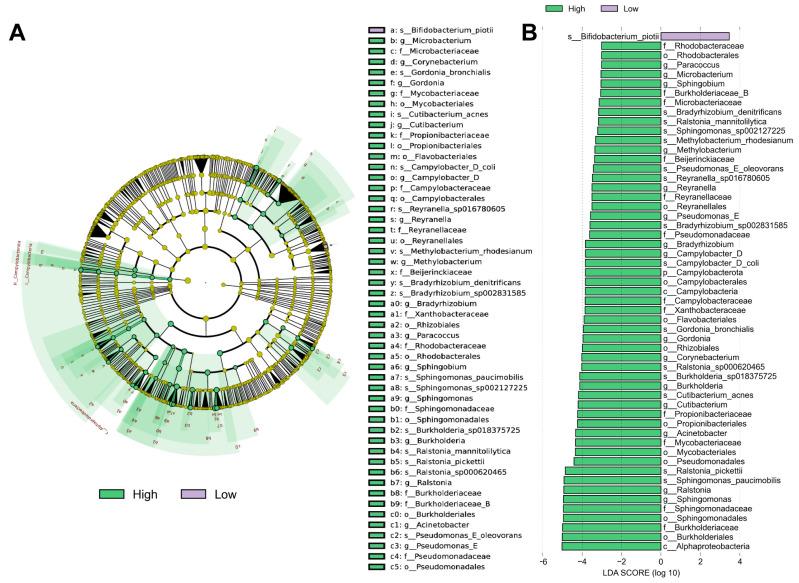
Urinary tract stone (UTS) is a common disease significantly impacting human health. Obesity influences stone formation and increases UTS incidence, yet the differences in the urinary microbiota and pathways between overweight and healthy-weight UTS patients remain unclear. In this study, 16 patients were analyzed: 8 overweight and 8 healthy-weight UTS patients. Bladder urine samples were collected during surgery, and DNA was extracted for microbial analysis using 2bRAD markers. Microbial diversity and KEGG pathway differences were studied. The results showed that overweight UTS patients had a significantly higher urinary microbial diversity than healthy-weight patients. The analysis identified differences in microbiota at various taxonomic levels. LEfSe analysis revealed as abundant in overweight patients, while dominated in healthy-weight patients. Key species, including , , and , were identified. KEGG analysis highlighted enriched pathways in overweight UTS patients, including the porphyrin and chlorophyll metabolism, fatty acid metabolism, amino acid degradation, and renin-angiotensin and mineral absorption pathways. This study is the first to use 2bRAD-M microbiome analysis to compare the urinary microbiota between overweight and healthy-weight UTS patients. It identified significant microbiota and pathway differences, suggesting a link between microbiota imbalance, obesity, and stone formation. These findings provide potential targets for further research on obesity-related stone susceptibility mechanisms.
尿路结石(UTS)是一种严重影响人类健康的常见疾病。肥胖会影响结石形成并增加UTS发病率,但超重和健康体重的UTS患者之间的泌尿微生物群及相关途径的差异仍不清楚。在本研究中,分析了16例患者:8例超重UTS患者和8例健康体重UTS患者。在手术期间收集膀胱尿液样本,并使用2bRAD标记提取DNA用于微生物分析。研究了微生物多样性和KEGG途径差异。结果表明,超重UTS患者的尿液微生物多样性显著高于健康体重患者。分析确定了不同分类水平上微生物群的差异。LEfSe分析显示 在超重患者中丰富,而 在健康体重患者中占主导。鉴定出了关键物种,包括 、 和 。KEGG分析突出了超重UTS患者中富集的途径,包括卟啉和叶绿素代谢、脂肪酸代谢、氨基酸降解以及肾素-血管紧张素和矿物质吸收途径。本研究首次使用2bRAD-M微生物组分析来比较超重和健康体重的UTS患者之间的尿液微生物群。它确定了显著的微生物群和途径差异,表明微生物群失衡、肥胖和结石形成之间存在联系。这些发现为进一步研究肥胖相关结石易感性机制提供了潜在靶点。




 Zotero 插件