
昆虫交配行为:神经肽调控作用综述
Insect Mating Behaviors: A Review of the Regulatory Role of Neuropeptides.
作者信息
Ombuya Alfayo, Guo Jianyang, Liu Wanxue
机构信息
State Key Laboratory for Biology of Plant Diseases and Insect Pests, Institute of Plant Protection, Chinese Academy of Agricultural Sciences, Beijing 100193, China.
Key Laboratory of Invasive Alien Species Control of Ministry of Agriculture and Rural Affairs, Chinese Academy of Agricultural Sciences, Beijing 100193, China.
出版信息
Insects. 2025 May 8;16(5):506. doi: 10.3390/insects16050506.
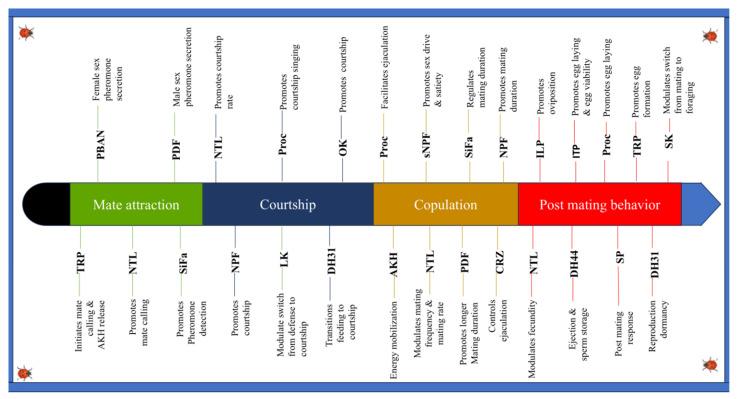
Insect mating behaviors are complex, diverse, and primarily regulated by neuropeptides and their receptors. Neuropeptides are peptide signaling molecules mainly secreted by insects' central nervous system (CNS) to reach target organs. A substantial body of research on the role of neuropeptides in regulating mating behaviors in insects has been undertaken. This review aims to (1) synthesize existing knowledge on insect mating behaviors, (2) elucidate the neuropeptidergic mechanisms governing these behaviors, and (3) identify knowledge gaps and propose future research directions. The mating process, covering mate attraction, courtship rituals, copulation, and post-mating behaviors, was elucidated with appropriate examples. Additionally, specific neuropeptides involved at each stage of the mating process, their functions, and mechanistic aspects were discussed as demonstrated in research. The review highlights that insects display behavioral dimorphism in the mating process driven by a complex underlying neuropeptidergic mechanism. While previous publications have generally addressed the role of neuropeptides in insect behavior, none has intensively and methodically examined their role in mating behaviors. In this review, we synthesized 18 neuropeptides that we found to regulate mating behaviors in insects. We note that some of the neuropeptides are malfunctional in their regulatory roles, while others are specific. We also note that these neuropeptides execute their regulatory functions through the G protein-coupled receptor (GPCR) signaling pathway but may take different routes and messengers downstream to effect behavioral change. Neuropeptides also interact with other regulatory systems, such as the endocrine system, to discharge their functions. Given their significance in mediating mating and reproduction, targeted manipulation of the signaling system of neuropeptides could serve as viable targets in the production of ecologically friendly pest management tools. Tools that could disrupt the mating process would be applied in crop production systems to reduce the population pressure of destructive pests, consequently reducing the urge to use chemical pesticides that are ecologically unfriendly. Our findings not only advance the understanding of neuropeptide-mediated mating regulation but also highlight their potential as eco-friendly pest control targets.
昆虫的交配行为复杂多样,主要受神经肽及其受体调控。神经肽是主要由昆虫中枢神经系统(CNS)分泌以作用于靶器官的肽类信号分子。关于神经肽在调节昆虫交配行为中的作用,已经开展了大量研究。本综述旨在:(1)综合昆虫交配行为的现有知识;(2)阐明控制这些行为的神经肽机制;(3)找出知识空白并提出未来研究方向。文中通过适当例子阐述了交配过程,包括配偶吸引、求偶仪式、交配及交配后行为。此外,还讨论了交配过程各阶段涉及的特定神经肽、它们的功能以及研究中所示的机制方面。该综述强调,昆虫在交配过程中表现出行为二态性,这是由复杂的潜在神经肽机制驱动的。虽然先前的出版物普遍探讨了神经肽在昆虫行为中的作用,但没有一篇深入且系统地研究它们在交配行为中的作用。在本综述中,我们综合了18种我们发现可调节昆虫交配行为的神经肽。我们注意到,其中一些神经肽在其调节作用中功能失调,而其他一些则具有特异性。我们还注意到,这些神经肽通过G蛋白偶联受体(GPCR)信号通路执行其调节功能,但在下游可能采取不同途径和信使来影响行为变化。神经肽还与其他调节系统相互作用,如内分泌系统,以发挥其功能。鉴于它们在介导交配和繁殖方面的重要性,对神经肽信号系统进行靶向操纵可成为生产生态友好型害虫管理工具的可行靶点。能够破坏交配过程的工具将应用于作物生产系统,以减轻有害害虫的种群压力,从而减少使用对生态环境不友好的化学农药的需求。我们的研究结果不仅推进了对神经肽介导的交配调节的理解,还突出了它们作为生态友好型害虫控制靶点的潜力。


 Zotero 插件