
神经肽速激肽是昆虫交配与觅食行为转换的外周调节器。
The neuropeptide sulfakinin is a peripheral regulator of insect behavioral switch between mating and foraging.
作者信息
Li Hong-Fei, Dong Bao, Peng Yuan-Yuan, Luo Hao-Yue, Ou Xiao-Lan, Ren Zheng-Lin, Park Yoonseong, Wang Jin-Jun, Jiang Hong-Bo
机构信息
Key Laboratory of Entomology and Pest Control Engineering, College of Plant Protection, Southwest University, Chongqing, China.
Key Laboratory of Agricultural Biosafety and Green Production of Upper Yangtze River (Ministry of Education), Academy of Agricultural Sciences, Southwest University, Chongqing, China.
出版信息
Elife. 2025 May 2;13:RP100870. doi: 10.7554/eLife.100870.
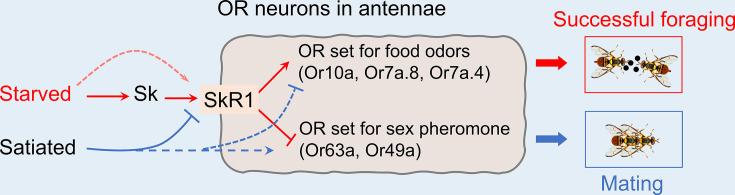
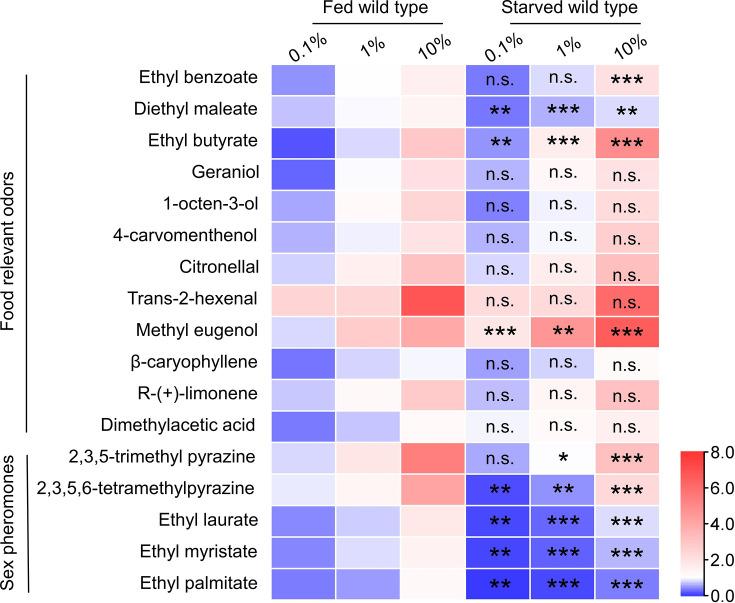
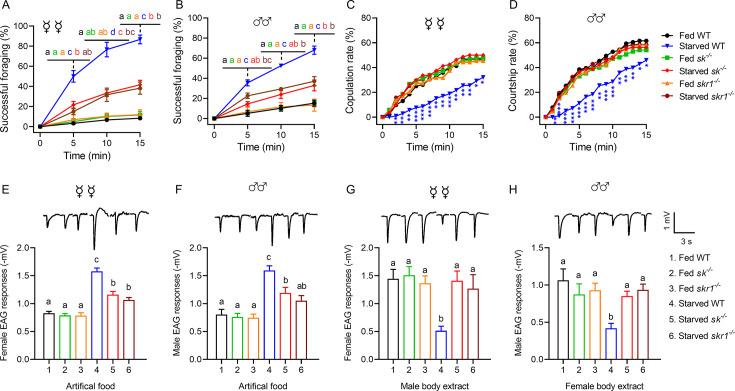
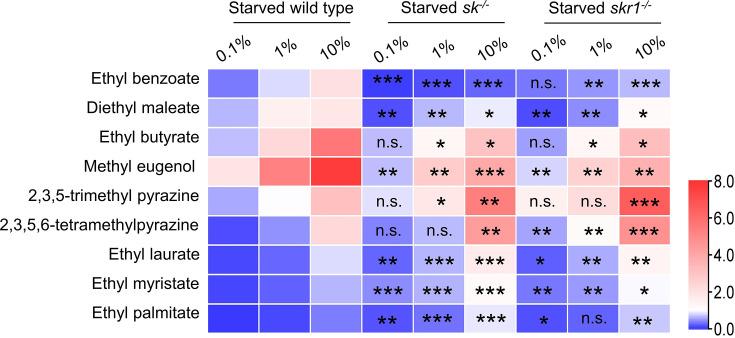
Behavioral strategies for foraging and reproduction in the oriental fruit fly () are alternative options for resource allocation and are controlled by neuropeptides. Here, we show that the behavioral switch between foraging and reproduction is associated with changes in antennal sensitivity. Starved flies became more sensitive to food odors while suppressing their response to opposite-sex pheromones. The gene encoding sulfakinin receptor 1 () was significantly upregulated in the antennae of starved flies, so we tested the behavioral phenotypes of null mutants for the genes encoding the receptor () and its ligand sulfakinin (). In both knockout lines, the antennal responses shifted to mating mode even when flies were starved. This suggests that sulfakinin signaling via SkR1 promotes foraging while suppressing mating. Further analysis of the mutant flies revealed that sets of odorant receptor (OR) genes were differentially expressed. Functional characterization of the differentially expressed ORs suggested that sulfakinin directly suppresses the expression of ORs that respond to opposite-sex hormones while enhancing the expression of ORs that detect food volatiles. We conclude that sulfakinin signaling via SkR1, modulating OR expressions and leading to altered antenna sensitivities, is an important component in starvation-dependent behavioral change.
东方果实蝇觅食和繁殖的行为策略是资源分配的替代选项,且受神经肽控制。在此,我们表明觅食和繁殖之间的行为转换与触角敏感性的变化有关。饥饿的果蝇对食物气味变得更加敏感,同时抑制它们对异性信息素的反应。编码速激肽受体1(SkR1)的基因在饥饿果蝇的触角中显著上调,因此我们测试了编码该受体(SkR1)及其配体速激肽(SK)的基因的无效突变体的行为表型。在两个敲除品系中,即使果蝇处于饥饿状态,触角反应也会转向交配模式。这表明通过SkR1的速激肽信号传导促进觅食,同时抑制交配。对突变果蝇的进一步分析表明,一组气味受体(OR)基因存在差异表达。对差异表达的ORs的功能表征表明,速激肽直接抑制对异性激素有反应的ORs的表达,同时增强检测食物挥发物的ORs的表达。我们得出结论,通过SkR1的速激肽信号传导,调节OR表达并导致触角敏感性改变,是饥饿依赖性行为变化的一个重要组成部分。






 Zotero 插件