
无嗅果蝇:Orco 沉默对橄榄果蝇的影响。
Anosmic flies: what Orco silencing does to olive fruit flies.
机构信息
Department of Biochemistry and Biotechnology, University of Thessaly, Biopolis, 41500, Larissa, Greece.
出版信息
BMC Genet. 2020 Dec 18;21(Suppl 2):140. doi: 10.1186/s12863-020-00937-0.
BACKGROUND
The olive fruit fly (Bactrocera oleae) is the most destructive pest of the olive cultivation worldwide causing significant production losses and olive fruit impoverishment, as its larvae feed exclusively on the olive fruit. Reproductive and sexual behavior, as well as host-plant recognition of the fly, are highly dependent on its chemosensory system. Therefore, exploring the role of genes that play a critical role in olfaction, could reveal potential molecular targets that determine species-specific features on chemical communication and could be used to impair sexual behavior.
RESULTS
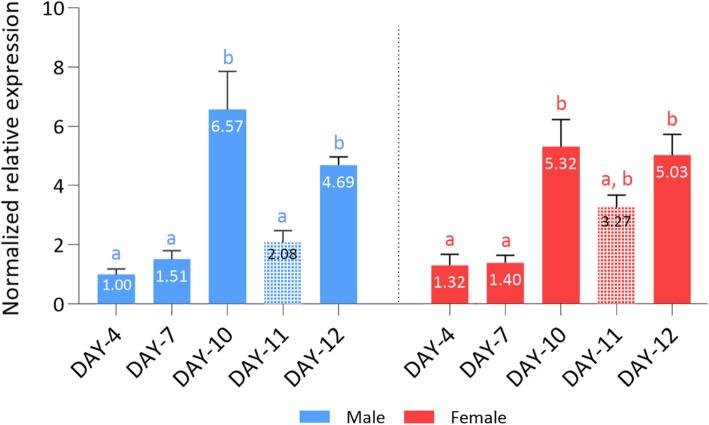
In this study we identified the gene that encodes the conserved olfactory co-receptor Orco (Odorant receptor co-receptor), which interacts with all divergent insect odorant receptors, and investigated how disruption of its expression affects chemoreception. We initially searched the expression profile of Bo-Orco in both sexes during sexual maturation, as well as pre- and post-mating communication by relative quantitative real time PCR (qRT-PCR) analysis suggesting that Bo-Orco was abundantly expressed in sexually mature adults. We further investigated the functional role of Bo-Orco in mating and oviposition behavior via transient gene silencing that was performed through in vivo dsRNA hemolymph injections in sexually mature flies 7 days after eclosion. Orco-knockdown phenotypes in both sexes showed reduced copulation rates in mating competitiveness tests, possibly through impaired olfactory-mediated detection of sex pheromone. In addition, oviposition was significantly inhibited in dsRNA-Orco injected females in a post-mating behavior test.
CONCLUSIONS
Our results demonstrate that Orco plays a crucial role in the reproductive behavior of the olive fruit fly, since pre- and post-mating processes were affected. This is the first report in the olive fruit fly that links the chemosensory pathway with the mating behavior and the reproductive potential at a molecular basis, rendering this gene a potential target for the improvement of the olive fruit fly population control techniques.
背景
橄榄果实蝇(Bactrocera oleae)是全球范围内对橄榄种植危害最大的害虫,它的幼虫专门以橄榄果实为食,造成了巨大的产量损失和橄榄果实的贫瘠,其生殖和性行为以及对寄主植物的识别高度依赖于其化学感受系统。因此,探索在嗅觉中起关键作用的基因的作用,可以揭示决定化学通讯物种特异性特征的潜在分子靶标,并可用于损害性行为。
结果
在这项研究中,我们鉴定了编码保守嗅觉共受体 Orco(气味受体共受体)的基因,该基因与所有不同的昆虫气味受体相互作用,并研究了其表达中断如何影响化学感受。我们最初通过相对定量实时 PCR(qRT-PCR)分析来搜索 Bo-Orco 在性成熟过程中以及交配前后通讯中的表达谱,表明 Bo-Orco 在性成熟成虫中大量表达。我们通过在性成熟后 7 天的活体 dsRNA 血淋巴注射,进一步研究了 Bo-Orco 在交配和产卵行为中的功能作用,通过瞬时基因沉默。在交配竞争力测试中,雄性和雌性的 Orco 敲低表型均显示交配率降低,这可能是由于嗅觉介导的性信息素检测受损所致。此外,在 dsRNA-Orco 注射的雌性中,产卵在交配后行为测试中显著受到抑制。
结论
我们的研究结果表明,Orco 在橄榄果实蝇的生殖行为中起关键作用,因为交配前和交配后的过程都受到了影响。这是橄榄果实蝇中第一个将化学感觉途径与交配行为和生殖潜力联系起来的报告,为该基因作为改善橄榄果实蝇种群控制技术的潜在靶标奠定了基础。




 Zotero 插件