
胃癌免疫治疗时代的预测性生物标志物:当前成果与未来展望
Predictive biomarkers in the era of immunotherapy for gastric cancer: current achievements and future perspectives.
作者信息
Sun Fujing, Gao Xiaozhuo, Wang Wentao, Zhao Xiaoyan, Zhang Jingdong, Zhu Yanmei
机构信息
Department of Pathology, Affiliated Cancer Hospital of Dalian University of Technology (Liaoning Cancer Hospital and Institute, Cancer Hospital of China Medical University), Shenyang, China.
Department of Gastric Surgery, Affiliated Cancer Hospital of Dalian University of Technology (Liaoning Cancer Hospital and Institute, Cancer Hospital of China Medical University), Shenyang, China.
出版信息
Front Immunol. 2025 May 14;16:1599908. doi: 10.3389/fimmu.2025.1599908. eCollection 2025.
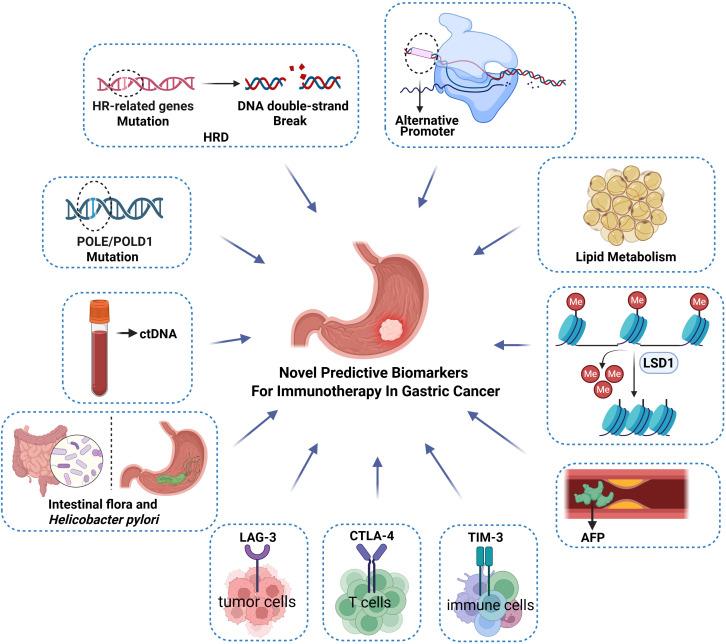
Gastric cancer (GC) is one of the primary contributors to cancer-related mortality on a global scale. It holds a position within the top five most prevalent malignancies both in terms of occurrence and fatality rates. Immunotherapy, as a breakthrough cancer treatment, brings new hope for GC patients. Various biomarkers, such as the expression of programmed death ligand-1 (PD-L1), the microsatellite instability (MSI) status, tumor mutational burden (TMB), and Epstein-Barr virus (EBV) infection, demonstrate potential to predict the effectiveness of immunotherapy in treating GC. Nevertheless, each biomarker has its own limitations, which leads to a significant portion of patients continue to be unresponsive to immunotherapy. With the understanding of the tumor immune microenvironment (TIME), genome sequencing technology, and recent advances in molecular biology, new molecular markers, such as POLE/POLD1mutations, circulating tumor DNA, intestinal flora, lymphocyte activation gene 3 (LAG-3), and lipid metabolism have emerged. This review aims to consolidate clinical evidence to offer a thorough comprehension of the existing and emerging biomarkers. We discuss the mechanisms, prospects of application, and limitations of each biomarker. We anticipate that this review will open avenues for fresh perspectives in the investigation of GC immunotherapy biomarkers and promote the precise choice of treatment modalities for gastric cancer patients, thereby advancing precision immuno-oncology endeavors.
胃癌(GC)是全球范围内癌症相关死亡的主要原因之一。在发病率和死亡率方面,它都位列最常见的五种恶性肿瘤之中。免疫疗法作为一种突破性的癌症治疗方法,为GC患者带来了新的希望。各种生物标志物,如程序性死亡配体-1(PD-L1)的表达、微卫星不稳定性(MSI)状态、肿瘤突变负荷(TMB)和爱泼斯坦-巴尔病毒(EBV)感染,都显示出预测免疫疗法治疗GC有效性的潜力。然而,每种生物标志物都有其自身的局限性,这导致很大一部分患者对免疫疗法仍然无反应。随着对肿瘤免疫微环境(TIME)、基因组测序技术以及分子生物学最新进展的了解,新的分子标志物,如POLE/POLD1突变、循环肿瘤DNA、肠道菌群、淋巴细胞激活基因3(LAG-3)和脂质代谢等已经出现。本综述旨在整合临床证据,以全面理解现有的和新出现的生物标志物。我们讨论了每种生物标志物的机制、应用前景和局限性。我们期望本综述将为GC免疫疗法生物标志物的研究开辟新的视角,并促进为胃癌患者精确选择治疗方式,从而推动精准免疫肿瘤学的发展。

 Zotero 插件