
抗病毒CD8中枢记忆否决细胞作为嵌合抗原受体T细胞疗法的新平台
Anti-viral CD8 central memory veto cells as a new platform for CAR T cell therapy.
作者信息
Liu Wei-Hsin, Globerson Levin Anat, Lask Assaf, Horn Galit, Waks Tova, Nathansohn Levi Bar, Milman Krentsis Irit, Shoshan Einav, Su Xiaohua, Mamonkin Maksim, Champlin Richard E, Reisner Yair, Bachar Lustig Esther
机构信息
Department of Stem Cell Transplantation and Cellular Therapy, The University of Texas MD Anderson Cancer Center, Houston, TX 77030, United States.
University of Texas MD Anderson UTHealth Houston Graduate School of Biomedical Sciences, Houston, TX 77030, United States.
出版信息
Stem Cells Transl Med. 2025 May 31;14(6). doi: 10.1093/stcltm/szaf020.
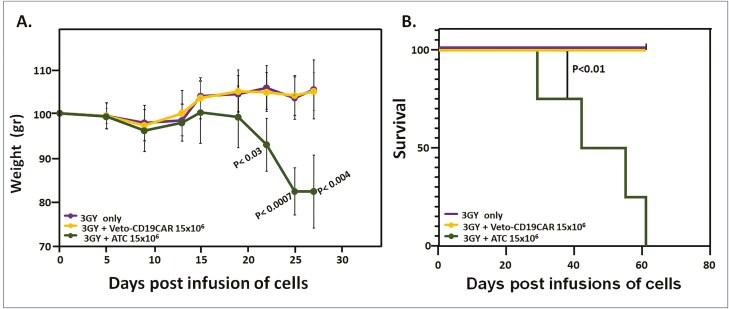
Central memory CD8 T cells exhibit marked veto activity enhancing engraftment in several mouse models of T cell-depleted bone marrow (TDBM) allografting. Graft-versus-host disease (GVHD) can be prevented by stimulation of mouse or human memory CD8 T cells against their cognate antigens under cytokine deprivation, in the early phase of culture followed by further expansion with IL21, IL15, and IL7. Thus, human anti-viral CD8 central memory veto T cells generated from CMV and EBV-positive donors are currently evaluated in a clinical trial at MD Anderson Cancer Centre (MDACC). Results in 15 patients indicate a low risk of GVHD. Considering that these cells could offer an attractive platform for CAR cell therapy, we evaluated methodologies for their effective transduction with 2 retroviral vectors. Initially, a vector directed against Her2 was tested and optimal transduction was attained at day 5 of culture. The transduced cells were expanded for an additional 7 days and exhibited marked anti-tumor reactivity ex-vivo while retaining their veto activity. Transduction with a vector directed at CD19 was effectively attained at days 4-5 allowing for substantial harvest of transduced cells at day 12 of culture. These Veto-CD19CAR central memory CD8 T cells exhibited marked anti-tumor reactivity in-vitro and in-vivo without GVHD, measured following transplantation into immune-deficient mice. These results strongly suggest that Veto-CAR T cells offer an attractive platform for CAR T cell therapy without gene editing for addressing the risk of GVHD or graft rejection.
在几种T细胞清除的骨髓(TDBM)同种异体移植小鼠模型中,中枢记忆CD8 T细胞表现出显著的否决活性,可增强植入。在细胞因子剥夺的情况下,通过刺激小鼠或人类记忆CD8 T细胞针对其同源抗原,在培养的早期阶段,然后用IL21、IL15和IL7进一步扩增,可以预防移植物抗宿主病(GVHD)。因此,目前MD安德森癌症中心(MDACC)正在一项临床试验中评估从CMV和EBV阳性供体产生的人类抗病毒CD8中枢记忆否决T细胞。15名患者的结果表明GVHD风险较低。考虑到这些细胞可以为CAR细胞疗法提供一个有吸引力的平台,我们评估了用2种逆转录病毒载体对其进行有效转导的方法。最初,测试了一种针对Her2的载体,在培养第5天达到了最佳转导效果。转导的细胞再扩增7天,在体外表现出显著的抗肿瘤反应性,同时保留其否决活性。在第4 - 5天有效地实现了用针对CD19的载体进行转导,从而在培养第12天能够大量收获转导的细胞。这些Veto - CD19CAR中枢记忆CD8 T细胞在体外和体内均表现出显著的抗肿瘤反应性,且无GVHD,这是在移植到免疫缺陷小鼠后测量的。这些结果强烈表明,Veto - CAR T细胞为CAR T细胞疗法提供了一个有吸引力的平台,无需基因编辑即可解决GVHD或移植物排斥的风险。


 Zotero 插件