
脂联素与胃底:肠道-脑轴功能障碍的一个潜在靶点。
Adiponectin and gastric fundus: A potential target for gut-brain axis dysfunctions.
作者信息
Garella R, Palmieri F, Chellini F, Tarchi L, Ricca V, Castellini G, Sassoli C, Squecco R
机构信息
Department of Experimental and Clinical Medicine, Section of Physiological Sciences, University of Florence, Florence, Italy.
Department of Experimental and Clinical Medicine, Section of Anatomy and Histology, Imaging Platform, University of Florence, Florence, Italy.
出版信息
Physiol Rep. 2025 Jun;13(11):e70398. doi: 10.14814/phy2.70398.
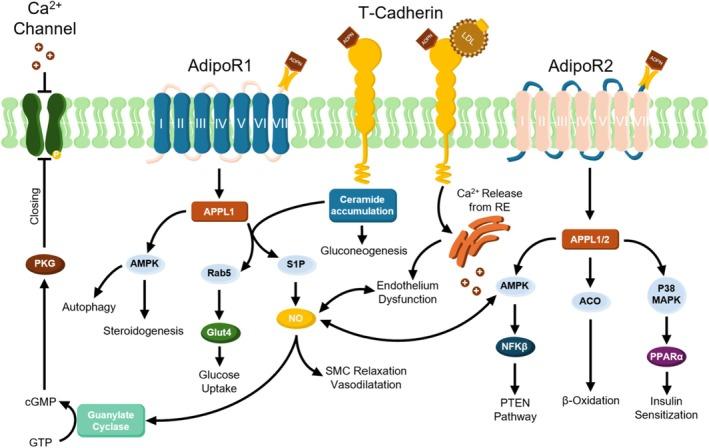
Adiponectin (ADPN) is a pleiotropic hormone produced by adipose tissue involved in the control of body weight, energy expenditure, and feeding behaviors. Alongside a central effect, ADPN acts on peripheral organs such as the stomach, where it can favor gastric fundus relaxation, reinforcing central satiety signals. Notably, ADPN serum levels are dysregulated in several conditions affecting the gastrointestinal tract. Moreover, altered hormone levels coexist with disorders related to the gut-brain axis malfunctioning, that is, eating disorders and inflammatory bowel diseases. Aiming at considering the effective utility of ADPN in a wide range of clinical conditions, there is an urgent need to identify its targets, clarify its mechanism of action, and downstream effectors. In this view, the present review highlights the advancement in elucidating ADPN effects on gastric fundus, describing its ability to cause morphofunctional alterations of smooth muscle cells, affecting their excitability, contractile machinery, and motor response. This comprehensive overview also provides a critical appraisal on the potential translational applications, including the possibility to consider ADPN as a biomarker for the diagnosis and staging of different clinical conditions. Finally, this review explores the potential employment of ADPN analogues for treating disorders characterized by functional gastric disturbances or altered feeding behaviors.
脂联素(ADPN)是一种由脂肪组织分泌的多效性激素,参与体重控制、能量消耗和进食行为的调节。除了中枢作用外,ADPN还作用于外周器官,如胃,它可以促进胃底松弛,增强中枢饱腹感信号。值得注意的是,在几种影响胃肠道的疾病中,ADPN血清水平会失调。此外,激素水平的改变与肠道-脑轴功能失调相关的疾病并存,即饮食失调和炎症性肠病。为了考虑ADPN在广泛临床情况下的有效应用,迫切需要确定其靶点、阐明其作用机制和下游效应器。从这个角度来看,本综述强调了在阐明ADPN对胃底作用方面的进展,描述了其引起平滑肌细胞形态功能改变的能力,影响其兴奋性、收缩机制和运动反应。这一全面概述还对潜在的转化应用进行了批判性评估,包括将ADPN作为不同临床疾病诊断和分期生物标志物的可能性。最后,本综述探讨了ADPN类似物在治疗以功能性胃紊乱或进食行为改变为特征的疾病中的潜在应用。

 Zotero 插件