
高脂血症患者冠状动脉疾病死亡率趋势:来自美国疾病控制与预防中心(CDC)WONDER数据(1999 - 2020年)的地理、性别和种族见解
Trends in coronary artery disease mortality among hyperlipidemic patients: Geographic, gender, and racial insights from CDC WONDER data (1999-2020).
作者信息
Naveed Muhammad Abdullah, Neppala Sivaram, Chigurupati Himaja Dutt, Azeem Bazil, Ali Ahila, Ahmed Faizan, Zafar Sabin, Rehan Muhammad Omer, Iqbal Rabia, Mubeen Manahil, Abid Hassaan, Mubasher Anum, Paul Timir
机构信息
Department of Cardiology, Dow Medical College, Dow University of Health Sciences, Karachi, Pakistan.
Department of Cardiology, University of Texas Health Sciences Center, San Antonio, TX, USA.
出版信息
Int J Cardiol Cardiovasc Risk Prev. 2025 May 3;25:200416. doi: 10.1016/j.ijcrp.2025.200416. eCollection 2025 Jun.
BACKGROUND
Coronary artery disease (CAD) in hyperlipidemia is a significant cause of mortality among adults in the United States. This study investigates trends in CAD-related mortality in hyperlipidemia among adults aged 25 and older, focusing on geographic, gender, and racial/ethnic disparities from 1999 to 2020.
METHODS
A retrospective analysis was conducted using the CDC WONDER database from 1999 to 2020. Age-adjusted mortality rates (AAMRs), annual percent change (APC), and average annual percentage change (AAPC) were calculated per 100,000 persons, stratified by year, sex, race/ethnicity, and geographical region.
RESULTS
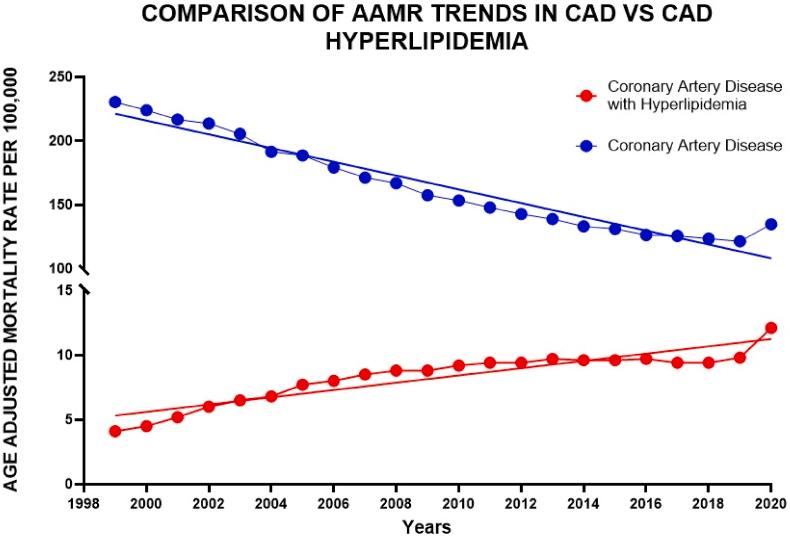
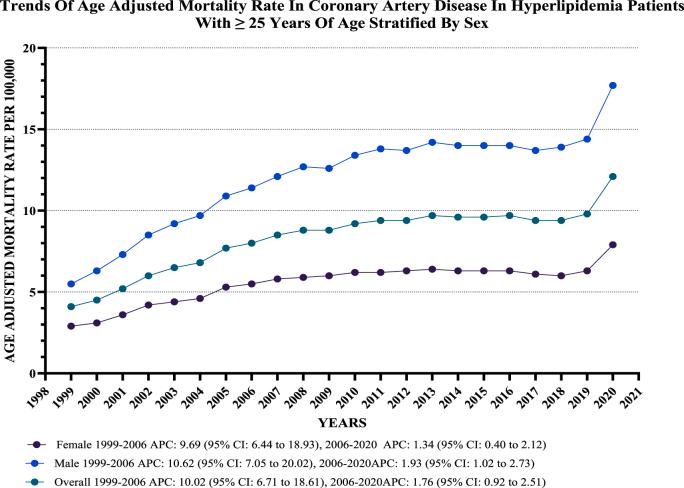
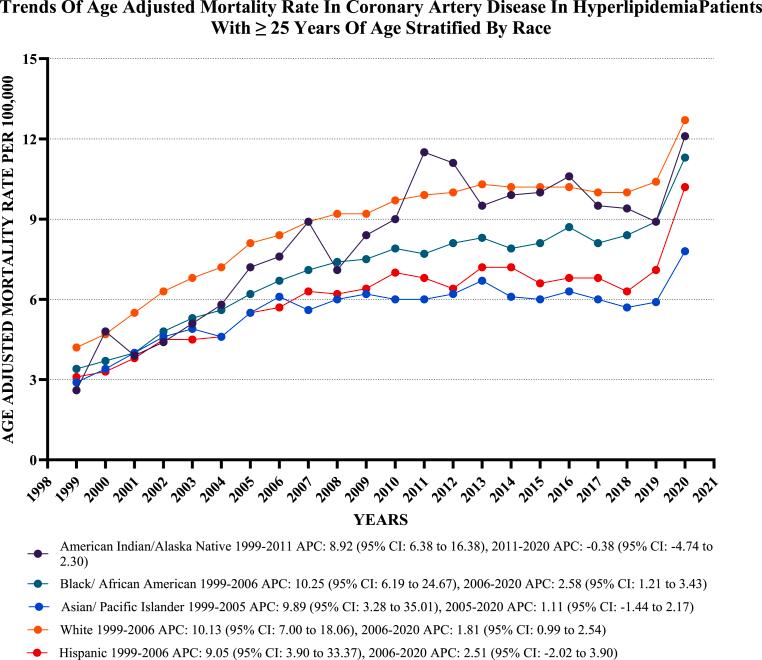
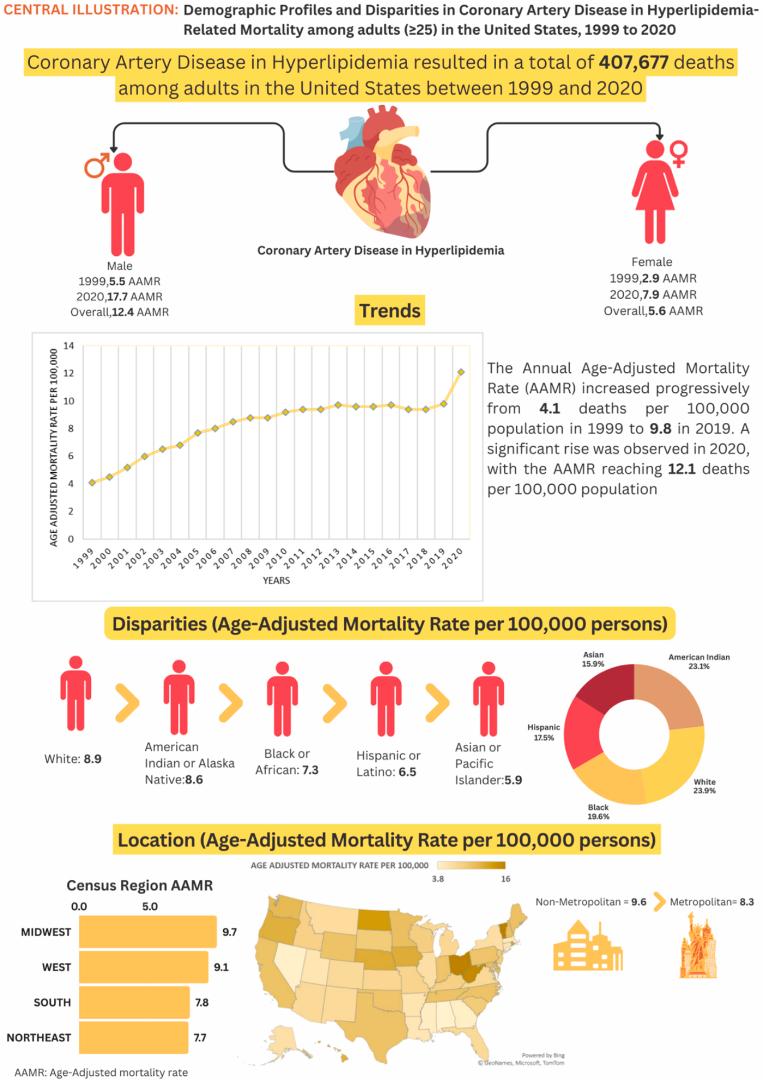
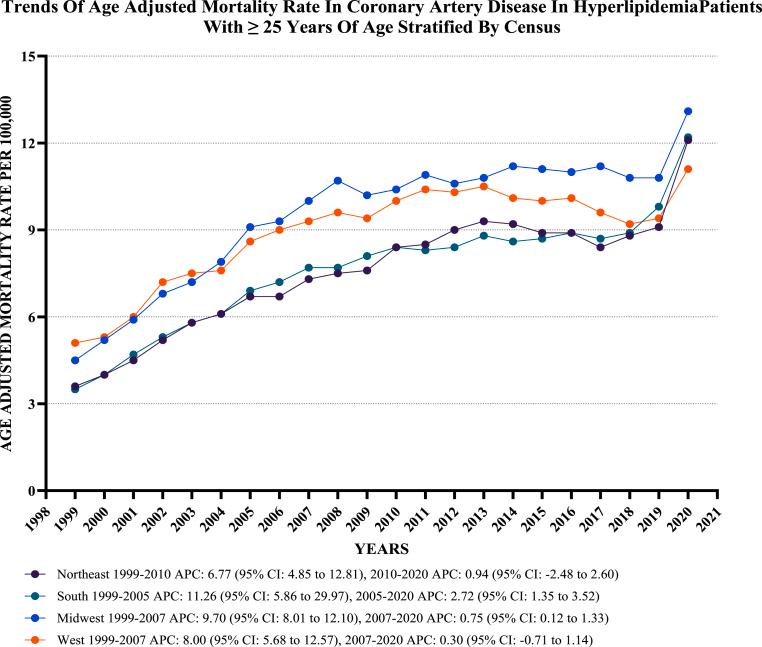
Between 1999 and 2020, CAD in hyperlipidemia led to 407,667 deaths among US adults aged 25+. The AAMR for CAD in hyperlipidemia rose from 4.1 in 1999 to 12.1 in 2020, with an AAPC of 4.44 (95 % CI: 3.69 to 5.48, p < 0.000001). Men had higher AAMRs (12.4) than women (5.6), with significant increases for both sexes over time. Racial/ethnic disparities showed the highest AAMRs in Whites (8.9), followed by American Indians/Alaska Natives (8.6). Geographically, AAMRs varied from 3.8 in Alabama to 16.0 in Vermont, with the Midwest showing the highest rates (9.7). Nonmetropolitan areas exhibited higher AAMRs (9.6) than metropolitan areas (8.3), with a more significant increase in nonmetropolitan areas (AAPC: 5.82, p < 0.000001).
CONCLUSION
This study highlights significant disparities in CAD in hyperlipidemia-related mortality among US adults by race, gender, and geography. The overall increase in AAMRs from 1999 to 2020 underscores the need for targeted public health interventions to address these growing inequities.
背景
高脂血症中的冠状动脉疾病(CAD)是美国成年人死亡的一个重要原因。本研究调查了25岁及以上成年人高脂血症中与CAD相关的死亡率趋势,重点关注1999年至2020年期间的地理、性别和种族/民族差异。
方法
使用1999年至2020年的美国疾病控制与预防中心(CDC)WONDER数据库进行回顾性分析。按年份、性别、种族/民族和地理区域分层,计算每10万人的年龄调整死亡率(AAMR)、年变化百分比(APC)和平均年变化百分比(AAPC)。
结果
1999年至2020年期间,高脂血症中的CAD导致25岁及以上美国成年人死亡407,667例。高脂血症中CAD的AAMR从1999年的4.1上升至2020年的12.1,AAPC为4.44(95%CI:3.69至5.48,p<0.000001)。男性的AAMR(12.4)高于女性(5.6),随着时间的推移,两性的AAMR均显著增加。种族/民族差异显示,白人的AAMR最高(8.9),其次是美洲印第安人/阿拉斯加原住民(8.6)。在地理上,AAMR从阿拉巴马州的3.8到佛蒙特州的16.0不等,中西部地区的发病率最高(9.7)。非都市地区的AAMR(9.6)高于都市地区(8.3),非都市地区的增加更为显著(AAPC:5.82,p<0.000001)。
结论
本研究突出了美国成年人中高脂血症相关CAD死亡率在种族、性别和地理方面的显著差异。1999年至2020年AAMR的总体上升凸显了需要有针对性的公共卫生干预措施来解决这些日益扩大的不平等问题。

 Zotero 插件