
马流感病毒多次传入英国,导致疫情广泛爆发和谱系更替。
Multiple introductions of equine influenza virus into the United Kingdom resulted in widespread outbreaks and lineage replacement.
作者信息
Mojsiejczuk Laura, Whitlock Fleur, Chen Hanting, Magill Callum, Aranday-Cortes Elihu, Bone Jordan, Tong Lily, Da Silva Filipe Ana, Bryant Neil, Newton J Richard, Chambers Thomas M, Reedy Stephanie E, Nemoto Manabu, Yamanaka Takashi, Hughes Joseph, Murcia Pablo R
机构信息
MRC-University of Glasgow Centre for Virus Research, Glasgow, United Kingdom.
Department of Veterinary Medicine, University of Cambridge, Cambridge, United Kingdom.
出版信息
PLoS Pathog. 2025 Jun 9;21(6):e1013227. doi: 10.1371/journal.ppat.1013227. eCollection 2025 Jun.
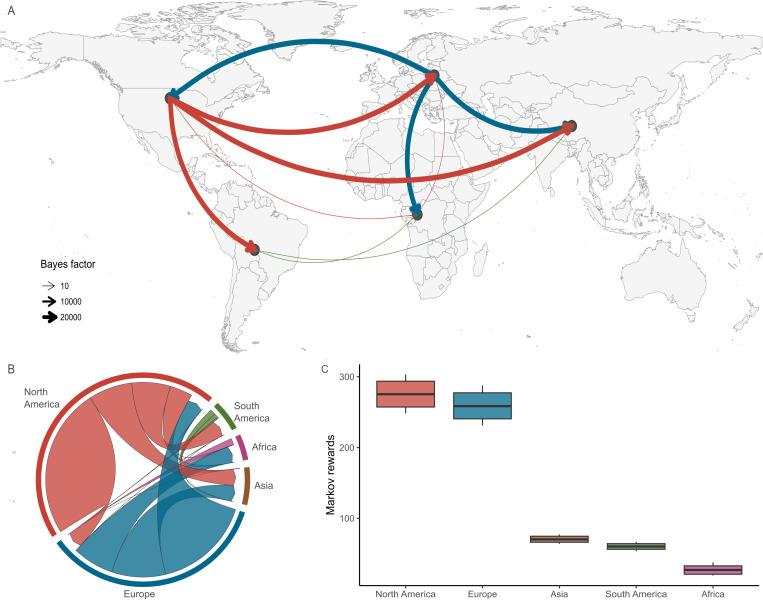
Influenza A viruses (IAVs) are prime examples of emerging viruses in humans and animals. IAV circulation in domestic animals poses a pandemic risk as it provides new opportunities for zoonotic infections. The recent emergence of H5N1 IAV in cows and subsequent spread over multiple states within the USA, together with reports of spillover infections in humans, cats and mice highlight this issue. The horse is a domestic animal in which an avian-origin IAV lineage has been circulating for >60 years. In 2018/19, a Florida Clade 1 (FC1) virus triggered one of the largest epizootics recorded in the UK, which led to the replacement of the Equine Influenza Virus (EIV) Florida Clade 2 (FC2) lineage that had been circulating in the country since 2003. We integrated geographical, epidemiological, and virus genetic data to determine the virological and ecological factors leading to this epizootic. By combining newly-sequenced EIV complete genomes derived from UK outbreaks with existing genomic and epidemiological information, we reconstructed the nationwide viral spread and analysed the global evolution of EIV. We show that there was a single EIV FC1 introduction from the USA into Europe, and multiple independent virus introductions from Europe to the UK. At the UK level, three English regions (East, West Midlands, and North-West) were the main sources of virus during the epizootic, and the number of affected premises together with the number of horses in the local area were found as key predictors of viral spread within the country. At the global level, phylogeographic analysis evidenced a source-sink model for intercontinental EIV migration, with a source population evolving in the USA and directly or indirectly seeding viral lineages into sink populations in other continents. Our results provide insight on the underlying factors that influence IAV spread in domestic animals.
甲型流感病毒(IAV)是人类和动物中新兴病毒的典型例子。IAV在家畜中的传播构成了大流行风险,因为它为人畜共患感染提供了新机会。最近H5N1 IAV在奶牛中出现并随后在美国多个州传播,以及有关人类、猫和小鼠发生溢出感染的报告都凸显了这一问题。马是一种家畜,一种源自禽类的IAV谱系已经在其中传播了60多年。在2018/19年,一种佛罗里达1型(FC1)病毒引发了英国有记录以来最大的一次动物流行病,导致自2003年以来一直在该国传播的马流感病毒(EIV)佛罗里达2型(FC2)谱系被取代。我们整合了地理、流行病学和病毒基因数据,以确定导致这次动物流行病的病毒学和生态学因素。通过将源自英国疫情的新测序的EIV完整基因组与现有的基因组和流行病学信息相结合,我们重建了全国范围内的病毒传播情况,并分析了EIV的全球进化。我们发现,有一个单一的EIV FC1毒株从美国传入欧洲,还有多个独立的病毒毒株从欧洲传入英国。在英国层面,三个英格兰地区(东部、西米德兰兹和西北部)是疫情期间病毒的主要来源地,受影响场所的数量以及当地马匹的数量被发现是病毒在该国传播的关键预测因素。在全球层面,系统发育地理学分析证明了洲际EIV迁移的源-汇模型,源种群在美国进化,并直接或间接地将病毒谱系传播到其他大陆的汇种群中。我们的结果为影响IAV在家畜中传播的潜在因素提供了见解。


 Zotero 插件