
连续十四天食用富含纳米塑料的饲料会增加斑马鱼端脑中小胶质细胞的免疫反应性。
Exposure to a nanoplastic-enriched diet for fourteen days increases microglial immunoreactivity in the zebrafish telencephalon.
作者信息
Mans Robert A, Kelehear Hannah, Rotschafer Sarah, Ganas Clare, Uche-Moon Brendan, Call Gabrielle, Mauersberg Callie C, Toller Justin, Diamanduros Andrew
机构信息
Department of Biology, College of Science and Mathematics, Georgia Southern University-Armstrong Campus, Savannah, GA, United States.
Department of Biomedical Sciences, School of Medicine, Mercer University, Savannah, GA, United States.
出版信息
Front Mol Neurosci. 2025 May 27;18:1563086. doi: 10.3389/fnmol.2025.1563086. eCollection 2025.
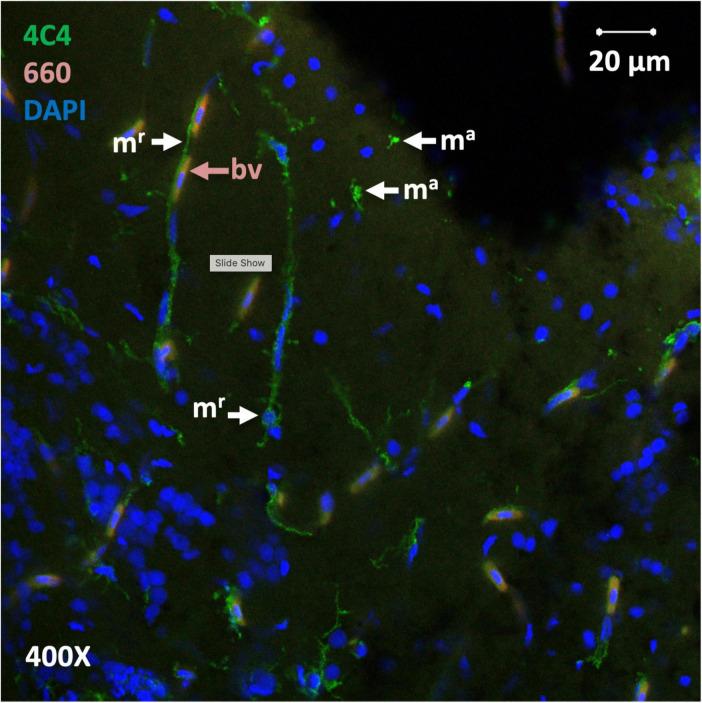
Microscopic plastic particles (micro- and nanoplastics) are an emerging environmental contaminant detected in air, soil, water, and human food supplies. Experiments using zebrafish have shown that polystyrene nanoplastics will infiltrate numerous organ systems after ingestion, including the brain, liver, muscle, and reproductive organs. Additionally, work in rodent models and cell culture has demonstrated that nanoplastics can induce inflammatory responses by microglia and alter astrocyte function. However, the responses of microglia and astrocytes in the zebrafish brain caused by daily exposures to nanoplastics have not been tested previously. In the current study, adult zebrafish were exposed to a nanoplastic-enriched diet consisting of brine shrimp containing 44 nm polystyrene spheres, and reactive gliosis by microglia and astrocytes was examined. Microglial 4C4-immunoreactive protein was elevated in the brains of zebrafish exposed to the nanoplastic-enriched diet. Levels of glial fibrillary acidic protein (GFAP) were not affected by plastic exposure. It was determined that microglial, but not astrocytic, markers were elevated in the zebrafish brain after 14-days of exposure to a nanopolystyrene-enriched diet. These findings contribute to our understanding of how a pervasive environmental contaminant, nanoplastics, may impair brain health, especially during the initial stages of nanoplastic exposure. Additionally, this is the first study using zebrafish to evaluate glial activation in the context of nanoplastic-contaminated foods.
微观塑料颗粒(微塑料和纳米塑料)是一种新出现的环境污染物,在空气、土壤、水和人类食物供应中均有检测到。使用斑马鱼进行的实验表明,聚苯乙烯纳米塑料在摄入后会渗透到许多器官系统,包括大脑、肝脏、肌肉和生殖器官。此外,在啮齿动物模型和细胞培养中的研究表明,纳米塑料可诱导小胶质细胞产生炎症反应并改变星形胶质细胞的功能。然而,此前尚未测试过斑马鱼大脑中的小胶质细胞和星形胶质细胞对每日接触纳米塑料的反应。在本研究中,成年斑马鱼被喂食富含纳米塑料的食物,该食物由含有44纳米聚苯乙烯球体的卤虫组成,并检测了小胶质细胞和星形胶质细胞的反应性胶质增生。暴露于富含纳米塑料食物的斑马鱼大脑中,小胶质细胞4C4免疫反应蛋白升高。胶质纤维酸性蛋白(GFAP)水平不受塑料暴露的影响。研究确定,在暴露于富含纳米聚苯乙烯的食物14天后,斑马鱼大脑中的小胶质细胞标志物升高,而星形胶质细胞标志物未升高。这些发现有助于我们理解一种普遍存在的环境污染物纳米塑料如何损害大脑健康,尤其是在纳米塑料暴露的初始阶段。此外,这是第一项使用斑马鱼评估纳米塑料污染食物背景下胶质细胞激活的研究。


 Zotero 插件