
一种用于评估暴露实验动物体内混合微塑料和纳米塑料颗粒数量的工作流程。
A Workflow for Assessing Particle Counts of Mixed Micro- and Nanoplastics in Exposed Laboratory Animals.
作者信息
Gaspar Lauren, Davis Sarah, Coppotelli Giuseppe, Davies Andrew J, Suckling Coleen C, Ross Jaime M
机构信息
Department of Biomedical and Pharmaceutical Sciences, College of Pharmacy, University of Rhode Island, Kingston, RI 02881, USA.
George and Anne Ryan Institute for Neuroscience, University of Rhode Island, Kingston, RI 02881, USA.
出版信息
Nanomaterials (Basel). 2025 May 28;15(11):812. doi: 10.3390/nano15110812.
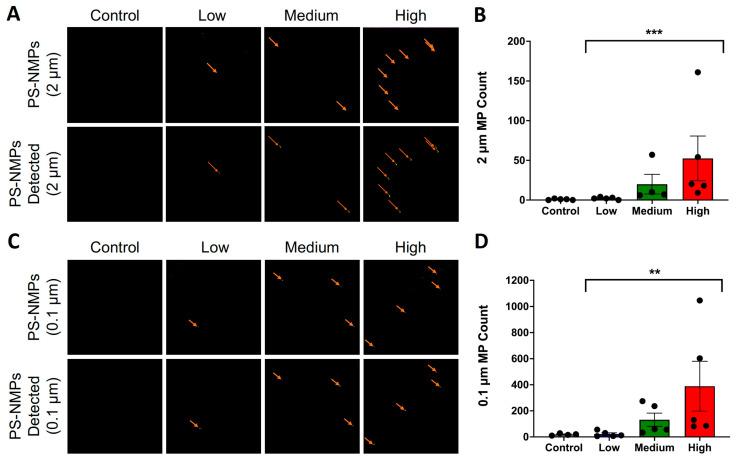
Micro- and nanoplastics (NMPs) have recently gained attention as one of the most pervasive and potentially dangerous environmental pollutants. An increasing number of studies have explored the presence and potential health consequences of NMPs exposure, leading to calls for techniques to assess their bioaccumulation. Significant gaps that remain in this growing field of research are methodologies to quantify discrete particle counts of NMPs below 5 μm in size and evaluate the recovery rate of such methods to ensure accuracy and comparability across studies. To address these gaps, we aimed to develop a high-throughput protocol for the extraction, isolation, and quantification of a 1:1 volume mixture of 2 and 0.1 μm pristine fluorescently labeled spherical polystyrene NMPs (PS-NMPs) from mouse tissue, and to determine recovery rates of both sizes to assess the success of the methodology. We found that we were able to successfully recover 85% of 2 μm NMPs and 30% of 0.1 μm NMPs, and that this workflow could be applied to tissues from mice experimentally exposed to a concentration gradient of PS-NMPs to detect differences in accumulation. This methodology is the first to attempt a continuous workflow to assess particle counts of both micro- and nanoplastics from biological tissues, including calculations of recovery rates, and we anticipate that the workflow described here may be applied and modified in future studies to answer outstanding questions regarding the accumulation of small NMPs that may not be addressed with traditional techniques. Additionally, in identifying the significant differences in recovery rates for micro- versus nanoplastics, we highlight the considerations that must be taken into account for nanoplastics that are often not discussed within the NMPs literature.
微塑料和纳米塑料(NMPs)最近作为最普遍且潜在危险的环境污染物之一受到关注。越来越多的研究探讨了NMPs暴露的存在及其潜在的健康后果,从而引发了对评估其生物累积技术的需求。在这个不断发展的研究领域中,仍然存在显著差距的是量化尺寸小于5μm的NMPs离散颗粒数量的方法,以及评估此类方法的回收率以确保不同研究之间的准确性和可比性。为了解决这些差距,我们旨在开发一种高通量方案,用于从小鼠组织中提取、分离和定量2μm和0.1μm原始荧光标记球形聚苯乙烯NMPs(PS-NMPs)的1:1体积混合物,并确定两种尺寸的回收率以评估该方法的成功性。我们发现我们能够成功回收85%的2μm NMPs和30%的0.1μm NMPs,并且该工作流程可应用于实验暴露于PS-NMPs浓度梯度的小鼠组织,以检测累积差异。这种方法是首次尝试采用连续工作流程来评估生物组织中微塑料和纳米塑料的颗粒数量,包括回收率的计算,我们预计此处描述的工作流程可能会在未来研究中得到应用和修改,以回答有关小型NMPs累积的未解决问题,而这些问题可能无法用传统技术解决。此外,在确定微塑料和纳米塑料回收率的显著差异时,我们强调了纳米塑料必须考虑的因素,而这些因素在NMPs文献中往往未被讨论。


 Zotero 插件