
Aging on Chip: Harnessing the Potential of Microfluidic Technologies in Aging and Rejuvenation Research.
作者信息
Zwi-Dantsis Limor, Jayarajan Vignesh, Church George M, Kamm Roger D, de Magalhães João Pedro, Moeendarbary Emad
机构信息
Department of Mechanical Engineering, Roberts Building, University College London, London, WC1E 6BT, United Kingdom.
Department of Genetics, Harvard Medical School, Boston, MA, 02115, USA.
出版信息
Adv Healthc Mater. 2025 Aug;14(20):e2500217. doi: 10.1002/adhm.202500217. Epub 2025 Jun 12.
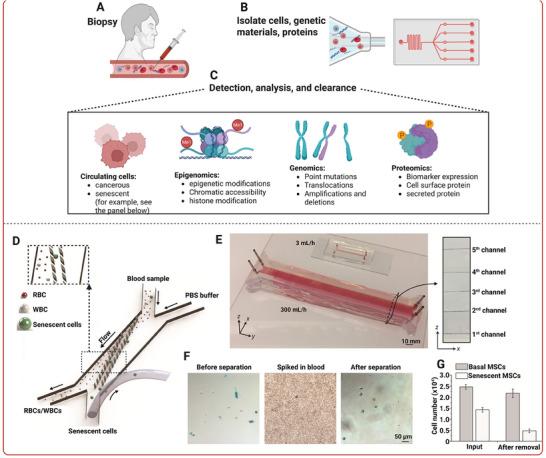
Aging is a complex process and the main risk factor for many common human diseases. Traditional aging research using short-lived animal models and two-dimensional cell cultures has led to key discoveries, but their relevance to human aging remains debatable. Microfluidics, a rapidly growing field that manipulates small volumes of fluids within microscale channels, offers new opportunities for aging research. By enabling the development of advanced three-dimensional cellular models that closely mimic human tissues, microfluidics allows more accurate investigation of aging processes while reducing costs, resource use, and culture time. This review explores how microfluidic systems, particularly organ-on-chip models, can improve our understanding of aging and age-related diseases, bridge the gap between animal models and human biology, and support the discovery of rejuvenation therapies. We highlight their role in monitoring aging biomarkers, analyzing functional cellular changes, and identifying longevity-promoting compounds. The ability of microfluidics to detect, analyze, and remove senescent cells is also discussed, along with emerging applications such as partial reprogramming for cellular rejuvenation. Furthermore, we summarize how these devices support single-cell analysis and recreate specific tissue microenvironments that influence aging. Insights from microfluidic approaches hold promise for developing therapeutic strategies to extend healthspan and promote longevity.


 Zotero 插件