
居家姑息治疗中家庭照顾者护理能力量表的编制与心理测量学评估
Development and psychometric assessment of a care competency scale for family caregivers in home palliative care.
作者信息
Wang Tingting, Kong Jun, Chen Xin, Yang Yiyun, Liu Dan, Liu Ting, Li Li
机构信息
Department of Health Care, The Third Affiliated Hospital of Naval Medical University, Shanghai, China.
Department of Hepatobiliary Surgery, The Third Affiliated Hospital of Naval Medical University, Shanghai, China.
出版信息
Asia Pac J Oncol Nurs. 2025 May 10;12:100719. doi: 10.1016/j.apjon.2025.100719. eCollection 2025 Dec.
OBJECTIVE
This study aimed to develop and validate a scale for measuring the care competency of family caregivers in home palliative care (CCSHPC).
METHODS
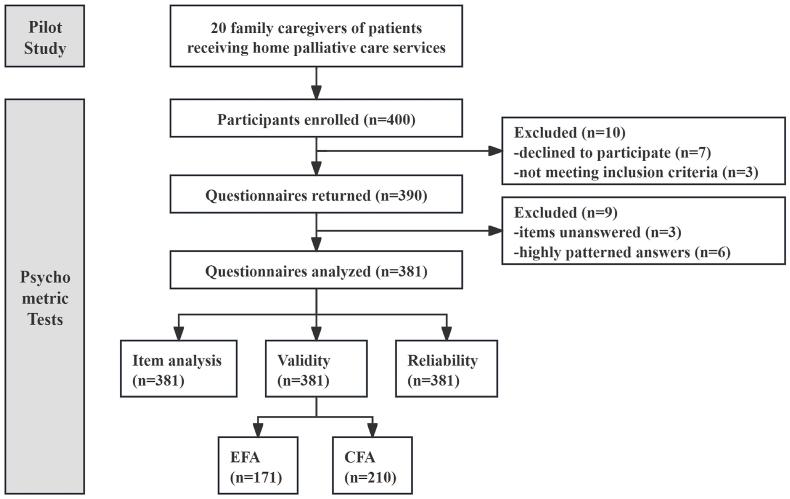
The initial version was established based on the model for caregiver skill building/effectiveness, literature review, qualitative research, expert consultations, and quantitative research. The measurement properties included content validity, structural validity, internal consistency, reliability, measurement error, and construct validity. The survey included 381 family caregivers who had previously or were currently receiving home palliative care services in Shanghai.
RESULTS
The final scale comprised 29 items across 6 dimensions: care knowledge, daily care skills, special care skills, caregiving qualities, self-care practices, and the acquisition of social supports and resources. The cumulative variance contribution rate was 75.406%. Confirmatory factor analysis showed good model fit ( = 767.146, = 357, / = 2.149, root mean square of approximation error = 0.074, root mean square residual = 0.063, incremental fitting index = 0.904, comparative fit index = 0.903). The content validity at the scale and item levels were 0.97 and 0.86 to 1.00, respectively. The reliability of the scale was acceptable (Cronbach's α = 0.954, McDonald's Omega = 0.959, split-half reliability = 0.886, test-retest reliability = 0.931). The standard error of measurement was 4.38.
CONCLUSIONS
The scale is reliable and valid, and it can be applied to measure the care competency of family caregivers in home palliative care, providing a reference for medical professionals to develop targeted intervention strategies. However, the applicability of the scale among family caregivers in different cultural and social contexts, as well as the validation of other measurement properties of the scale, requires further research.
目的
本研究旨在开发并验证一种用于衡量居家姑息治疗中家庭照顾者照护能力的量表(CCSHPC)。
方法
初始版本基于照顾者技能培养/效能模型、文献综述、定性研究、专家咨询和定量研究建立。测量属性包括内容效度、结构效度、内部一致性、信度、测量误差和构想效度。该调查纳入了381名曾接受或正在接受上海居家姑息治疗服务的家庭照顾者。
结果
最终量表由29个项目组成,涵盖6个维度:照护知识、日常照护技能、特殊照护技能、照护品质、自我照护实践以及社会支持与资源的获取。累积方差贡献率为75.406%。验证性因素分析显示模型拟合良好(χ² = 767.146,df = 357,χ²/df = 2.149,近似误差均方根 = 0.074,残差均方根 = 0.063,增值拟合指数 = 0.904,比较拟合指数 = 0.903)。量表和项目层面的内容效度分别为0.97和0.86至1.00。量表的信度可接受(克朗巴哈α系数 = 0.954,麦克唐纳ω系数 = 0.959,分半信度 = 0.886,重测信度 = 0.931)。测量标准误为4.38。
结论
该量表可靠且有效,可用于衡量居家姑息治疗中家庭照顾者的照护能力,为医疗专业人员制定针对性干预策略提供参考。然而,该量表在不同文化和社会背景下家庭照顾者中的适用性以及量表其他测量属性的验证,仍需进一步研究。

 Zotero 插件