
基于新型机器学习的预后模型的开发与验证以及倾向评分匹配用于黏液性乳腺癌手术方法比较
Development and validation of novel machine learning-based prognostic models and propensity score matching for comparison of surgical approaches in mucinous breast cancer.
作者信息
Chen Chunmei, Wu Jundong, Fang Yutong, Li Yong, Zhang Qunchen
机构信息
Department of Breast, Jiangmen Central Hospital, Jiangmen, Guangdong, China.
The Breast Center, Cancer Hospital of Shantou University Medical College, Shantou, Guangdong, China.
出版信息
Front Endocrinol (Lausanne). 2025 Jun 3;16:1557858. doi: 10.3389/fendo.2025.1557858. eCollection 2025.
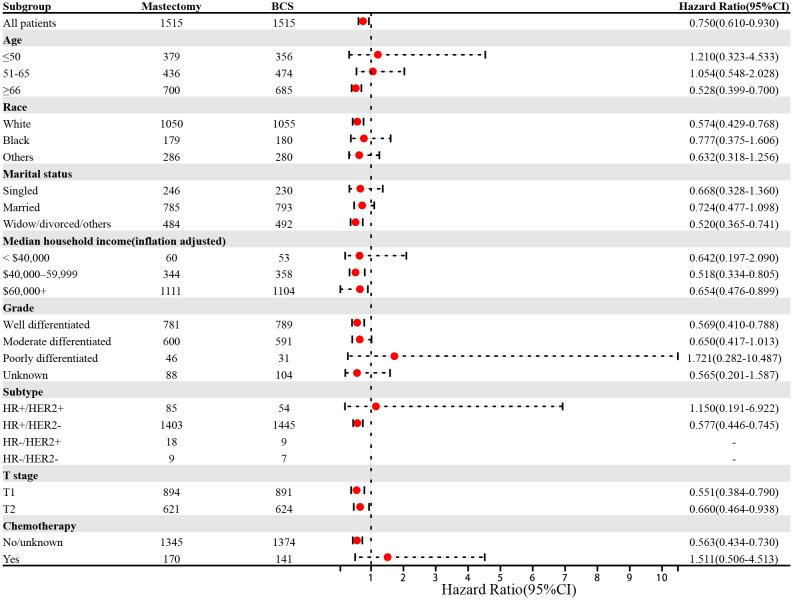
Mucinous breast cancer (MBC) is a rare subtype of breast cancer with specific clinicopathologic and molecular features. Despite MBC patients generally having a favorable survival prognosis, there is a notable absence of clinically accurate predictive models. Patients diagnosed with MBC from the SEER database spanning 2010 to 2020 were included for analysis. Cox regression analysis was conducted to identify independent prognostic factors. Ten machine learning algorithms were utilized to develop prognostic models, which were further validated using MBC patients from two Chinese hospitals. Cox analysis and propensity score matching were applied to evaluate survival differences between MBC patients undergoing mastectomy and breast-conserving surgery (BCS). We determined that the XGBoost models were the optimal models for predicting overall survival (OS) and breast cancer-specific survival (BCSS) in MBC patients with the most accurate performance (AUC=0.833-0.948). Moreover, the XGBoost models still demonstrated robust performance in the external test set (AUC=0.856-0.911). Patients treated with BCS exhibited superior OS compared to those undergoing mastectomy (p < 0.001, HR: 0.60, 95% CI: 0.47-0.77). However, no significant difference was observed in the risk of breast cancer-related mortality. We have successfully developed 6 optimal prognostic models utilizing the XGBoost algorithm to accurately predict the survival of MBC patients. We also developed an interactive web application to facilitate the utilization of our models by clinicians or researchers. Notably, we observed a significant improvement in OS for patients undergoing BCS.
黏液性乳腺癌(MBC)是一种具有特定临床病理和分子特征的罕见乳腺癌亚型。尽管MBC患者总体生存预后良好,但临床上缺乏准确的预测模型。纳入了2010年至2020年SEER数据库中诊断为MBC的患者进行分析。进行Cox回归分析以确定独立的预后因素。利用十种机器学习算法开发预后模型,并使用来自两家中国医院的MBC患者进行进一步验证。应用Cox分析和倾向得分匹配来评估接受乳房切除术和保乳手术(BCS)的MBC患者之间的生存差异。我们确定XGBoost模型是预测MBC患者总生存(OS)和乳腺癌特异性生存(BCSS)的最佳模型,性能最准确(AUC=0.833-0.948)。此外,XGBoost模型在外部测试集中仍表现出强大的性能(AUC=0.856-0.911)。接受BCS治疗的患者与接受乳房切除术的患者相比,OS更好(p<0.001,HR:0.60,95%CI:0.47-0.77)。然而,在乳腺癌相关死亡率风险方面未观察到显著差异。我们成功地利用XGBoost算法开发了6种最佳预后模型,以准确预测MBC患者的生存情况。我们还开发了一个交互式网络应用程序,以方便临床医生或研究人员使用我们的模型。值得注意的是,我们观察到接受BCS治疗的患者OS有显著改善。


 Zotero 插件