
非洲女性人乳头瘤病毒疫苗接种情况及其影响因素:一项综合综述
Human papillomavirus vaccine uptake and its determinants among women in Africa: an umbrella review.
作者信息
Mengistie Berihun Agegn, Yirsaw Amlaku Nigusie, Lakew Gebeyehu, Mekonnen Gebrehiwot Berie, Shibabaw Adamu Ambachew, Chereka Alex Ayenew, Kitil Gemeda Wakgari, Wondie Wubet Tazeb, Abuhay Alemken Eyayu, Getachew Eyob
机构信息
Department of General Midwifery, School of Midwifery, College of Medicine and Health Sciences, University of Gondar, Gondar, Ethiopia.
Department of Health Promotion and Health Behavior, Institute of Public Health, College of Medicine and Health Sciences, University of Gondar, Gondar, Ethiopia.
出版信息
Front Public Health. 2025 Jun 5;13:1537250. doi: 10.3389/fpubh.2025.1537250. eCollection 2025.
BACKGROUND
Globally, cervical cancer is the fourth most prevalent disease among women. It is primarily caused by persistent infections with human papillomavirus (HPV). The World Health Organization (WHO) strongly recommends HPV vaccination for girls aged 9 to 14 years. Although HPV vaccination is the most effective form of primary prevention against cervical cancer, the accessibility and uptake of the HPV vaccine remain low in developing nations, particularly in Africa. Therefore, this umbrella review aimed to determine the pooled prevalence of human papillomavirus vaccine uptake and its determinant factors in Africa.
METHODS
The protocol was registered in the International Prospective Register of Systematic Reviews (PROSPERO) under reference number CRD42024560032. Eligible systematic review and meta-analysis (SRM) studies were retrieved from PubMed, Hinari, ScienceDirect, and Google Scholar. Data were extracted using Microsoft Excel 2019 and analyzed using Stata software (version 17). The methodological quality of the included studies was examined using A Measurement Tool to Assess systematic Reviews (AMSTAR 2). Publication bias was checked using a funnel plot and Egger's test. A random-effects model (DerSimonian-Laird method) was used to estimate the pooled prevalence of HPV vaccine uptake. The I-squared (I) test was performed to assess statistical heterogeneity among the included studies.
RESULTS
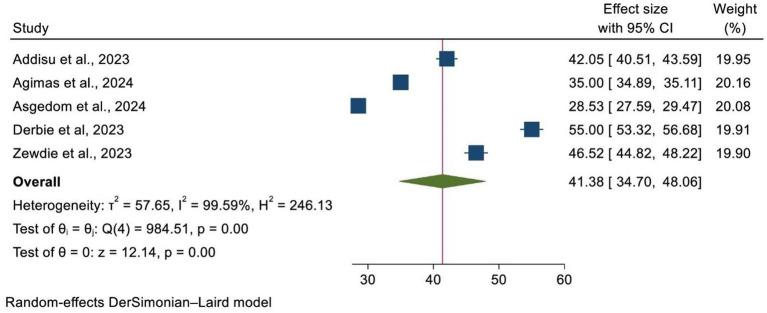
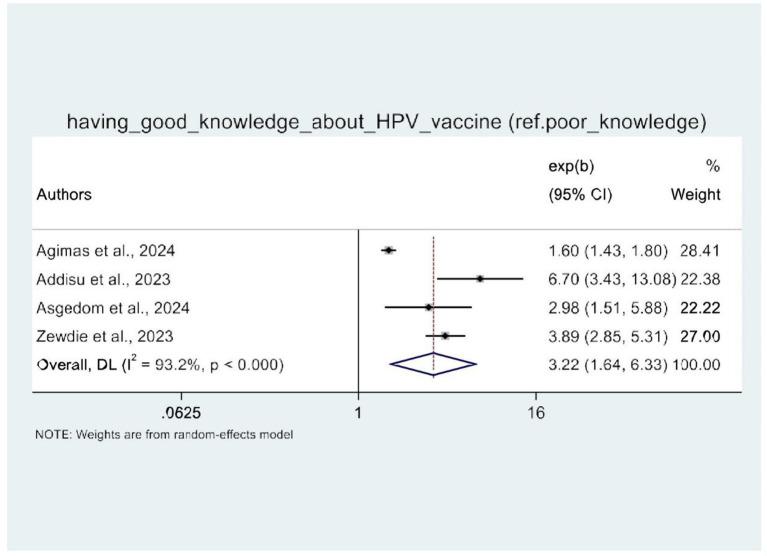
This umbrella review included five SRM studies conducted across Africa, encompassing a total of 707,005 study participants. The pooled prevalence of HPV vaccine uptake in Africa was 41.38% (95% CI: 34.70, 48.06). Women's knowledge of HPV vaccination (AOR: 3.22, 95% CI: 1.64-6.33) and attitudes toward HPV immunization (AOR: 2.48, 95% CI: 2.18-2.81) were significantly associated with HPV vaccine uptake.
CONCLUSION
The uptake of the HPV vaccine in Africa remains significantly lower (41.38%) than the WHO's global HPV vaccination target of 90% by 2030. Therefore, increasing vaccine uptake requires promoting women's knowledge and attitudes toward HPV vaccination through facility-based education and counseling, planned campaigns, community-based programs, and advocacy for HPV vaccination and cervical cancer prevention using various mass media platforms.
SYSTEMATIC REVIEW REGISTRATION
Berihun Agegn Mengistie, Muluken Demeke, Abebaw Setegn. An Umbrella review of Human Papillomavirus (HPV) Vaccine Uptake and its predictors among females in Africa, 2024. PROSPERO 2024 Available from https://www.crd.york.ac.uk/PROSPERO/view/CRD42024560032.
背景
在全球范围内,宫颈癌是女性中第四大常见疾病。它主要由人乳头瘤病毒(HPV)持续感染引起。世界卫生组织(WHO)强烈建议9至14岁的女孩接种HPV疫苗。尽管HPV疫苗接种是预防宫颈癌最有效的一级预防方式,但在发展中国家,尤其是非洲,HPV疫苗的可及性和接种率仍然很低。因此,本系统综述旨在确定非洲HPV疫苗接种的汇总流行率及其决定因素。
方法
该方案已在国际系统评价前瞻性注册库(PROSPERO)中注册,注册号为CRD42024560032。从PubMed、Hinari、ScienceDirect和谷歌学术中检索符合条件的系统评价和荟萃分析(SRM)研究。使用Microsoft Excel 2019提取数据,并使用Stata软件(版本17)进行分析。使用评估系统评价的测量工具(AMSTAR 2)检查纳入研究的方法学质量。使用漏斗图和Egger检验检查发表偏倚。采用随机效应模型(DerSimonian-Laird方法)估计HPV疫苗接种的汇总流行率。进行I²检验以评估纳入研究之间的统计异质性。
结果
本系统综述纳入了在非洲开展的五项SRM研究,共涉及707,005名研究参与者。非洲HPV疫苗接种的汇总流行率为41.38%(95%CI:34.70,48.06)。女性对HPV疫苗接种的了解(优势比:3.22,95%CI:1.64 - 6.33)和对HPV免疫的态度(优势比:2.48,95%CI:2.18 - 2.81)与HPV疫苗接种显著相关。
结论
非洲HPV疫苗的接种率(41.38%)仍显著低于世界卫生组织设定的到2030年全球90%的HPV疫苗接种目标。因此,提高疫苗接种率需要通过基于机构的教育和咨询、有计划的宣传活动、社区项目以及利用各种大众媒体平台宣传HPV疫苗接种和宫颈癌预防,来提升女性对HPV疫苗接种的了解和态度。
系统评价注册
Berihun Agegn Mengistie、Muluken Demeke、Abebaw Setegn。《非洲女性人乳头瘤病毒(HPV)疫苗接种情况及其预测因素的系统综述》,2024年。PROSPERO 2024可从https://www.crd.york.ac.uk/PROSPERO/view/CRD42024560032获取。




 Zotero 插件