
抗体水平及预防奥密克戎BQ.1/XBB突破性感染的决定因素
Determinants of antibody levels and protection against omicron BQ.1/XBB breakthrough infection.
作者信息
Martín Pérez Carla, Ramírez-Morros Anna, Jiménez Alfons, Vidal Marta, Pradenas Edwards, Barrios Diana, Canyelles Mar, Rubio Rocío, Cuamba Inocencia, Izquierdo Luis, Santamaria Pere, Trinité Benjamin, Vidal-Alaball Josep, Molinos-Albert Luis M, Blanco Julià, Aguilar Ruth, Ruiz-Comellas Anna, Moncunill Gemma, Dobaño Carlota
机构信息
ISGlobal, Barcelona, Catalonia, Spain.
Facultat de Medicina i Ciències de la Salut, Universitat de Barcelona (UB), Barcelona, Spain.
出版信息
Commun Med (Lond). 2025 Jun 20;5(1):243. doi: 10.1038/s43856-025-00943-2.
BACKGROUND
The ongoing evolution of SARS-CoV-2, particularly through the emergence of new variants, continues to challenge our understanding of immune protection. While antibody levels correlate with protection against earlier variants such as Alpha and Delta, their relationship with Omicron sub-variants remains unclear.
METHODS
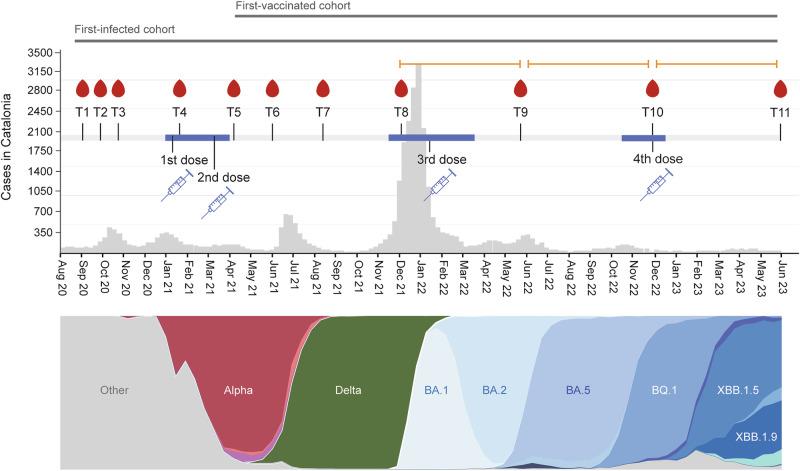
To investigate the role of antibody levels and neutralizing activity in preventing breakthrough infections, we analyzed longitudinal SARS-CoV-2 humoral responses and neutralizing activity against the ancestral virus and major emerging variants in a well-characterized cohort of healthcare workers in Spain (N = 405).
RESULTS
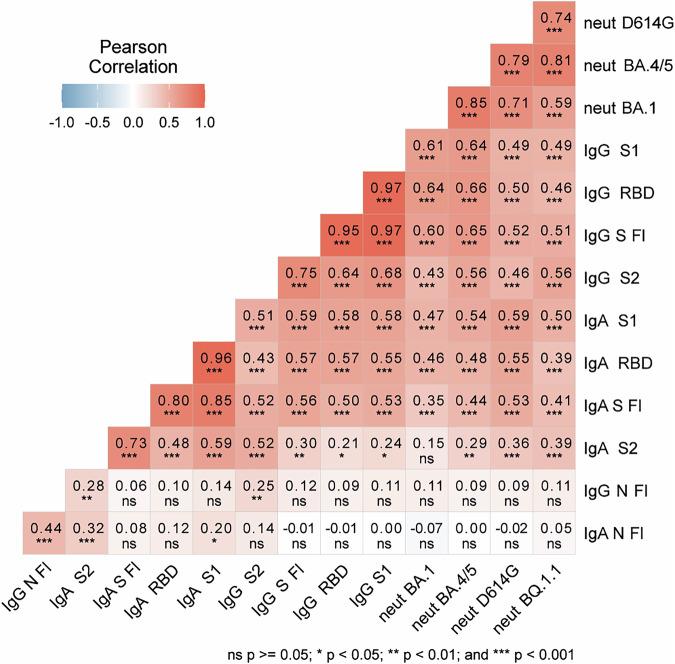
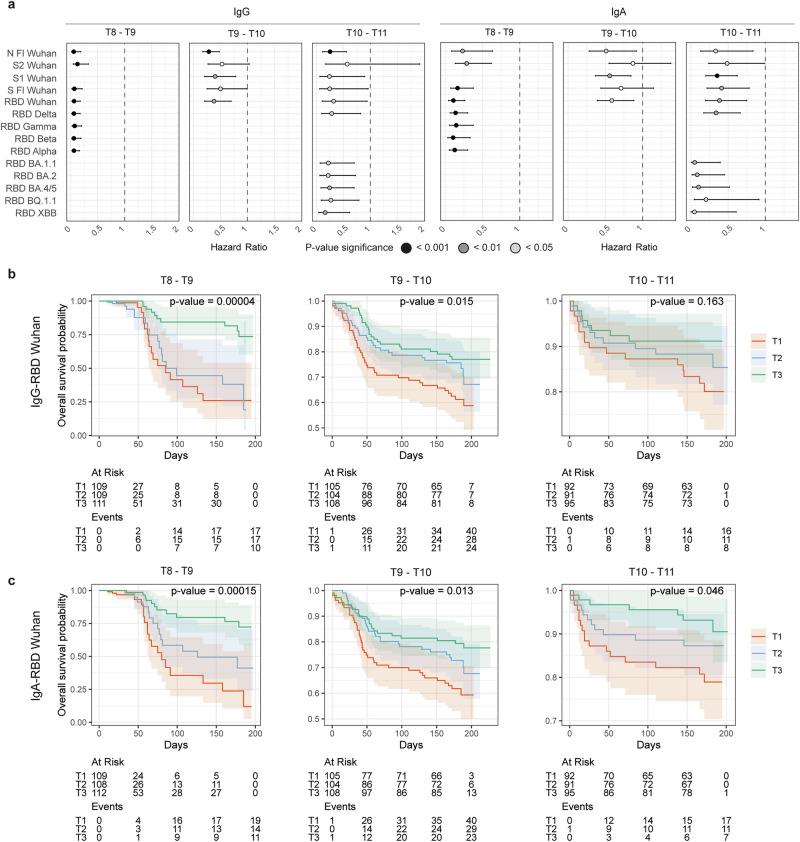
We find that antibody levels and neutralization titers are key indicators of protection against SARS-CoV-2, including the more evasive BQ.1 and XBB Omicron variants. Higher IgG and IgA levels are associated with protection over three 6-month follow-up periods sequentially dominated by BA.1, BA.2, BA.5, BQ.1, and XBB Omicron sub-variants, although the strength of the association between antibody levels and protection declines over time.
CONCLUSIONS
Our findings demonstrate that binding antibody levels and neutralizing responses are valid correlates of protection against more evasive BQ.1 and XBB Omicron variants, although the strength of this association diminishes over time. Additionally, our results underscore the importance of continuous monitoring and updating vaccination strategies to maintain effective protection against emerging SARS-CoV-2 variants.
背景
严重急性呼吸综合征冠状病毒2(SARS-CoV-2)的持续进化,尤其是通过新变种的出现,继续挑战我们对免疫保护的理解。虽然抗体水平与针对早期变种(如阿尔法和德尔塔)的保护相关,但其与奥密克戎亚变种的关系仍不明确。
方法
为了研究抗体水平和中和活性在预防突破性感染中的作用,我们分析了西班牙一组特征明确的医护人员(N = 405)中针对原始病毒和主要新出现变种的SARS-CoV-2体液反应和中和活性的纵向数据。
结果
我们发现抗体水平和中和滴度是预防SARS-CoV-2的关键指标,包括更具逃避性的BQ.1和XBB奥密克戎变种。在依次由BA.1、BA.2、BA.5、BQ.1和XBB奥密克戎亚变种主导的三个6个月随访期内,较高的IgG和IgA水平与保护相关,尽管抗体水平与保护之间的关联强度随时间下降。
结论
我们的研究结果表明,结合抗体水平和中和反应是针对更具逃避性的BQ.1和XBB奥密克戎变种的有效保护相关指标,尽管这种关联的强度会随时间减弱。此外,我们的结果强调了持续监测和更新疫苗接种策略以维持对新出现的SARS-CoV-2变种的有效保护的重要性。


 Zotero 插件