
在奥密克戎XBB.1.16/EG.5为主的疫情波期间,核衣壳抗体以及刺突蛋白和核衣壳抗体组合与预防新冠病毒感染的相关性
Correlates of Nucleocapsid Antibodies and a Combination of Spike and Nucleocapsid Antibodies Against Protection of SARS-CoV-2 Infection During the Omicron XBB.1.16/EG.5-Predominant Wave.
作者信息
Yamamoto Shohei, Oshiro Yusuke, Inamura Natsumi, Nemoto Takashi, Tan Tomofumi, Horii Kumi, Okudera Kaori, Konishi Maki, Mizoue Tetsuya, Sugiyama Haruhito, Aoyanagi Nobuyoshi, Sugiura Wataru, Ohmagari Norio
机构信息
Department of Epidemiology and Prevention, Center for Clinical Sciences, National Center for Global Health and Medicine, Tokyo, Japan.
Department of Laboratory Testing, Center Hospital of the National Center for the Global Health and Medicine, Tokyo, Japan.
出版信息
Open Forum Infect Dis. 2024 Aug 28;11(9):ofae455. doi: 10.1093/ofid/ofae455. eCollection 2024 Sep.
BACKGROUND
We aimed to examine the association among nucleocapsid (N) antibodies, a combination of N and spike (S) antibodies, and protection against SARS-CoV-2 reinfection.
METHODS
We conducted a prospective cohort study among staff at a national medical research center in Tokyo and followed them for the incidence of SARS-CoV-2 infection between June and September 2023 (Omicron XBB.1.16/EG.5 wave). At baseline, participants donated blood samples to measure N- and S-specific antibodies. Cox regression was used to estimate the hazard ratio and protection ([1 - hazard ratio] × 100) against subsequent SARS-CoV-2 infection across these antibody levels.
RESULTS
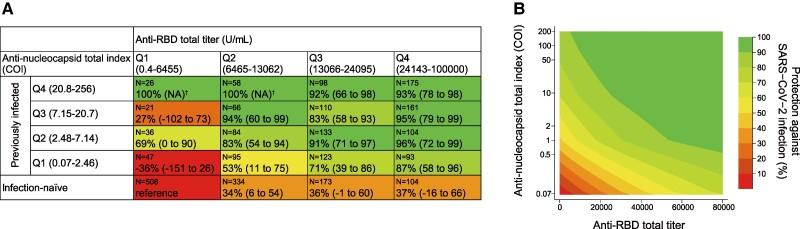
Among participants with previous infection, higher pre-reinfection N antibodies were associated with a lower risk of reinfection, even after adjusting S antibody levels ( < .01 for trend). Estimation of the protection matrix for N and S antibodies revealed that high levels in N and S antibodies conferred robust protection (>90%) against subsequent infection. In addition, a pattern of low pre-reinfection N antibodies but high vaccine-enhanced S antibodies showed high protection (>80%).
CONCLUSIONS
Pre-reinfection N antibody levels correlated with protection against reinfection, independent of S antibodies. If the N antibodies were low, vaccine-boosted S antibodies might enhance the reinfection protection.
背景
我们旨在研究核衣壳(N)抗体、N抗体与刺突(S)抗体的组合以及针对SARS-CoV-2再感染的保护作用之间的关联。
方法
我们在东京的一个国家医学研究中心对工作人员进行了一项前瞻性队列研究,并对他们在2023年6月至9月期间(奥密克戎XBB.1.16/EG.5毒株流行期)的SARS-CoV-2感染发病率进行了随访。在基线时,参与者捐献血液样本以检测N特异性抗体和S特异性抗体。使用Cox回归来估计不同抗体水平下后续SARS-CoV-2感染的风险比和保护率([1 - 风险比]×100)。
结果
在既往感染过的参与者中,即使在调整S抗体水平后,再感染前较高的N抗体与较低的再感染风险相关(趋势<0.01)。对N抗体和S抗体的保护矩阵估计显示,高水平的N抗体和S抗体对后续感染具有强大的保护作用(>90%)。此外,再感染前N抗体水平低但疫苗增强的S抗体水平高的模式显示出较高的保护作用(>80%)。
结论
再感染前的N抗体水平与针对再感染的保护作用相关,独立于S抗体。如果N抗体水平低,疫苗增强的S抗体可能会增强对再感染的保护作用。

 Zotero 插件