
利用放射组学和深度学习预测肝细胞癌患者早期复发的术前模型:一项多中心研究。
Preoperative model for predicting early recurrence in hepatocellular carcinoma patients using radiomics and deep learning: A multicenter study.
作者信息
Li Yong-Hai, Qian Gui-Xiang, Yao Ling, Lei Xue-Di, Zhu Yu, Tang Lei, Xu Zi-Ling, Bu Xiang-Yi, Wei Ming-Tong, Lu Jian-Lin, Jia Wei-Dong
机构信息
Cheeloo College of Medicine, Shandong University, Jinan 250021, Shandong Province, China.
The First Affiliated Hospital of University of Science and Technology of China, University of Science and Technology of China, Hefei 230001, Anhui Province, China.
出版信息
World J Gastrointest Oncol. 2025 Jun 15;17(6):106608. doi: 10.4251/wjgo.v17.i6.106608.
BACKGROUND
Hepatocellular carcinoma (HCC) is the most common primary liver malignancy. Ablation therapy is one of the first-line treatments for early HCC. Accurately predicting early recurrence (ER) is crucial for making precise treatment plans and improving patient prognosis.
AIM
To establish an intratumoral and peritumoral model for predicting ER in HCC patients following curative ablation.
METHODS
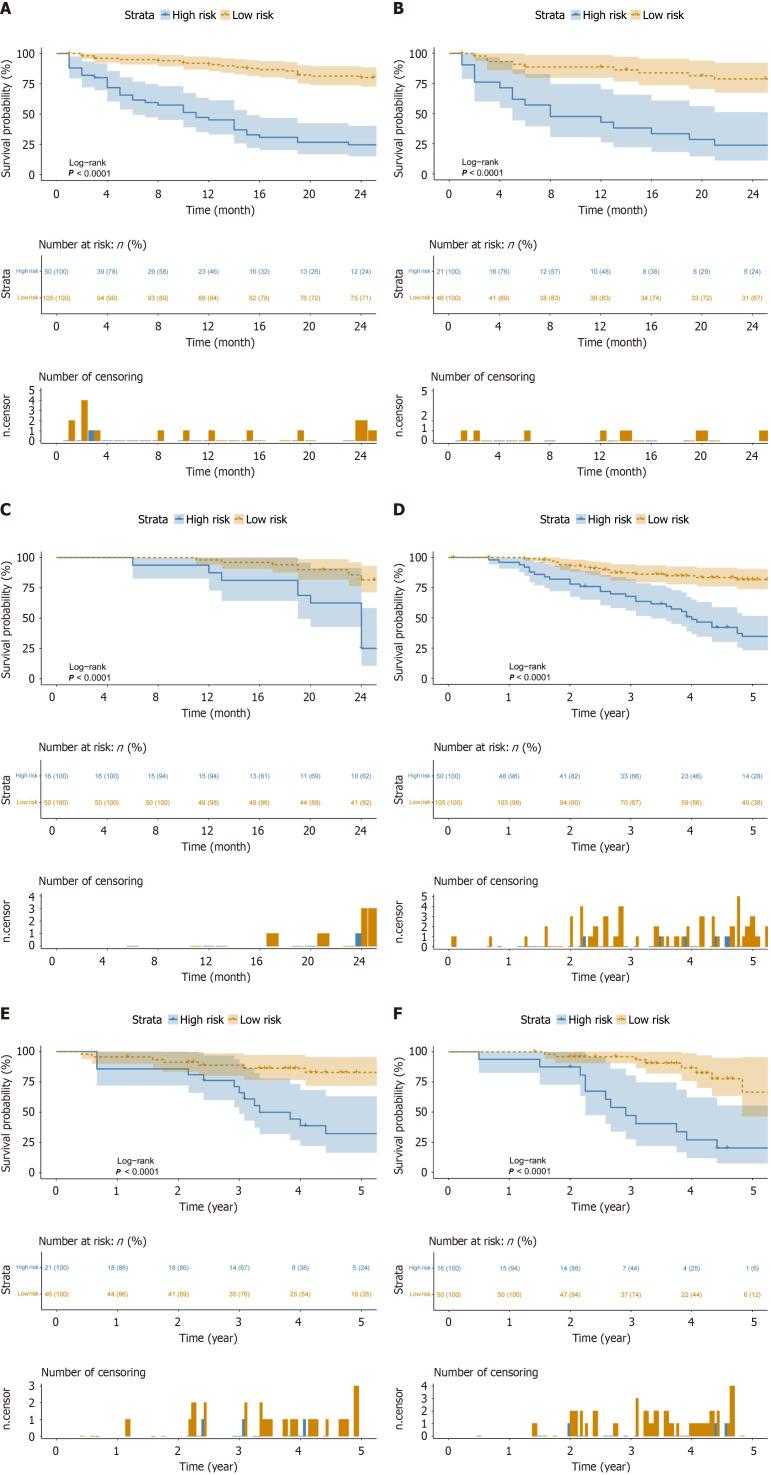
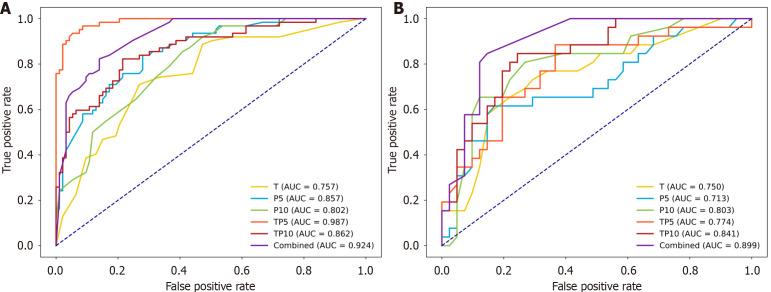
This study included a total of 288 patients from three Centers. The patients were divided into a primary cohort ( = 222) and an external cohort ( = 66). Radiomics and deep learning methods were combined for feature extraction, and models were constructed following a three-step feature selection process. Model performance was evaluated using the area under the receiver operating characteristic curve (AUC), while calibration curves and decision curve analysis (DCA) were used to assess calibration and clinical utility. Finally, Kaplan-Meier (K-M) analysis was used to stratify patients according to progression-free survival (PFS) and overall survival (OS).
RESULTS
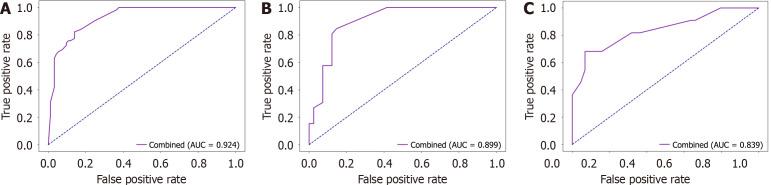
The combined model, which utilizes the light gradient boosting machine learning algorithm and incorporates both intratumoral and peritumoral regions (5 mm and 10 mm), demonstrated the best predictive performance for ER following HCC ablation, achieving AUCs of 0.924 in the training set, 0.899 in the internal validation set, and 0.839 in the external validation set. Calibration and DCA curves confirmed strong calibration and clinical utility, whereas K-M curves provided risk stratification for PFS and OS in HCC patients.
CONCLUSION
The most efficient model integrated the tumor region with the peritumoral 5 mm and 10 mm regions. This model provides a noninvasive, effective, and reliable method for predicting ER after curative ablation of HCC.
背景
肝细胞癌(HCC)是最常见的原发性肝脏恶性肿瘤。消融治疗是早期HCC的一线治疗方法之一。准确预测早期复发(ER)对于制定精确的治疗方案和改善患者预后至关重要。
目的
建立一种用于预测HCC患者根治性消融术后ER的瘤内和瘤周模型。
方法
本研究共纳入来自三个中心的288例患者。患者分为初级队列(n = 222)和外部队列(n = 66)。将放射组学和深度学习方法相结合进行特征提取,并按照三步特征选择过程构建模型。使用受试者操作特征曲线下面积(AUC)评估模型性能,同时使用校准曲线和决策曲线分析(DCA)评估校准和临床实用性。最后,采用Kaplan-Meier(K-M)分析根据无进展生存期(PFS)和总生存期(OS)对患者进行分层。
结果
该联合模型利用轻梯度提升机器学习算法,纳入瘤内和瘤周区域(5 mm和10 mm),对HCC消融术后的ER显示出最佳预测性能,在训练集中AUC为0.924,内部验证集中为0.899,外部验证集中为0.839。校准曲线和DCA曲线证实了良好的校准和临床实用性,而K-M曲线为HCC患者的PFS和OS提供了风险分层。
结论
最有效的模型将肿瘤区域与瘤周5 mm和10 mm区域相结合。该模型为预测HCC根治性消融术后的ER提供了一种无创、有效且可靠的方法。



 Zotero 插件