
家禽屠宰场过程卫生标准评估:意大利东北部自身检查与官方控制的比较分析(2021 - 2023年)
Assessment of process hygiene criteria in poultry slaughterhouses: A comparative analysis of own-checks and official controls in Northeast Italy (2021-2023).
作者信息
Rosamilia Alfonso, Galletti Giorgio, Casadei Gabriele, Dell'Orfano Giovanni, Ferrari Margherita, Carlantonio Elisa Di, Vergani Francesca, Riceputi Nicola, Zanchini Francesco, Bardasi Lia, Fiorentini Laura, Chiapponi Chiara, Dottori Michele, Padovani Anna, Trevisani Marcello
机构信息
Istituto Zooprofilattico Sperimentale of Lombardy and Emilia-Romagna, Via Bianchi 9, 25124 Brescia, Italy.
Istituto Zooprofilattico Sperimentale of Lombardy and Emilia-Romagna, Via Bianchi 9, 25124 Brescia, Italy.
出版信息
Poult Sci. 2025 Jun 20;104(9):105465. doi: 10.1016/j.psj.2025.105465.
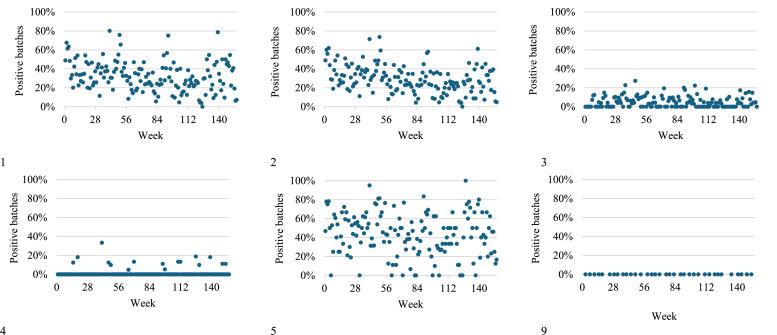
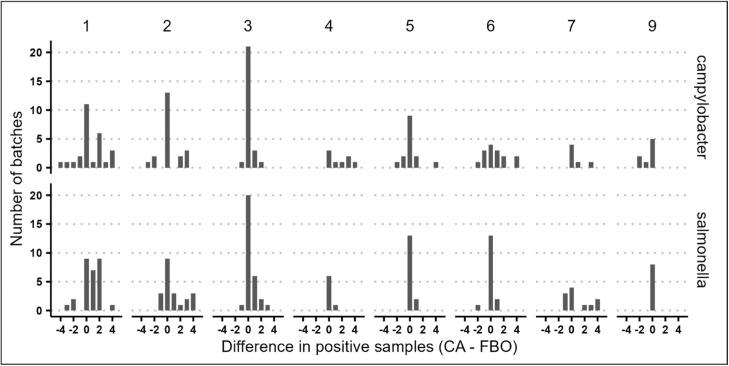
Process hygiene criteria (PHC) for Campylobacter and Salmonella provide essential guidance on hygiene standards for poultry processing at slaughterhouses. Data collected by Member States (MSs) in Europe revealed inconsistencies between official verification and internal monitoring results, highlighting the need for a comprehensive investigation to uncover the reasons behind these discrepancies. This study investigated PHC in relation to operational factors at nine poultry slaughterhouses, integrating production characteristics and epidemiological surveillance data from a representative sample of supplying farms. The analysis is based on microbiological testing results collected between 2021 and 2023. PHC were monitored at regular intervals, creating a "moving window" of data to assess hygienic performance over time. The findings indicated that samples tested by competent authorities (CAs) showed higher prevalence rates of Campylobacter (27.6 %) and Salmonella (30.7 %) compared to those tested by food business operators (FBOs) (13.0 % and 8.7 %, respectively). However, statistically significant differences between paired observations (P < 0.05) were detected only in four high-throughput slaughterhouses. Six of the nine slaughterhouses face challenges in meeting the hygiene standards established by EC Regulation 2073/2005, with recurring non-compliance over three years, representing 17.0 % to 82.0 % of their total operational time. Serotyping of Salmonella isolates identified a high prevalence of S. Infantis (61.7 %), also prevalent in farm samples (72.0 %), frequently linked to human cases related to poultry meat in the region, underscoring its public health importance. The study highlights the importance of robust sampling protocols for comparative assessments by FBOs and CAs, alongside the need for continuous improvement in hygiene management. Discrepancies between FBO and CA sampling results, as reported by European Food Safety Authority (EFSA), in this study are largely attributed to the lower sampling frequency employed by CAs, which likely captures only a fraction of the microbial variability. Recurrent breaches of PHC underscore the ineffectiveness of current interventions in controlling microbial loads. These findings emphasize the need for comprehensive control measures throughout the production chain, including surveillance of emerging serovars and antimicrobial resistance monitoring.
弯曲杆菌和沙门氏菌的加工卫生标准(PHC)为屠宰场家禽加工的卫生标准提供了重要指导。欧洲成员国(MSs)收集的数据显示,官方核查结果与内部监测结果之间存在不一致,这凸显了进行全面调查以揭示这些差异背后原因的必要性。本研究调查了九家家禽屠宰场与运营因素相关的PHC,整合了供应农场代表性样本的生产特征和流行病学监测数据。分析基于2021年至2023年期间收集的微生物检测结果。定期监测PHC,创建一个数据“移动窗口”以评估随时间的卫生表现。研究结果表明,与食品企业经营者(FBOs)检测的样本相比,主管当局(CAs)检测的样本中弯曲杆菌(27.6%)和沙门氏菌(30.7%)的流行率更高(FBOs检测的样本中弯曲杆菌和沙门氏菌的流行率分别为13.0%和8.7%)。然而,仅在四家高通量屠宰场中检测到配对观察值之间存在统计学显著差异(P < 0.05)。九家屠宰场中有六家在满足欧盟法规2073/2005规定的卫生标准方面面临挑战,在三年期间反复出现不符合规定的情况,占其总运营时间的17.0%至82.0%。对沙门氏菌分离株的血清型分析确定,婴儿沙门氏菌的流行率很高(61.7%),在农场样本中也很普遍(72.0%),该血清型经常与该地区与禽肉相关的人类病例有关,凸显了其对公共卫生的重要性。该研究强调了FBOs和CAs进行比较评估时采用稳健抽样方案的重要性,以及卫生管理持续改进的必要性。欧洲食品安全局(EFSA)报告的FBO和CA抽样结果之间的差异,在本研究中很大程度上归因于CAs采用的较低抽样频率,这可能仅捕获了微生物变异性的一小部分。反复违反PHC凸显了当前干预措施在控制微生物负荷方面的无效性。这些发现强调了在整个生产链中采取全面控制措施的必要性,包括监测新兴血清型和抗菌药物耐药性监测。
 Zotero 插件