
生物合成机制与非生物胁迫驱动的排放:解析植物中挥发性萜类化合物的多层调控
Biosynthetic Machinery to Abiotic Stress-Driven Emission: Decoding Multilayer Regulation of Volatile Terpenoids in Plants.
作者信息
Shan Yingying, Jin Songheng
机构信息
Jiyang College, Zhejiang A&F University, Zhuji 311800, China.
College of Landscape Architecture, Zhejiang A&F University, Hangzhou 311300, China.
出版信息
Antioxidants (Basel). 2025 May 31;14(6):673. doi: 10.3390/antiox14060673.
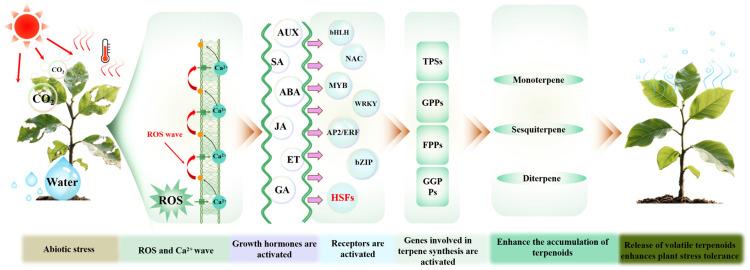
Volatile terpenoids (VTs) are key secondary metabolites that play dual roles as endogenous antioxidants and airborne signals in plants under abiotic stress. Their biosynthesis is orchestrated via the mevalonate (MVA) and 2-C-methyl-D-erythritol 4-phosphate (MEP) pathways, with metabolic plasticity regulated by transcription factors, phytohormonal crosstalk, and stress-responsive elements. Recent advances have revealed that VTs such as isoprene, monoterpenes, and sesquiterpenes help mitigate oxidative stress by scavenging reactive oxygen species (ROS) and modulating antioxidant enzyme systems. However, regulatory mechanisms of stress-induced VT emissions remain fragmented and species-dependent. This review synthesizes current knowledge of VT biosynthesis and emission under abiotic stress, highlights their antioxidant functions and regulatory architecture, and underscores their protective roles in redox homeostasis and stress signal transduction. By identifying key metabolic nodes (e.g., TPS, DXS and MYC2) and stress-responsive pathways, we propose potential molecular targets for the development of stress-resilient cultivars. The integration of VT-based traits into breeding strategies and production-oriented metabolic engineering offers promising avenues for improving crop performance, reducing oxidative damage, and supporting sustainable agricultural systems.
挥发性萜类化合物(VTs)是关键的次生代谢产物,在非生物胁迫下的植物中作为内源性抗氧化剂和空气传播信号发挥双重作用。它们的生物合成通过甲羟戊酸(MVA)和2-C-甲基-D-赤藓糖醇4-磷酸(MEP)途径进行编排,其代谢可塑性受转录因子、植物激素相互作用和胁迫响应元件调控。最近的研究进展表明,异戊二烯、单萜和倍半萜等VTs通过清除活性氧(ROS)和调节抗氧化酶系统来帮助减轻氧化应激。然而,胁迫诱导的VT排放的调控机制仍然支离破碎且因物种而异。本综述综合了非生物胁迫下VT生物合成和排放的现有知识,突出了它们的抗氧化功能和调控结构,并强调了它们在氧化还原稳态和胁迫信号转导中的保护作用。通过识别关键代谢节点(如TPS、DXS和MYC2)和胁迫响应途径,我们提出了培育抗逆品种的潜在分子靶点。将基于VT的性状整合到育种策略和面向生产的代谢工程中,为提高作物性能、减少氧化损伤和支持可持续农业系统提供了有前景的途径。


 Zotero 插件