
嵌合抗原受体(CAR)超越αβ T细胞:释放自然杀伤细胞、巨噬细胞和γδ T淋巴细胞对抗实体瘤
CAR Beyond αβ T Cells: Unleashing NK Cells, Macrophages, and γδ T Lymphocytes Against Solid Tumors.
作者信息
Xian Yunjia, Wen Lu
机构信息
Cancer Center, Union Hospital, Tongji Medical College, Huazhong University of Science and Technology, Wuhan 430022, China.
Tongji Medical College, Huazhong University of Science and Technology, Wuhan 430022, China.
出版信息
Vaccines (Basel). 2025 Jun 19;13(6):654. doi: 10.3390/vaccines13060654.
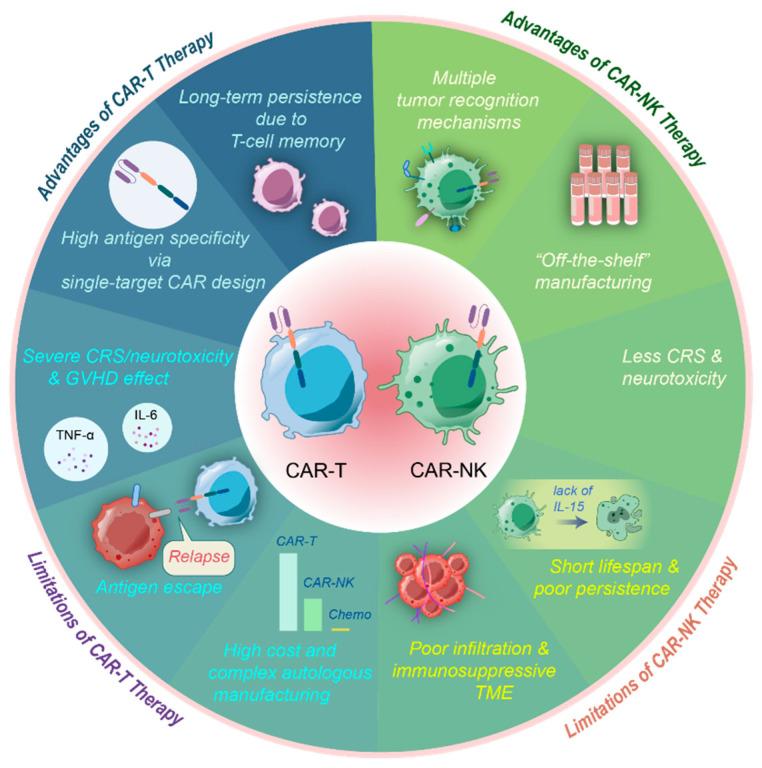
Chimeric antigen receptor (CAR)-engineered cell therapy represents a landmark advancement in cancer immunotherapy. While αβ CAR-T therapy has demonstrated remarkable success in hematological malignancies, its efficacy in solid tumors remains constrained mainly by factors such as antigen heterogeneity, immunosuppressive microenvironments, and on-target/off-tumor toxicity. To overcome these limitations, emerging CAR platforms that utilize alternative immune effectors, including natural killer (NK) cells, macrophages, and γδ T lymphocytes, are rapidly gaining traction. This review systematically analyzes the mechanistic advantages of CAR-NK, CAR-M, and CAR-γδ T cell therapies, while critically evaluating persistent challenges in clinical translation, including limited cell persistence, manufacturing scalability, and dynamic immune evasion mechanisms. We further discuss innovative strategies to enhance therapeutic efficacy through some viable strategies. By bridging fundamental immunology with translational engineering, this work provides a roadmap for developing CAR therapies capable of addressing the complexities of solid tumor eradication.
嵌合抗原受体(CAR)工程细胞疗法是癌症免疫疗法的一项里程碑式进展。虽然αβ CAR-T疗法在血液系统恶性肿瘤中已取得显著成功,但其在实体瘤中的疗效仍主要受到抗原异质性、免疫抑制微环境和靶向脱瘤毒性等因素的限制。为克服这些局限性,利用包括自然杀伤(NK)细胞、巨噬细胞和γδ T淋巴细胞在内的替代免疫效应细胞的新兴CAR平台正迅速获得关注。本综述系统分析了CAR-NK、CAR-M和CAR-γδ T细胞疗法的机制优势,同时批判性地评估了临床转化中持续存在的挑战,包括细胞持久性有限、生产可扩展性以及动态免疫逃逸机制。我们还通过一些可行策略讨论了提高治疗效果的创新策略。通过将基础免疫学与转化工程相结合,这项工作为开发能够应对实体瘤根除复杂性的CAR疗法提供了路线图。



 Zotero 插件