
2019冠状病毒病(COVID-19)大流行期间基层医疗中急性呼吸道感染患者病情恶化的及时识别:质量改进协作项目
Timely identification of deteriorating patients from acute respiratory infections at the primary care level in the COVID-19 era: quality improvement collaborative.
作者信息
Jorro Barón Facundo, Falaschi Andrea, Bosio Lía, Gibbons Luz, Vitar Emilse, Guglielmino Marina, Negri Erica, Peralta-Roca María Belén, Rodriguez Ana Paula, Suarez-Anzorena Inés, Alonso Juan Pedro, Rodríguez Viviana, Roberti Javier, García Elorrio Ezequiel
机构信息
Instituto de Efectividad Clinica y Sanitaria, Buenos Aires, Argentina
Hospital de Niños Pedro de Elizalde, Buenos Aires, Argentina.
出版信息
BMJ Open Qual. 2025 Jul 1;14(3):e003390. doi: 10.1136/bmjoq-2025-003390.
BACKGROUND
Primary care has been essential in ensuring the continuity of health services for patients with COVID-19 and other conditions. We aimed to increase the adoption of evidence-based interventions to identify clinical deterioration in adult patients with confirmed or suspected respiratory COVID-19 at the primary care level.
METHODS
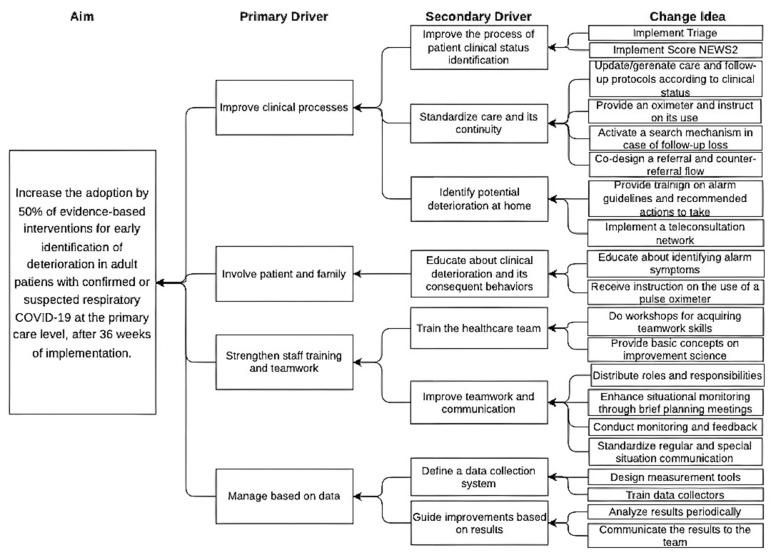
We implemented specific interventions in nine Primary Healthcare Centres (PHCC) through a quality improvement collaborative (QIC) with an interrupted time-series design. Interventions included triage for acute respiratory symptoms, the National Early Warning Score 2 (NEWS2) scale, portable oximeters for selected patients and the provincial telehealth system. Additional components involved leadership commitment, teamwork tools, reminders, audits, feedback and direct observation. A mixed-method evaluation was conducted, with two learning sessions and three action periods to test and implement selected change ideas.
RESULTS
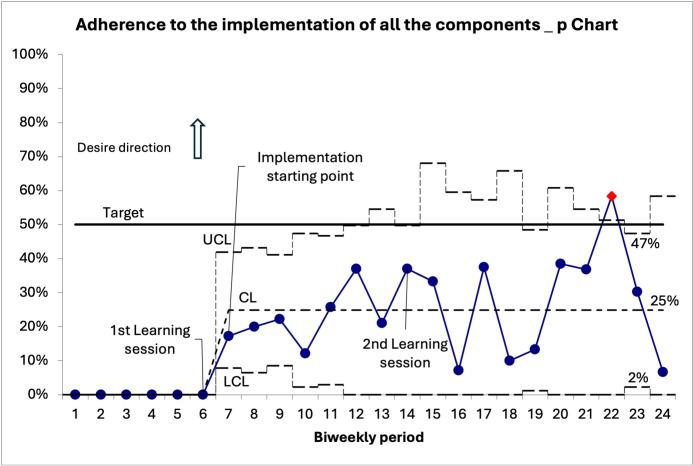
Six PHHCs completed the study. Over 48 weeks, data from 877 patients were gathered, 356 in the baseline period (BP) and 477 in the implementation period (IP). Eight hundred and sixty-two medical consultations were reported, 367 for BP and 495 for IP. More COVID-19-confirmed diagnoses were observed in the IP group (1.9% vs 15%, p<0.001).The bundle was implemented in 0% and 28.4% of patients in the BP and IP groups, respectively. On evaluating the individual components of the bundle, we discovered enhancements in the utilisation of triage, application of NEWS2 and utilisation of oximeters when appropriate. A decrease in the number of follow-up calls was observed at the end of the implementation.Patients rated the quality of care as positive in 66% of the cases in the BP and 76% in the IP group (p=0.023).
CONCLUSION
We successfully implemented a triage algorithm based on the NEWS2 score to identify respiratory deterioration in adult patients in primary care through a QIC. This intervention was perceived as an improvement in the quality of care by the patients.
背景
基层医疗对于确保新型冠状病毒肺炎(COVID-19)患者及其他疾病患者获得持续的医疗服务至关重要。我们旨在提高基于证据的干预措施的采用率,以在基层医疗层面识别确诊或疑似呼吸道COVID-19成年患者的临床病情恶化情况。
方法
我们通过一项采用中断时间序列设计的质量改进协作项目(QIC),在9个初级医疗保健中心(PHCC)实施了具体干预措施。干预措施包括对急性呼吸道症状进行分诊、使用国家早期预警评分2(NEWS2)量表、为选定患者配备便携式血氧仪以及省级远程医疗系统。其他组成部分包括领导承诺、团队合作工具、提醒、审核、反馈和直接观察。进行了一项混合方法评估,包括两次学习会议和三个行动期,以测试和实施选定的变革想法。
结果
6个PHHC完成了研究。在48周内,收集了877例患者的数据,基线期(BP)为356例,实施期(IP)为477例。报告了862次医疗会诊,BP期为367次,IP期为495次。IP组中观察到更多确诊的COVID-19病例(1.9%对15%,p<0.001)。该综合干预措施在BP组和IP组患者中的实施率分别为0%和28.4%。在评估该综合干预措施的各个组成部分时,我们发现分诊的利用率、NEWS2的应用以及血氧仪在适当情况下的使用均有所提高。在实施结束时,随访电话数量有所减少。患者对护理质量的评价在BP组66%的病例中为积极,在IP组76%的病例中为积极(p=0.023)。
结论
我们通过QIC成功实施了一种基于NEWS2评分的分诊算法,以识别基层医疗中成年患者的呼吸道病情恶化情况。患者认为这种干预措施提高了护理质量。

 Zotero 插件