
药物对提取物治疗鼻咽癌的网络药理学机制及实验验证
Network pharmacology mechanisms and experimental verification of drug pair extract in the treatment of nasopharyngeal carcinoma.
作者信息
Li Tiantian, Chen Haijun, Zhang Jing, Liu Jiaxin, Tang Rundong, Zhang Liang, Feng Tian, Xiao Yanchun, Liu Shiwen, Chen Xiangjun
机构信息
Department of Otorhinolaryngology, Shenzhen Bao'an Traditional Chinese Medicine Hospital Group, Guangzhou University of Chinese Medicine, Shenzhen, China.
School of Pharmaceutical Sciences, Hunan University of Medicine, Huaihua, China.
出版信息
Front Oncol. 2025 Jun 18;15:1601725. doi: 10.3389/fonc.2025.1601725. eCollection 2025.
BACKGROUND
Nasopharyngeal carcinoma (NPC) represents the predominant head-neck malignancy in China. While the Hedyotis Diffusae Herba-Scutellariae Barbatae Herba (HDH-SBH) herb pair shows antitumor potential, its mechanism against NPC remains unclear.
METHODS
This network pharmacology study integrated with experimental validation identified NPC-related targets through GEO database and disease databases (OMIM, GeneCards, TTD). Active components of HDH-SBH and their targets were retrieved from Traditional Chinese Medicine Systems Pharmacology Database (TCMSP). Common targets were analyzed via STRING, with functional enrichment using Gene Ontology (GO) and Kyoto Encyclopedia of Genes and Genomes (KEGG). Core components were validated through molecular docking and experiments using HDH-SBH-treated 5-8F and CNE2 cells.
RESULTS
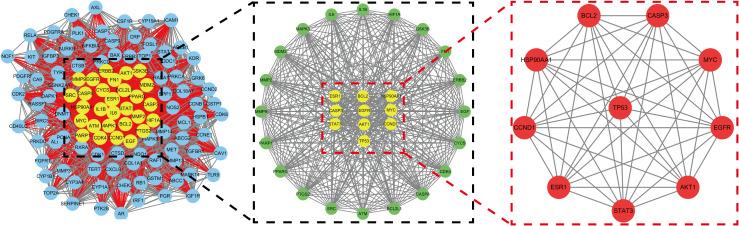
We identified 36 bioactive components and 155 shared targets, with quercetin, luteolin, wogonin, and β-sitosterol emerging as core components. KEGG analysis highlighted PI3K/AKT pathway inhibition (P<0.05). Molecular docking confirmed strong binding between core components and key targets (AKT1, TP53, BCL2). validation showed HDH-SBH significantly inhibited NPC cell proliferation/migration while inducing apoptosis through downregulating BCL2, upregulating TP53, and suppressing AKT1 phosphorylation.
CONCLUSIONS
Based on the network pharmacology approach, we predicted the potential mechanism of HDH-SBH for the treatment of NPC, which provided a new idea for further research on its pharmacological mechanism.
背景
鼻咽癌(NPC)是中国主要的头颈部恶性肿瘤。虽然白花蛇舌草-半枝莲药对显示出抗肿瘤潜力,但其抗鼻咽癌的机制仍不清楚。
方法
本网络药理学研究结合实验验证,通过GEO数据库和疾病数据库(OMIM、GeneCards、TTD)确定鼻咽癌相关靶点。从中药系统药理学数据库(TCMSP)中检索白花蛇舌草-半枝莲的活性成分及其靶点。通过STRING分析共同靶点,并使用基因本体论(GO)和京都基因与基因组百科全书(KEGG)进行功能富集。通过分子对接以及使用白花蛇舌草-半枝莲处理的5-8F和CNE2细胞进行实验来验证核心成分。
结果
我们确定了36种生物活性成分和155个共同靶点,其中槲皮素、木犀草素、汉黄芩素和β-谷甾醇为核心成分。KEGG分析突出了PI3K/AKT通路抑制(P<0.05)。分子对接证实了核心成分与关键靶点(AKT1、TP53、BCL2)之间的强结合。实验验证表明,白花蛇舌草-半枝莲通过下调BCL2、上调TP53和抑制AKT1磷酸化,显著抑制鼻咽癌细胞增殖/迁移,同时诱导细胞凋亡。
结论
基于网络药理学方法,我们预测了白花蛇舌草-半枝莲治疗鼻咽癌的潜在机制,为进一步研究其药理机制提供了新思路。




 Zotero 插件