
2021年至2022年政策措施、学校假期和旅行对爱沙尼亚儿童和成人中新型冠状病毒2感染发病率的影响。
The effect of policy measures, school holidays and travel on the incidence of SARS-CoV-2 infection in children and adults in Estonia from 2021 to 2022.
作者信息
Soeorg Hiie, Päll Taavi, Abroi Aare, Avi Radko, Sadikova Olga, Härma Mari-Anne, Reisberg Tuuli, Lutsar Irja, Huik Kristi
机构信息
Department of Microbiology, Institute of Biomedicine and Translational Medicine, Faculty of Medicine, University of Tartu, Tartu, Estonia.
Institute of Technology, Faculty of Science and Technology, University of Tartu, Tartu, Estonia.
出版信息
PLoS One. 2025 Jul 3;20(7):e0327719. doi: 10.1371/journal.pone.0327719. eCollection 2025.
PURPOSE
The policy measures implemented during the COVID-19 pandemic, travel and school holidays could have influenced the spread of SARS-CoV-2 infection in children and adults differently. We aimed to determine the effect of policy measures, school holidays and travel on the incidence of SARS-CoV-2 infection in children and adults.
METHODS
The overall SARS-CoV-2 infection incidence between 1 February 2021 and 1 May 2022 was decomposed into the most common lineage-specific incidence per 100,000 by imputing lineage based on the sequencing results of random samples. A phenomenological logistic growth model was fitted to the incidence data in adults (aged ≥15 years) and children (aged <15 years) in four regions in Estonia. Factors influencing the spread of the virus, such as policy measures, school holidays, the number of travel-related cases, and cumulative vaccination or infection rates, were tested as covariates in the model.
RESULTS
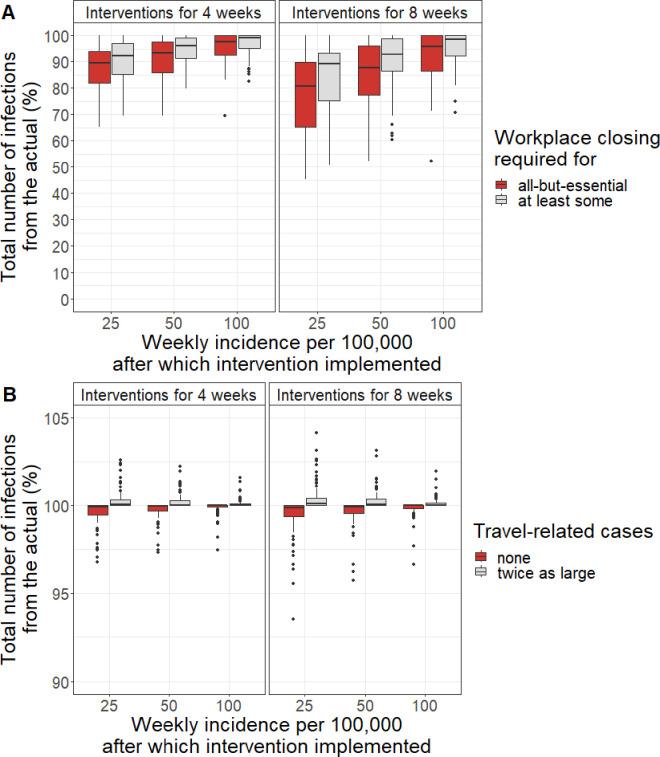
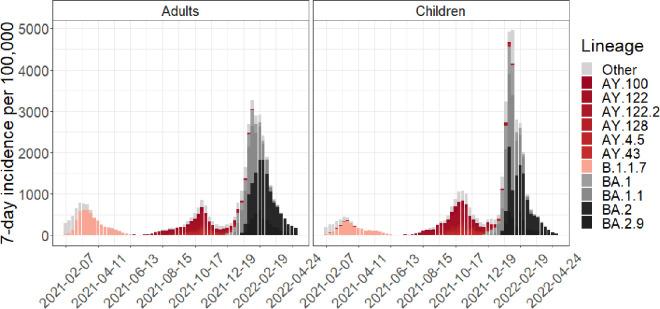
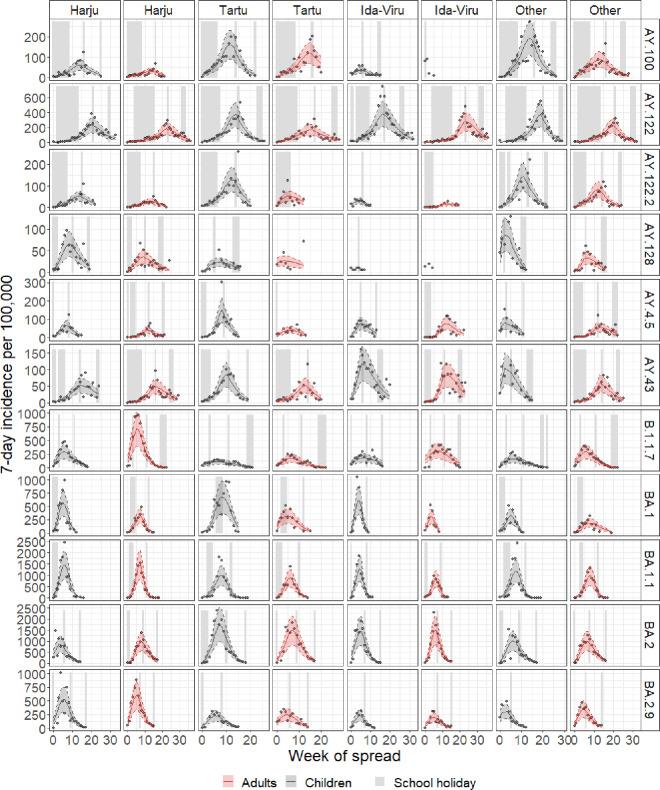
The eleven most common lineages (one Alpha, six Delta, two Omicron BA.1, and two Omicron BA.2) caused 84.7% and 85.8% of all SARS-CoV-2 infections in children and adults, respectively, during the study period. According to the final model, the Delta variant had slower growth and a lower maximum cumulative incidence. The number of workplace closures in the previous week and school holidays in the same week decreased, but the number of travel-related cases in the same week increased the incidence growth. No difference between children and adults was observed. The testing rate was lower during school holidays than during school terms (median (IQR) 1964 (1437-2970) vs. 3136 (2476-4417) vs. per 100,000; p < 0.001). In 40.3% of the weeks, travel-related cases were detected, accounting for (IQR) 2.1% (0.9-4.3%) of the incidence of nontravel-related infections.
CONCLUSION
Our study suggests that the spread of SARS-CoV-2 infection was similar in children and adults. Workplace closures reduced transmission, whereas during school holidays lower testing contributed to a lower reported incidence, and travel-related cases were possibly underreported.
目的
在新冠疫情期间实施的政策措施、旅行和学校假期可能对儿童和成人中新冠病毒2型(SARS-CoV-2)感染的传播产生了不同影响。我们旨在确定政策措施、学校假期和旅行对儿童和成人中SARS-CoV-2感染发病率的影响。
方法
通过根据随机样本的测序结果推算谱系,将2021年2月1日至2022年5月1日期间的总体SARS-CoV-2感染发病率分解为每10万人中最常见的谱系特异性发病率。对爱沙尼亚四个地区成人(年龄≥15岁)和儿童(年龄<15岁)的发病率数据拟合了一个现象学逻辑增长模型。将影响病毒传播的因素,如政策措施、学校假期、与旅行相关的病例数以及累计疫苗接种率或感染率,作为模型中的协变量进行检验。
结果
在研究期间,11种最常见的谱系(1种阿尔法、6种德尔塔、2种奥密克戎BA.1和2种奥密克戎BA.2)分别导致儿童和成人中所有SARS-CoV-2感染的84.7%和85.8%。根据最终模型,德尔塔变异株的增长较慢且最大累计发病率较低。前一周的工作场所关闭数量和同一周的学校假期数量减少,但同一周与旅行相关的病例数增加了发病率的增长。未观察到儿童和成人之间的差异。学校假期期间的检测率低于学期期间(中位数(四分位间距)为每10万人1964(1437 - 2970)对3136(2476 - 4417);p < 0.001)。在40.3%的周中检测到了与旅行相关的病例,占非旅行相关感染发病率的(四分位间距)2.1%(0.9 - 4.3%)。
结论
我们的研究表明,SARS-CoV-2感染在儿童和成人中的传播情况相似。工作场所关闭减少了传播,而在学校假期期间检测率较低导致报告的发病率较低,并且与旅行相关的病例可能报告不足。
 Zotero 插件