
在病毒性脑炎期间,长寿的脑驻留髓样细胞的MAVS信号传导是调整中枢神经系统浸润性CD8 T细胞转录组所必需的。
MAVS signaling of long-lived brain-resident myeloid cells is needed during viral encephalitis to adjust the transcriptome of CNS infiltrating CD8 T cells.
作者信息
Pavlou Andreas, Ghita Luca, Mulenge Felix, Waltl Inken, Gern Olivia Luise, Larsen Pia-Katharina, Costa Bibiana, Duran Veronica, Busker Lena Mareike, Robertson Shelly J, Lueder Yvonne, Halle Stephan, Förster Reinhold, Best Sonja M, Stangel Martin, Kalinke Ulrich
机构信息
Institute for Experimental Infection Research, TWINCORE, Centre for Experimental and Clinical Infection Research, a joint venture between the Helmholtz Centre for Infection Research and the Hannover Medical School, Hannover, 30625, Germany.
Department of Neurology, Clinical Neuroimmunology and Neurochemistry, Hannover Medical School, Hannover, 30625, Germany.
出版信息
J Neuroinflammation. 2025 Jul 7;22(1):175. doi: 10.1186/s12974-025-03497-1.
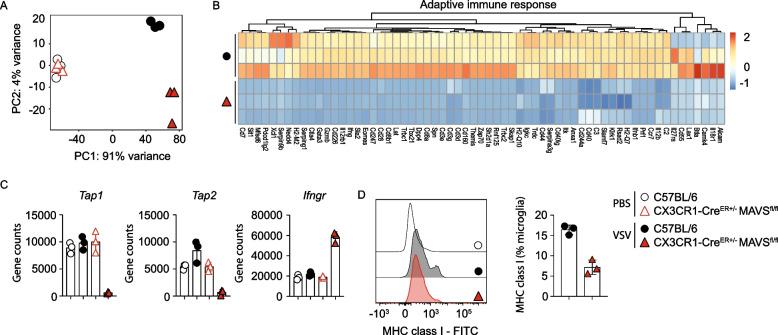
Neurotropic viruses like vesicular stomatitis virus (VSV) can infect the central nervous system (CNS) through the olfactory route. Following intranasal instillation, VSV moves along the axons of olfactory sensory neurons to the olfactory bulb. While within the olfactory bulb the spread of the virus is controlled by microglia activation and the recruitment of peripheral leukocytes, some of the underlying mechanisms remain unknown. To investigate these mechanisms, we used mice with conditional deletions of the mitochondrial antiviral-signaling protein (MAVS), an adaptor for RIG-I-like receptor (RLR) signaling. By selectively deleting MAVS in neurons, astrocytes, or long-lived myeloid cells, we discovered that RLR signaling specifically within brain-resident myeloid cells is crucial for protection against the virus. Infected mice with a MAVS deletion in these myeloid cells showed normal myeloid cell and leukocyte infiltration into the brain. However, the P2RY12 microglia showed aberrant expression of genes involved in antigen cross-presentation. Furthermore, flow cytometry experiments revealed diminished MHC class I expression on MAVS deficient microglia. Moreover, CNS infiltrating CD8 T cells had dysfunctional transcriptional profiles. Therefore, our findings indicate that during viral CNS infection, MAVS signaling in brain-resident myeloid cells, presumably microglia, is essential for antigen cross-presentation and the relicensing of protective, infiltrating CD8 T cells.
像水疱性口炎病毒(VSV)这样的嗜神经病毒可以通过嗅觉途径感染中枢神经系统(CNS)。经鼻内滴注后,VSV沿着嗅觉感觉神经元的轴突移动到嗅球。虽然在嗅球内病毒的传播受到小胶质细胞激活和外周白细胞募集的控制,但一些潜在机制仍然未知。为了研究这些机制,我们使用了有条件缺失线粒体抗病毒信号蛋白(MAVS)的小鼠,MAVS是视黄酸诱导基因I样受体(RLR)信号通路的接头蛋白。通过选择性地在神经元、星形胶质细胞或长寿髓样细胞中删除MAVS,我们发现特别是脑内驻留髓样细胞内的RLR信号对于抵抗病毒至关重要。在这些髓样细胞中缺失MAVS的感染小鼠,其髓样细胞和白细胞向脑内的浸润显示正常。然而,P2RY12小胶质细胞显示出参与抗原交叉呈递的基因表达异常。此外,流式细胞术实验显示MAVS缺陷的小胶质细胞上MHC I类分子的表达减少。而且,浸润到CNS的CD8 T细胞具有功能失调的转录谱。因此,我们的研究结果表明,在病毒性CNS感染期间,脑内驻留髓样细胞(可能是小胶质细胞)中的MAVS信号对于抗原交叉呈递和保护性浸润CD8 T细胞的重新激活至关重要。


 Zotero 插件