
通过犬尿氨酸类似物优化解耦行为域:对精神分裂症和帕金森病治疗的启示
Decoupling Behavioral Domains via Kynurenic Acid Analog Optimization: Implications for Schizophrenia and Parkinson's Disease Therapeutics.
作者信息
Martos Diána, Lőrinczi Bálint, Szatmári István, Vécsei László, Tanaka Masaru
机构信息
HUN-REN-SZTE Neuroscience Research Group, Hungarian Research Network, University of Szeged Danube Neuroscience Research Laboratory, Tisza Lajos krt. 113, H-6725 Szeged, Hungary.
Institute of Pharmaceutical Chemistry and HUN-REN-SZTE Stereochemistry Research Group, University of Szeged, Eötvös u. 6, H-6720 Szeged, Hungary.
出版信息
Cells. 2025 Jun 25;14(13):973. doi: 10.3390/cells14130973.
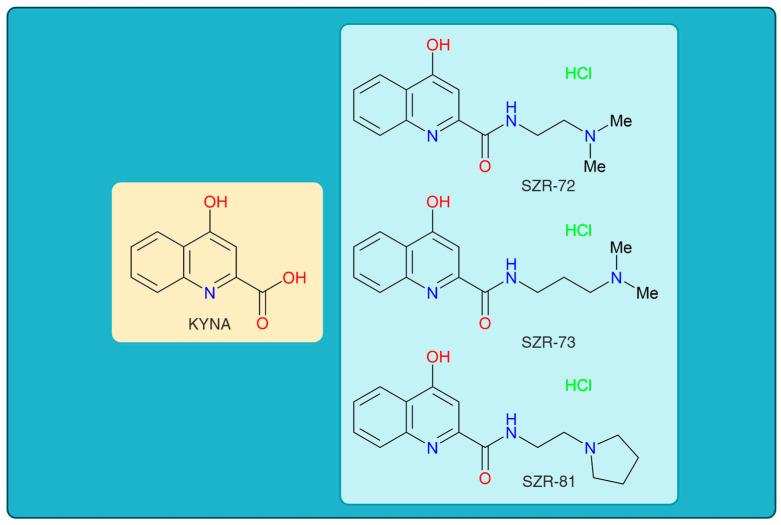
Kynurenic acid (KYNA), a putative neuroprotective agent, modulates glutamatergic pathways in schizophrenia and Parkinson's disease but is limited by acute motor activity impairments (e.g., ataxia). Research leveraging animal disease models explores its structure-activity relationship to enhance therapeutic efficacy while mitigating adverse effects, addressing global neuropsychiatric disorders affecting over 1 billion people. Structural analogs of KYNA (SZR-72, SZR-73, and SZR-81) were designed to uncouple therapeutic benefits from motor toxicity; yet, systematic comparisons of their acute behavioral profiles remain unexplored. Here, we assess the motor safety, time-dependent effects, and therapeutic potential of these analogs in mice. Using acute intracerebroventricular dosing, we evaluated motor coordination (rotarod), locomotor activity (open-field), and stereotypic behaviors. KYNA induced significant ataxia and stereotypic behaviors at 15 min, resolving by 45 min. In contrast, all analogs avoided acute motor deficits, with SZR-73 maintaining baseline rotarod performance and eliciting a delayed decrease in ambulation and inquisitiveness in open-field assays. These findings demonstrate that the structural optimization of KYNA successfully mitigates motor toxicity while retaining neuromodulatory activity. Here, we show that SZR-73 emerges as a lead candidate, combining transient therapeutic effects with preserved motor coordination. This study advances the development of safer neuroactive compounds, bridging a critical gap between preclinical innovation and clinical translation. Future work must validate chronic efficacy, disease relevance, and mechanistic targets to harness the full potential of KYNA analogs in treating complex neuropsychiatric disorders.
犬尿喹啉酸(KYNA)是一种假定的神经保护剂,可调节精神分裂症和帕金森病中的谷氨酸能通路,但受急性运动活动障碍(如共济失调)的限制。利用动物疾病模型的研究探索其构效关系,以提高治疗效果同时减轻不良反应,解决影响超过10亿人的全球神经精神疾病。KYNA的结构类似物(SZR - 72、SZR - 73和SZR - 81)旨在将治疗益处与运动毒性分离;然而,它们急性行为特征的系统比较仍未得到探索。在此,我们评估这些类似物在小鼠中的运动安全性、时间依赖性效应和治疗潜力。通过急性脑室内给药,我们评估了运动协调性(转棒试验)、运动活动(旷场试验)和刻板行为。KYNA在15分钟时诱导显著的共济失调和刻板行为,45分钟时恢复。相比之下,所有类似物均避免了急性运动缺陷,其中SZR - 73维持了基线转棒试验表现,并在旷场试验中引起行走和好奇心的延迟下降。这些发现表明,KYNA的结构优化成功减轻了运动毒性,同时保留了神经调节活性。在此,我们表明SZR - 73成为主要候选物,兼具短暂治疗效果和保留的运动协调性。本研究推动了更安全的神经活性化合物的开发,弥合了临床前创新与临床转化之间的关键差距。未来的工作必须验证慢性疗效、疾病相关性和作用机制靶点,以充分发挥KYNA类似物在治疗复杂神经精神疾病中的潜力。



 Zotero 插件