
水分亏缺胁迫对作物的影响:生长与产量、生理生化响应
Impact of Water Deficit Stress on Crops: Growth and Yield, Physiological and Biochemical Responses.
作者信息
Mohan Vijaya R, MacDonald Mason T, Abbey Lord
机构信息
Department of Plant, Food, and Environmental Sciences, Faculty of Agriculture, Dalhousie University, Bible Hill, NS B2N 5E3, Canada.
出版信息
Plants (Basel). 2025 Jun 24;14(13):1942. doi: 10.3390/plants14131942.
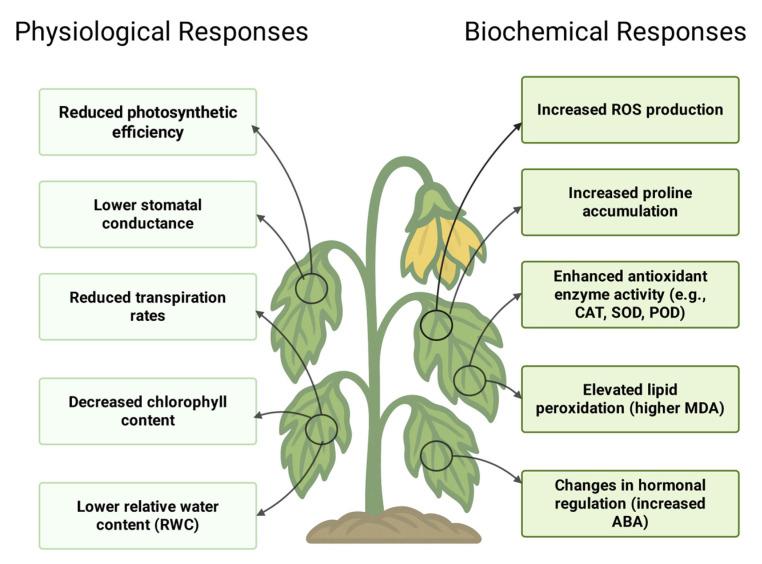
Drought including both meteorological drought and water deficiency stress conditions is a major constraint on global agricultural productivity, particularly affecting species, which are vital oilseed and vegetable crops. As climate change intensifies, understanding plant responses to drought is crucial for improving drought resilience. Drought stress impacts crops at multiple levels, reducing germination rates, impairing physiological functions such as photosynthesis and water-use efficiency, and triggering oxidative stress due to the accumulation of reactive oxygen species. To counteract these effects, plants employ various adaptive mechanisms, including osmotic adjustment, antioxidant defense activation, and hormonal regulation. Recent research has explored molecular and physiological pathways involved in drought tolerance, revealing key physiological changes and biochemical markers that could be targeted for crop improvement. This review summarizes the latest findings on the physiological, biochemical, and molecular responses of crops to drought stress, with an emphasis on adaptive mechanisms and potential drought mitigation strategies. Additionally, future research directions are proposed, focusing on integrating molecular and agronomic approaches to enhance drought resilience in species.
干旱,包括气象干旱和水分亏缺胁迫条件,是全球农业生产力的主要制约因素,尤其影响着作为重要油料作物和蔬菜作物的物种。随着气候变化加剧,了解植物对干旱的反应对于提高抗旱能力至关重要。干旱胁迫在多个层面影响作物,降低发芽率,损害光合作用和水分利用效率等生理功能,并因活性氧的积累引发氧化应激。为了抵消这些影响,植物采用各种适应性机制,包括渗透调节、抗氧化防御激活和激素调节。最近的研究探索了参与耐旱性的分子和生理途径,揭示了可用于作物改良的关键生理变化和生化标记。本综述总结了作物对干旱胁迫的生理、生化和分子反应的最新发现,重点是适应性机制和潜在的干旱缓解策略。此外,还提出了未来的研究方向,重点是整合分子和农艺方法以增强物种的抗旱能力。

 Zotero 插件