
昼夜节律紊乱与阿尔茨海默病的关联及治疗干预
Linkage of circadian rhythm disruptions with Alzheimer's disease and therapeutic interventions.
作者信息
Madamanchi Kishore, Zhang Jianhua, Melkani Girish C
机构信息
Department of Pathology, Division of Molecular and Cellular Pathology, Heersink School of Medicine, The University of Alabama at Birmingham, AL 35294, USA.
UAB Nathan Shock Center, Birmingham, AL 35294, USA.
出版信息
Acta Pharm Sin B. 2025 Jun;15(6):2945-2965. doi: 10.1016/j.apsb.2025.04.011. Epub 2025 Apr 15.
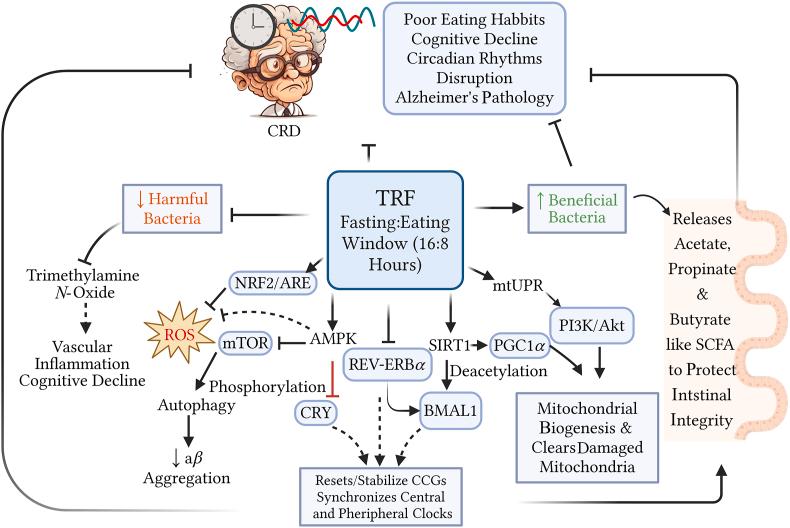
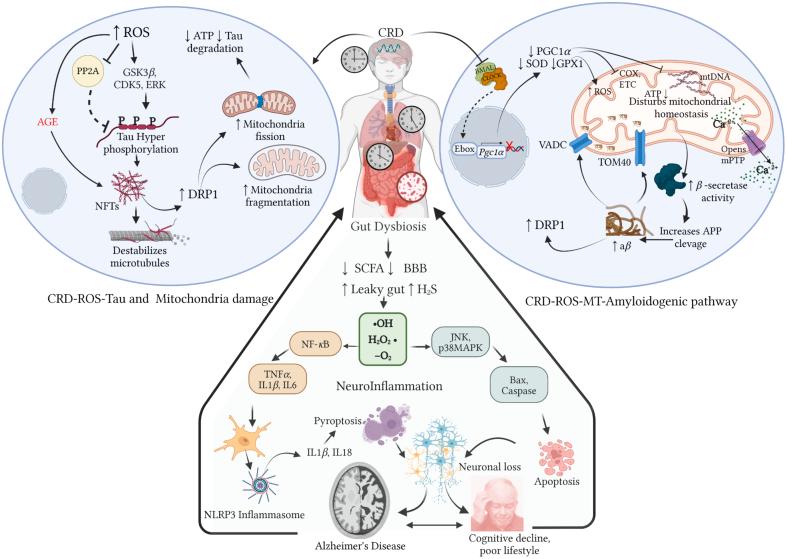
Alzheimer's disease (AD) is a progressive neurodegenerative disorder characterized by cognitive decline and pathological brain changes. While aging is the primary risk factor, circadian rhythm disruption (CRD) is increasingly recognized as a central driver of AD pathology. CRD exacerbates oxidative stress, systemic inflammation, and gut microbiome dysbiosis, impairing sleep-wake cycles, disrupting metabolic homeostasis, and promoting neuroinflammation, ultimately accelerating disease progression. Oxidative stress, a key factor in neuronal damage, is both a cause and consequence of circadian misalignment, while mitochondrial dysfunction further amplifies oxidative damage, impairing synaptic function and cognitive stability. Additionally, gut microbiome dysbiosis contributes to neuroinflammatory processes, worsening neurodegeneration. Given these complex interactions, this review aims to elucidate the role of CRD in AD pathology and explore potential therapeutic interventions targeting circadian dysfunction. Specifically, it examines the efficacy of time-restricted feeding (TRF), a dietary strategy that aligns food intake with circadian rhythms. TRF has shown promise in restoring circadian function, reducing oxidative stress, improving mitochondrial health, and promoting gut microbiome diversity. By addressing CRD, TRF may offer a novel approach to mitigating AD pathologies. This review also identifies current research gaps and future directions for developing circadian-based interventions in AD prevention and treatment.
阿尔茨海默病(AD)是一种进行性神经退行性疾病,其特征为认知能力下降和脑部病理变化。虽然衰老为主要风险因素,但昼夜节律紊乱(CRD)日益被视为AD病理的核心驱动因素。CRD会加剧氧化应激、全身炎症和肠道微生物群失调,损害睡眠-觉醒周期,扰乱代谢稳态,并促进神经炎症,最终加速疾病进展。氧化应激作为神经元损伤的关键因素,既是昼夜节律失调的原因,也是其结果,而线粒体功能障碍会进一步加剧氧化损伤,损害突触功能和认知稳定性。此外,肠道微生物群失调会导致神经炎症过程,使神经退行性变恶化。鉴于这些复杂的相互作用,本综述旨在阐明CRD在AD病理中的作用,并探索针对昼夜节律功能障碍的潜在治疗干预措施。具体而言,它研究了限时进食(TRF)的功效,这是一种使食物摄入与昼夜节律同步的饮食策略。TRF在恢复昼夜节律功能、降低氧化应激、改善线粒体健康以及促进肠道微生物群多样性方面已显示出前景。通过解决CRD问题,TRF可能为减轻AD病理提供一种新方法。本综述还确定了当前的研究空白以及在AD预防和治疗中开发基于昼夜节律的干预措施的未来方向。


 Zotero 插件