
肠道微生物群调控阿尔茨海默病中的神经炎症:阐明关键因素和潜在机制。
The Gut Microbiota Modulates Neuroinflammation in Alzheimer's Disease: Elucidating Crucial Factors and Mechanistic Underpinnings.
机构信息
Harbin Institute of Physical Education, Harbin, Heilongjiang Province, China.
Heilongjiang University of Traditional Chinese Medicine, Harbin, Heilongjiang Province, China.
出版信息
CNS Neurosci Ther. 2024 Oct;30(10):e70091. doi: 10.1111/cns.70091.
BACKGROUND AND PURPOSE
Alzheimer's disease (AD) is characterized by progressive cognitive decline and neuronal loss, commonly linked to amyloid-β plaques, neurofibrillary tangles, and neuroinflammation. Recent research highlights the gut microbiota as a key player in modulating neuroinflammation, a critical pathological feature of AD. Understanding the role of the gut microbiota in this process is essential for uncovering new therapeutic avenues and gaining deeper insights into AD pathogenesis.
METHODS
This review provides a comprehensive analysis of how gut microbiota influences neuroinflammation and glial cell function in AD. A systematic literature search was conducted, covering studies from 2014 to 2024, including reviews, clinical trials, and animal studies. Keywords such as "gut microbiota," "Alzheimer's disease," "neuroinflammation," and "blood-brain barrier" were used.
RESULTS
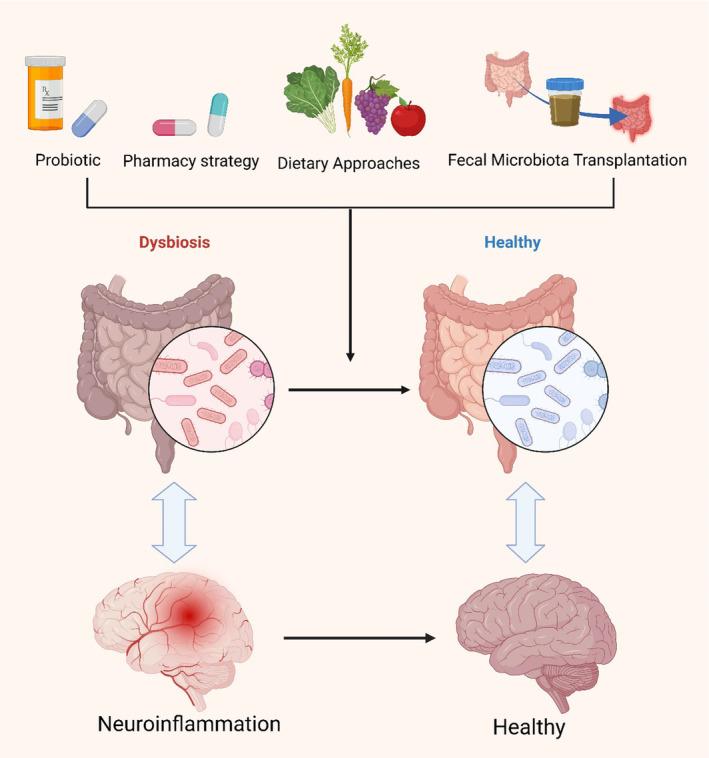
Dysbiosis, or the imbalance in gut microbiota composition, has been implicated in the modulation of key AD-related mechanisms, including neuroinflammation, blood-brain barrier integrity, and neurotransmitter regulation. These disruptions may accelerate the onset and progression of AD. Additionally, therapeutic strategies targeting gut microbiota, such as probiotics, prebiotics, and fecal microbiota transplantation, show promise in modulating AD pathology.
CONCLUSIONS
The gut microbiota is a pivotal factor in AD pathogenesis, influencing neuroinflammation and disease progression. Understanding the role of gut microbiota in AD opens avenues for innovative diagnostic, preventive, and therapeutic strategies.
背景与目的
阿尔茨海默病(AD)的特征是进行性认知能力下降和神经元丧失,通常与β淀粉样蛋白斑块、神经原纤维缠结和神经炎症有关。最近的研究强调了肠道微生物群作为调节神经炎症的关键因素,神经炎症是 AD 的关键病理特征。了解肠道微生物群在这一过程中的作用对于揭示新的治疗途径和深入了解 AD 的发病机制至关重要。
方法
本综述全面分析了肠道微生物群如何影响 AD 中的神经炎症和神经胶质细胞功能。进行了系统的文献检索,涵盖了 2014 年至 2024 年的研究,包括综述、临床试验和动物研究。使用了“肠道微生物群”、“阿尔茨海默病”、“神经炎症”和“血脑屏障”等关键词。
结果
肠道微生物群失调或组成失衡与关键的 AD 相关机制的调节有关,包括神经炎症、血脑屏障完整性和神经递质调节。这些破坏可能加速 AD 的发病和进展。此外,靶向肠道微生物群的治疗策略,如益生菌、益生元和粪便微生物群移植,在调节 AD 病理方面显示出了希望。
结论
肠道微生物群是 AD 发病机制中的关键因素,影响神经炎症和疾病进展。了解肠道微生物群在 AD 中的作用为创新的诊断、预防和治疗策略开辟了途径。


 Zotero 插件