
聚多巴胺纳米颗粒集成的智能多糖水凝胶:用于糖尿病伤口微环境调节的光热触发CO释放
Polydopamine Nanoparticle-Integrated Smart Polysaccharide Hydrogel: Photothermal-Triggered CO Release for Diabetic Wound Microenvironment Modulation.
作者信息
Wang Xiao, Ma Zihao, He Yujie, Sun Ying, Peng Qian, Zhao Ming, Huang Xiaojing, Lei Lei, Gu Huan, Gou Kaijun, Zeng Rui
机构信息
College of Pharmacy and Food, Southwest Minzu University, Chengdu & Key Laboratory of Research and Application of Ethnic Medicine Processing and Preparation on the Qinghai Tibet Plateau, Chengdu, 610225, People's Republic of China.
Sichuan Sports College, Chengdu, 610043, People's Republic of China.
出版信息
Int J Nanomedicine. 2025 Jul 8;20:8873-8890. doi: 10.2147/IJN.S525172. eCollection 2025.
PURPOSE
Bacterial infection, oxidative stress, vascular damage, and nutrient deficiencies significantly hinder the repair of diabetic skin wounds. Conventional wound dressings offer limited protection and fail to effectively promote the healing of diabetic wounds. To address these challenges, we developed a photothermal-responsive polysaccharide hydrogel capable of releasing carbon dioxide (CO@PDA Hydrogel).
METHODS
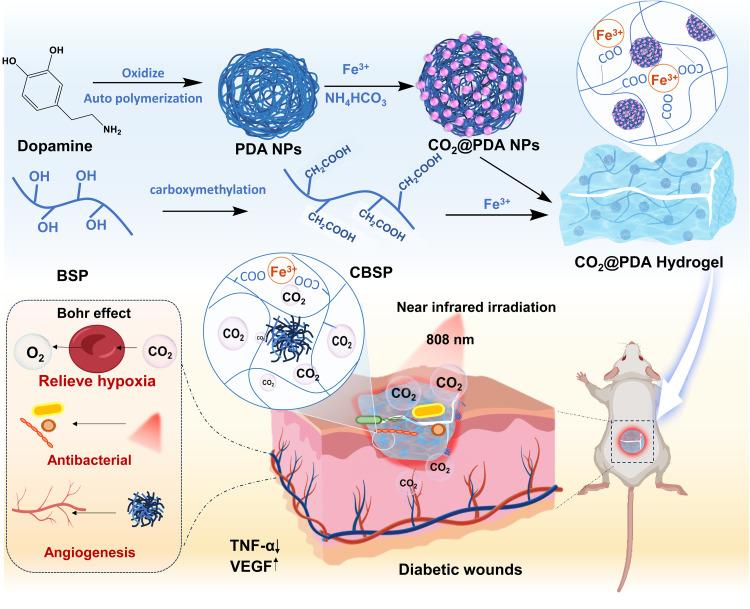
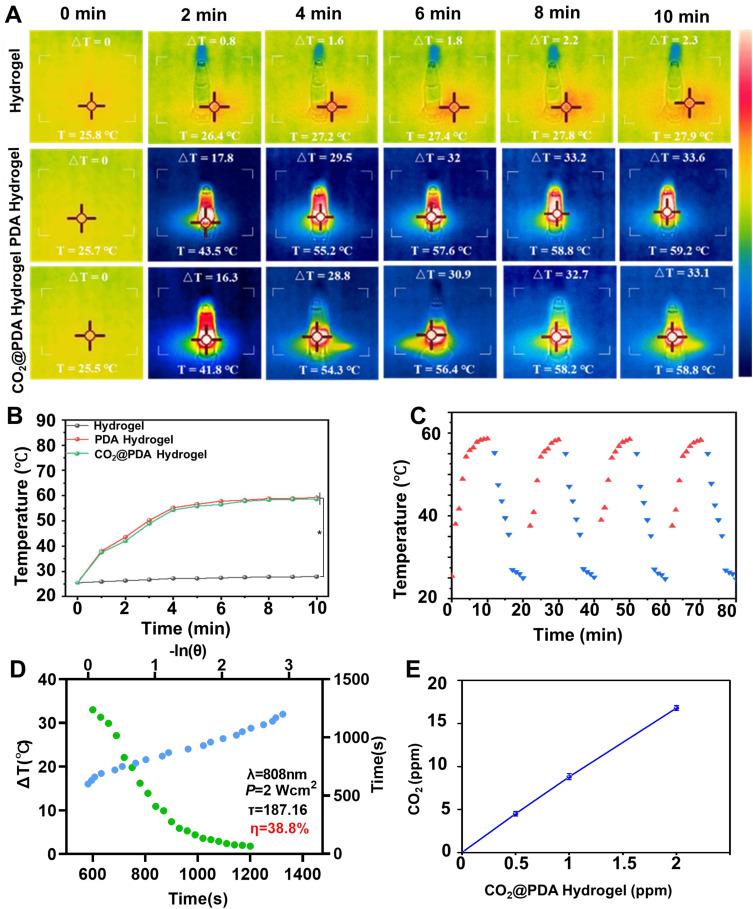
This hydrogel utilizes carboxymethylated polysaccharide as the primary matrix, cross-linked through metal coordination bonds, and incorporates bicarbonate-containing polydopamine nanoparticles (CO@PDA NPs) with photothermal conversion properties to generate CO. The structure and morphology of CO@PDA NPs were characterized by DLS, SEM, FTIR, and XRD, and the hydrogel properties of CO@PDA Hydrogel were characterized by SEM, rheological properties, and FTIR. The photothermal properties of the CO@PDA Hydrogel were studied by measuring the temperature change and CO release after irradiation with an NIR laser (808nm). The improvement effect of CO@PDA Hydrogel on the diabetes wound microenvironment was comprehensively evaluated by promoting L929 cell proliferation, inhibiting bacterial growth ( and ), and treating diabetes wound infection in rat models.
RESULTS
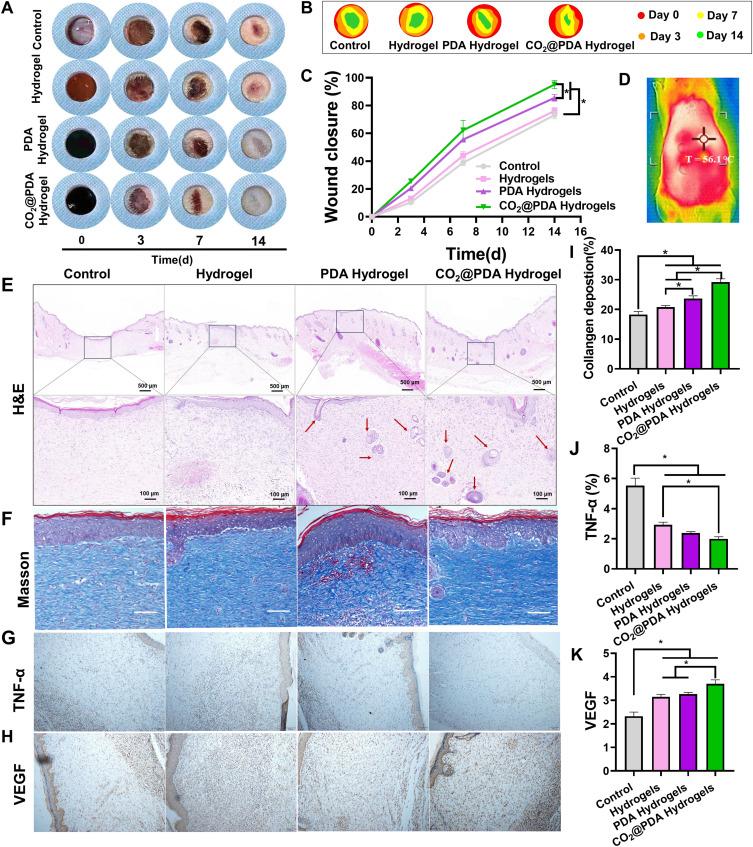
Under 808 nm near-infrared laser irradiation, the embedded CO@PDA NPs convert light into heat, triggering the decomposition of HCO and releasing a substantial amount of CO locally at the diabetic wound site. The released CO responds to the Bohr effect, alleviating hypoxia and promoting angiogenesis. Simultaneously, the polysaccharide in the hydrogel exerts antioxidant and anti-inflammatory effects, while the cross-linking agent Fe and the photothermal properties of CO@PDA NPs provide robust antibacterial activity.
CONCLUSION
The self-assembled cross-linked carboxymethyl polysaccharide Hydrogel with CO@PDA NPs prepared in this study has a good photothermal conversion effect. It improves the microenvironment of diabetes wounds by improving hypoxia, antibacterial, antioxidant, and other effects, providing a good multi-functional alternative material for the treatment of refractory diabetes wounds.
目的
细菌感染、氧化应激、血管损伤和营养缺乏显著阻碍糖尿病皮肤伤口的修复。传统伤口敷料提供的保护有限,无法有效促进糖尿病伤口的愈合。为应对这些挑战,我们开发了一种能够释放二氧化碳的光热响应性多糖水凝胶(CO@PDA水凝胶)。
方法
这种水凝胶以羧甲基化多糖为主要基质,通过金属配位键交联,并掺入具有光热转换特性的含碳酸氢盐聚多巴胺纳米颗粒(CO@PDA NPs)以产生CO。通过动态光散射(DLS)、扫描电子显微镜(SEM)、傅里叶变换红外光谱(FTIR)和X射线衍射(XRD)对CO@PDA NPs的结构和形态进行表征,通过SEM、流变学性质和FTIR对CO@PDA水凝胶的水凝胶性质进行表征。通过测量808nm近红外激光照射后的温度变化和CO释放来研究CO@PDA水凝胶的光热性质。通过促进L929细胞增殖、抑制细菌生长(和)以及治疗大鼠模型中的糖尿病伤口感染,全面评估CO@PDA水凝胶对糖尿病伤口微环境的改善作用。
结果
在808nm近红外激光照射下,嵌入的CO@PDA NPs将光转化为热,触发HCO的分解并在糖尿病伤口部位局部释放大量CO。释放的CO响应玻尔效应,缓解缺氧并促进血管生成。同时,水凝胶中的多糖发挥抗氧化和抗炎作用,而交联剂Fe和CO@PDA NPs的光热性质提供强大的抗菌活性。
结论
本研究制备的具有CO@PDA NPs的自组装交联羧甲基多糖水凝胶具有良好的光热转换效果。它通过改善缺氧、抗菌、抗氧化等作用改善糖尿病伤口的微环境,为治疗难治性糖尿病伤口提供了一种良好的多功能替代材料。





 Zotero 插件