
从获取到储备:从世界卫生组织的AWaRe抗菌谱角度看中心静脉导管相关血流感染病原体中的抗菌药物耐药性
From access to reserve: antimicrobial resistance among etiological agents of central line-associated bloodstream infections in the view of WHO's AWaRe antimicrobial spectrum.
作者信息
Anand Gargee, Lahariya Rijhul, Priyadarshi Ketan, Sarfraz Asim
机构信息
All India Institute of Medical Sciences, Patna, Bihar, India.
出版信息
GMS Hyg Infect Control. 2025 Jun 17;20:Doc30. doi: 10.3205/dgkh000559. eCollection 2025.
AIM
Central line-associated bloodstream infections (CLABSI) remain a major contributor to morbidity and mortality in critically ill patients. The rise of antimicrobial resistance (AMR) exacerbates treatment challenges, making it crucial to examine pathogen resistance patterns. This study analyses CLABSI-associated pathogens' antimicrobial susceptibility using the WHO's AWaRe antimicrobial framework, providing insights to guide targeted treatment and strengthen infection control strategies.
METHODS
This observational study (2021-2024) assessed data from adult and pediatric ICUs to evaluate CLABSI incidence, microbial etiology, and antimicrobial susceptibility trends. We categorized antimicrobials based on the WHO's AWaRe classification system, analysing their susceptibility to Access, Watch, and Reserve antimicrobials. Statistical analysis was performed using SPSS version 22.
RESULTS
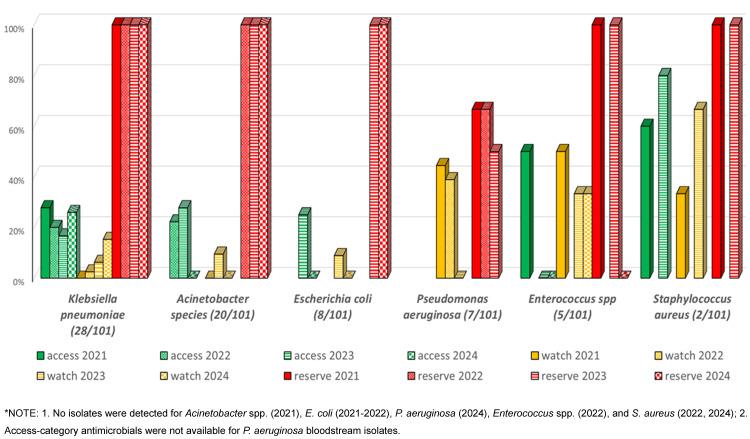
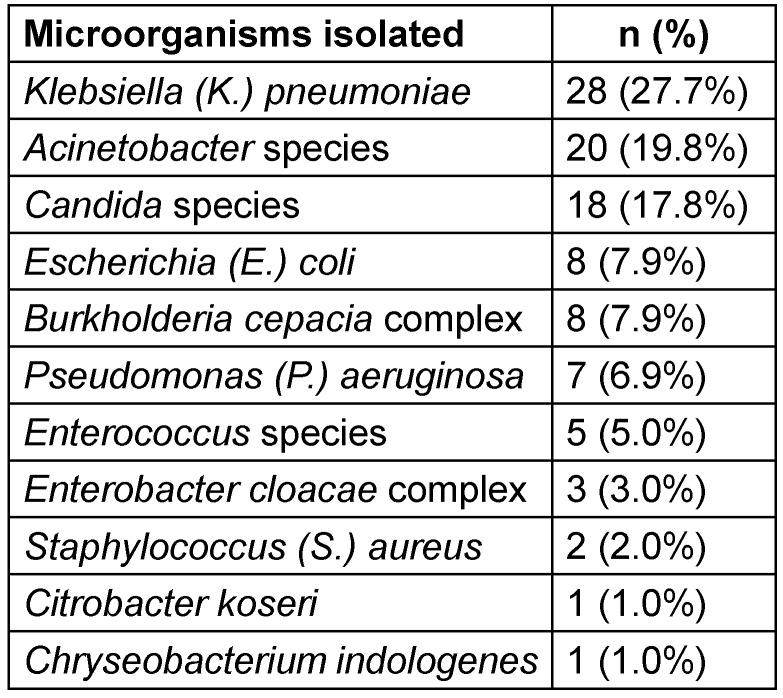
Among 5,398 patient records, 101 cases of CLABSI were confirmed. The predominant pathogens were (27.7%), spp. (19.8%), and spp. (17.8%). A worrying decline in susceptibility to Access- and Watch-category antimicrobials was observed in key pathogens. demonstrated a steep decline in susceptibility to Access-category agents, from 27.8% in 2021 to 16.7% in 2023. Conversely, Reserve-category antimicrobials maintained 100% efficacy across the study period. spp. exhibited resistance to both Access- and Watch-category antimicrobials by 2024. showed a drastic drop in Watch-category susceptibility, from 44.5% in 2021 to 0% in 2023, while Reserve-agents remained effective. These results underline the growing reliance on Reserve antimicrobials and the diminishing effectiveness of first-line agents. Furthermore, a fluctuation in CLABSI rates was also observed, with a significant reduction in infection rates in 2024 after the implementation of enhanced infection control practices.
CONCLUSION
This study highlights the escalating resistance patterns of CLABSI pathogens, with a consternating decline in Access- and Watch-category antimicrobial efficacy. The AWaRe framework proves invaluable in identifying critical resistance trends, demonstrating the need for targeted antimicrobial stewardship. Prioritizing Access antimicrobials as first-line therapies, guided by local resistance data, can preserve the effectiveness of Reserve agents. A strategic focus on the AWaRe classification, coupled with rigorous infection control and stewardship programs, is essential to combat the rising AMR threat and optimize patient outcomes in critical care settings.
目的
中心静脉导管相关血流感染(CLABSI)仍然是重症患者发病和死亡的主要原因。抗菌药物耐药性(AMR)的上升加剧了治疗挑战,因此检查病原体耐药模式至关重要。本研究使用世界卫生组织的AWaRe抗菌框架分析CLABSI相关病原体的抗菌药物敏感性,为指导靶向治疗和加强感染控制策略提供见解。
方法
这项观察性研究(2021 - 2024年)评估了成人和儿科重症监护病房的数据,以评估CLABSI的发病率、微生物病因和抗菌药物敏感性趋势。我们根据世界卫生组织的AWaRe分类系统对抗菌药物进行分类,分析它们对准入类、观察类和储备类抗菌药物的敏感性。使用SPSS 22版进行统计分析。
结果
在5398份患者记录中,确诊101例CLABSI。主要病原体为(27.7%)、 spp.(19.8%)和 spp.(17.8%)。在关键病原体中,观察到对准入类和观察类抗菌药物的敏感性令人担忧地下降。对准入类药物的敏感性急剧下降,从202年的27.8%降至2023年的16.7%。相反,储备类抗菌药物在整个研究期间保持100%的疗效。到2024年, spp. 对准入类和观察类抗菌药物均表现出耐药性。观察类药物的敏感性急剧下降,从2021年的44.5%降至2023年的0%,而储备类药物仍然有效。这些结果强调了对储备类抗菌药物的依赖日益增加以及一线药物的有效性不断下降。此外,还观察到CLABSI发生率的波动,在实施强化感染控制措施后,2024年感染率显著降低。
结论
本研究突出了CLABSI病原体不断升级的耐药模式,准入类和观察类抗菌药物的疗效令人担忧地下降。AWaRe框架在识别关键耐药趋势方面被证明具有重要价值,表明需要有针对性的抗菌药物管理。根据当地耐药数据将准入类抗菌药物作为一线治疗药物优先使用,可以保留储备类药物的有效性。对AWaRe分类的战略关注,再加上严格的感染控制和管理计划,对于应对不断上升的AMR威胁和优化重症监护环境中的患者结局至关重要。



 Zotero 插件