
基于多种机器学习方法和在线计算器开发脓毒症相关性谵妄风险预测模型。
Development of a risk prediction model for sepsis-related delirium based on multiple machine learning approaches and an online calculator.
作者信息
Gao Lang, Wang Guang Dong, Yang Xing Yi, Tong Shi Jun, Wang Xu Jie, Chen Yun Ruo, Bai Jin Ying, Zhang Ya Xin
机构信息
Department of Critical Care Medicine, Clinical Medical College of Qinghai University, Xi ning, China.
Department of Respiratory and Critical Care Medicine, First Affiliated Hospital of Xi'an Jiaotong University, Xi'an, Shanxi, China.
出版信息
PLoS One. 2025 Jul 16;20(7):e0323831. doi: 10.1371/journal.pone.0323831. eCollection 2025.
BACKGROUND
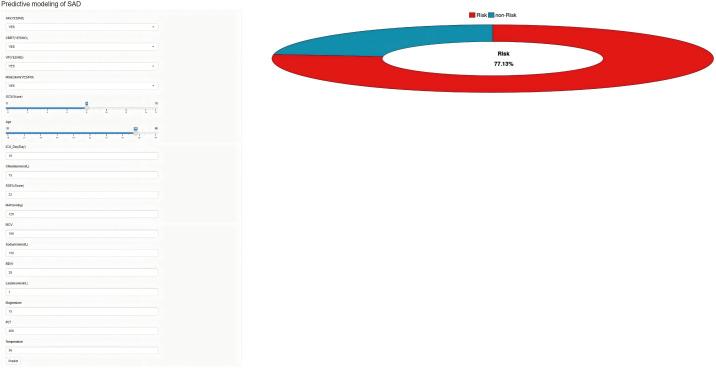
Sepsis-associated delirium (SAD) occurs due to disruptions in neurotransmission linked to inflammatory responses from infections. It poses significant challenges in clinical management and is associated with poor outcomes. Survivors often experience long-term cognitive and behavioral issues that impact their quality of life and place a burden on their families. This study aimed to develop and validate an interpretable machine learning model for early prediction of SAD in critically ill patients. Additionally, we constructed an online risk calculator to facilitate real-time clinical assessment.
METHODS
This study is a retrospective analysis utilizing data from 16,120 patients in the Medical Information Mart for Intensive Care IV database. To manage imbalanced data, we applied the Synthetic Minority Over-sampling Technique (SMOTE) method. Feature selection was conducted using Multivariate Logistic Regression, LASSO regression, and the Boruta algorithm. We developed predictive models using eight machine learning algorithms and selected the best one for validation. The SHapley Additive exPlanations (SHAP) method was used for visualization and interpretation, enhancing the clinical understanding of the model, alongside the creation of an online web calculator.
RESULTS
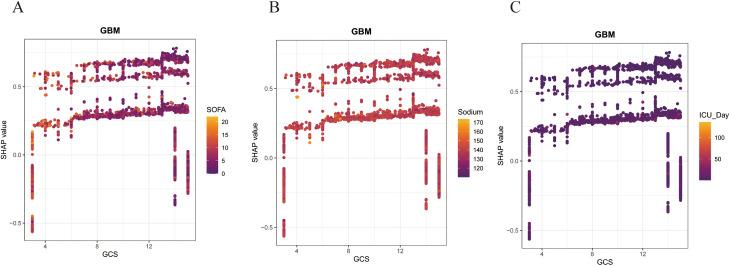
We combined three feature selection methods to identify 17 key features for our machine learning prediction model. The Gradient Boosting Machine (GBM) model demonstrated excellent calibration and strong predictive accuracy in the validation cohort. The SHAP feature importance ranking revealed five critical risk factors for predicting outcomes: Glasgow Coma Scale (GCS), ICU stay duration, chloride, sodium, and Sequential Organ Failure Assessment (SOFA). Based on this optimal model, we successfully developed an online web calculator.
CONCLUSION
We developed and validated a machine learning model capable of accurately predicting SAD with high clinical applicability. The integration of interpretable machine learning and an online calculator offers a practical tool to support early identification and timely management of SAD in critically ill patients.
背景
脓毒症相关性谵妄(SAD)是由于与感染引起的炎症反应相关的神经传递中断而发生的。它在临床管理中带来了重大挑战,并与不良预后相关。幸存者常常会经历长期的认知和行为问题,这会影响他们的生活质量,并给其家庭带来负担。本研究旨在开发并验证一种可解释的机器学习模型,用于早期预测重症患者的SAD。此外,我们构建了一个在线风险计算器,以促进实时临床评估。
方法
本研究是一项回顾性分析,利用重症监护医学信息数据库IV中16120例患者的数据。为了处理不平衡数据,我们应用了合成少数过采样技术(SMOTE)方法。使用多变量逻辑回归分析、套索回归和博鲁塔算法进行特征选择。我们使用八种机器学习算法开发了预测模型,并选择最佳模型进行验证。使用夏普利值附加解释(SHAP)方法进行可视化和解释,增强对该模型的临床理解,同时创建一个在线网络计算器。
结果
我们结合三种特征选择方法,为我们的机器学习预测模型识别出17个关键特征。梯度提升机(GBM)模型在验证队列中显示出良好的校准和强大的预测准确性。SHAP特征重要性排名揭示了预测结果的五个关键风险因素:格拉斯哥昏迷量表(GCS)、重症监护病房停留时间、氯离子、钠离子和序贯器官衰竭评估(SOFA)。基于这个最优模型,我们成功开发了一个在线网络计算器。
结论
我们开发并验证了一个能够准确预测SAD且具有高临床适用性的机器学习模型。可解释机器学习与在线计算器的结合提供了一个实用工具,以支持对重症患者SAD的早期识别和及时管理。


 Zotero 插件