
解释新冠病毒肺炎死亡率增长率:对以色列城市的实证分析。
Explaining the COVID19 mortality growth rate: an empirical analysis of Israeli cities.
作者信息
Arbel Yuval, Arbel Yifat, Kerner Amichai, Kerner Miryam
机构信息
Sir Harry Solomon School of Economics and Management, Western Galilee College, Acre, Israel.
Department of Mathematics, Bar Ilan University, Ramat Gan, Israel.
出版信息
Front Public Health. 2025 Jul 9;13:1548294. doi: 10.3389/fpubh.2025.1548294. eCollection 2025.
BACKGROUND
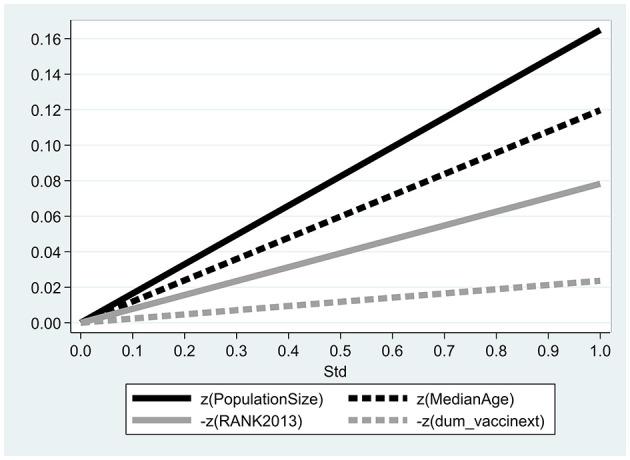
The severe acute respiratory syndrome coronavirus 2 (SARS-CoV-2) is an infectious virus, which has generated a global pandemic. Since December 20, 2020, Israel was one of the first countries to vaccinate its population. This study analyzes the weight of four covariates on a daily mortality growth rate from SARS-COV2 virus. These include population size, median age, a socio-economic ranking at a city level, a date variable and a dummy variable that equals 1 for post-vaccination and 0 for pre-vaccination era.
METHOD
Regression analysis, where each variable is converted to the standard normal distribution function. This methodology permits the estimation of variations in daily mortality growth rates, where all the covariates are given in comparable units of measurement (one standard deviation). Consequently, the coefficients of this regression have to be measured as absolute value weights.
RESULTS
Findings suggest a rise in projected mortality growth rate with population-size and median age, and a drop with socio-economic ranking and vaccination availability. Of the four investigated covariates, population size and median age of the city have the highest weight, whereas socio-economic ranking and vaccination availability have the lowest weight.
CONCLUSIONS
In an effort to reduce the mortality of severe coronavirus disease (COVID19) patients, greater priority should be given to larger cities with a relatively older population profile. In particular, policies should strive for better coordination at a municipal level between health and municipal and welfare services, particularly in large cities.
背景
严重急性呼吸综合征冠状病毒2(SARS-CoV-2)是一种传染性病毒,已引发全球大流行。自2020年12月20日起,以色列是最早为其民众接种疫苗的国家之一。本研究分析了四个协变量对SARS-CoV-2病毒每日死亡率增长率的影响。这些协变量包括人口规模、年龄中位数、城市层面的社会经济排名、一个日期变量以及一个虚拟变量,接种疫苗后该变量等于1,接种疫苗前时代等于0。
方法
进行回归分析,将每个变量转换为标准正态分布函数。这种方法允许估计每日死亡率增长率的变化,其中所有协变量都以可比的测量单位(一个标准差)给出。因此,该回归的系数必须以绝对值权重来衡量。
结果
研究结果表明,预计死亡率增长率随人口规模和年龄中位数上升,随社会经济排名和疫苗接种可及性下降。在四个调查的协变量中,城市的人口规模和年龄中位数权重最高,而社会经济排名和疫苗接种可及性权重最低。
结论
为降低重症冠状病毒病(COVID-19)患者的死亡率,应更加优先关注人口相对老龄化的大城市。特别是,政策应努力在市级层面更好地协调卫生与市政及福利服务,尤其是在大城市。
 Zotero 插件