
一组新型血浆蛋白能以高精度对非裔美国个体的阿尔茨海默病性痴呆进行分类。
Novel set of plasma proteins classifies Alzheimer's dementia in African American individuals with high accuracy.
作者信息
Kuchenbecker Lindsey A, Thompson Kevin J, Hurst Cheyenne D, Huang Yen-Ning, Heckman Michael G, Reddy Joseph S, Nguyen Thuy, Casellas Heidi L, Sotelo Katie D, Reddy Delila J, Opdenbosch Bianca M, Tsai Wei, Saykin Andrew J, Lucas John A, Willis Floyd B, Day Gregory S, Ramanan Vijay K, Graff-Radford Neill R, Ertekin-Taner Nilufer, Nho Kwangsik, Kalari Krishna R, Carrasquillo Minerva M
机构信息
Department of Neuroscience, Mayo Clinic Jacksonville, Jacksonville, Florida, USA.
Center for Clinical and Translational Science, Mayo Clinic, Rochester, Minnesota, USA.
出版信息
Alzheimers Dement. 2025 Jul;21(7):e70505. doi: 10.1002/alz.70505.
INTRODUCTION
African American (AA) individuals are underrepresented in biomarker studies for Alzheimer's disease (AD). Biomarkers that reflect the heterogeneity of AD and achieve the greatest accuracy across populations are sorely needed.
METHODS
Untargeted proteome measurements were obtained using the SomaScan 7k platform to identify novel plasma biomarkers for AD in AA participants with clinical diagnoses of AD dementia (n = 181) and cognitively unimpaired (CU, n = 142). Machine learning was used to identify a set of plasma proteins that yielded the best classification accuracy.
RESULTS
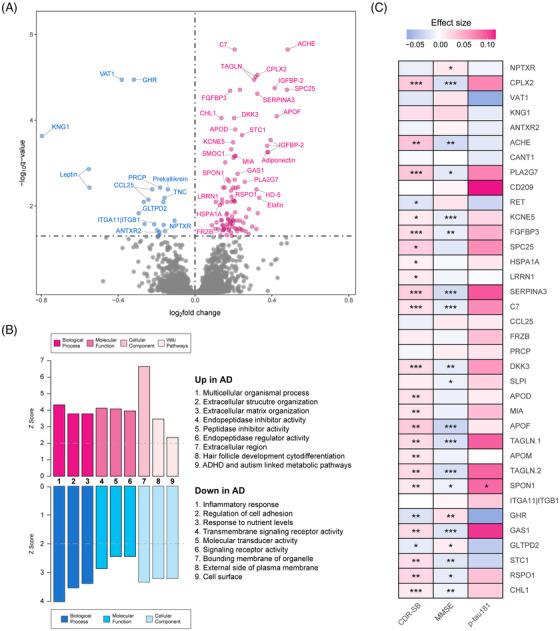
A set of 36 proteins achieved an area under the curve (AUC) of 0.94 to classify AD dementia versus CU, a 16% improvement over age, sex, and apolipoprotein E (APOE). This finding was replicated in multiple plasma and brain datasets (AUCs 0.73-0.97). Our findings underscore the importance of matrisome and cerebrovascular dysfunction in AD pathophysiology.
DISCUSSION
This study demonstrates the potential of biomarker discovery through untargeted plasma proteomics and machine learning.
HIGHLIGHTS
Conducted large-scale plasma proteomics in Alzheimer's disease (AD) versus cognitively unimpaired controls. Machine learning biomarker discovery was replicated in an independent cohort. Novel set of proteins distinguishes AD versus controls with high accuracy (area under the curve [AUC] = 0.94). Achieved reproducibility across multiple replication cohorts (AUC = 0.73-0.97). Network analyses implicates matrisome biology and cerebrovascular dysfunction.
引言
非裔美国人(AA)在阿尔茨海默病(AD)生物标志物研究中的代表性不足。迫切需要能够反映AD异质性并在不同人群中实现最高准确性的生物标志物。
方法
使用SomaScan 7k平台进行非靶向蛋白质组测量,以在临床诊断为AD痴呆(n = 181)和认知未受损(CU,n = 142)的AA参与者中识别AD的新型血浆生物标志物。使用机器学习来识别一组产生最佳分类准确性的血浆蛋白。
结果
一组36种蛋白质在区分AD痴呆与CU时的曲线下面积(AUC)达到0.94,比年龄、性别和载脂蛋白E(APOE)提高了16%。这一发现已在多个血浆和脑数据集中得到验证(AUC为0.73 - 0.97)。我们的发现强调了基质组和脑血管功能障碍在AD病理生理学中的重要性。
讨论
本研究证明了通过非靶向血浆蛋白质组学和机器学习发现生物标志物的潜力。
要点
在阿尔茨海默病(AD)与认知未受损对照中进行大规模血浆蛋白质组学研究。机器学习生物标志物发现在独立队列中得到验证。一组新型蛋白质能够高精度区分AD与对照(曲线下面积[AUC] = 0.94)。在多个重复队列中实现了可重复性(AUC = 0.73 - 0.97)。网络分析表明与基质组生物学和脑血管功能障碍有关。



 Zotero 插件