
时钟与大脑:昼夜节律和阿尔茨海默病
The Clock and the Brain: Circadian Rhythm and Alzheimer's Disease.
作者信息
Ghorbani Shirkouhi Samaneh, Karimi Ashkan, Khatami Seyed Sepehr, Asgari Gashtrodkhani Ashkan, Kamari Farzin, Blaabjerg Morten, Andalib Sasan
机构信息
Student Research Committee, School of Medicine, Shahroud University of Medical Sciences, Shahroud 36147-73943, Iran.
Department of Psychology, Centre for Vision Research, York University, Toronto, ON M3J 1P3, Canada.
出版信息
Curr Issues Mol Biol. 2025 Jul 15;47(7):547. doi: 10.3390/cimb47070547.
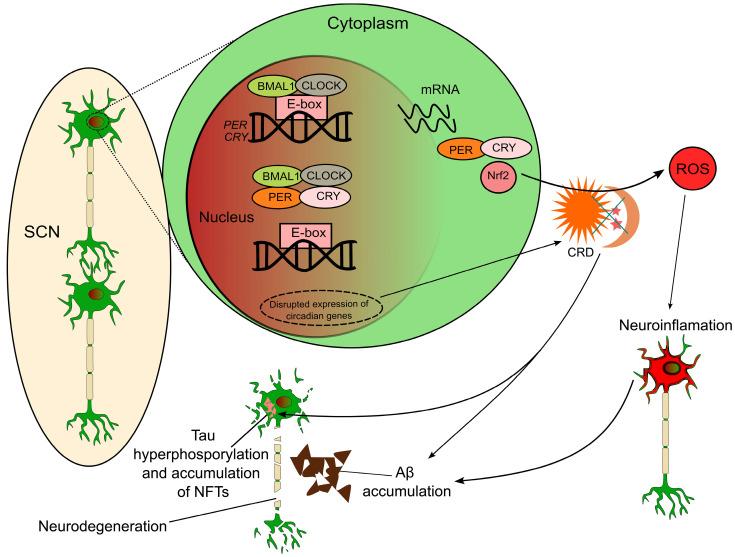
Alzheimer's Disease (AD) is the most common type of dementia. The circadian system, which is controlled by the master clock in the Suprachiasmatic Nucleus (SCN) of the hypothalamus, is crucial for various physiological processes. Studies have shown that changes in the circadian rhythms can deteriorate neurodegenerative diseases. Changes in the SCN are associated with cognitive decline in AD. The cognitive impairments in AD, especially memory dysfunctions, may be related to Circadian Rhythm Disturbances (CRDs). Moreover, rhythmic expression of clock genes is disrupted in AD patients. There is a circadian pattern of inflammatory processes in AD, and dysregulation of core clock genes promotes neuroinflammation. The present narrative review addresses the intricate link between CRDs and AD, revisiting the relevant cellular and molecular mechanisms. The association between CRDs and AD highlights the need for further investigation of the underlying mechanisms.
阿尔茨海默病(AD)是最常见的痴呆类型。昼夜节律系统由下丘脑视交叉上核(SCN)中的主时钟控制,对各种生理过程至关重要。研究表明,昼夜节律的变化会使神经退行性疾病恶化。SCN的变化与AD患者的认知衰退有关。AD患者的认知障碍,尤其是记忆功能障碍,可能与昼夜节律紊乱(CRD)有关。此外,AD患者体内时钟基因的节律性表达受到破坏。AD存在炎症过程的昼夜节律模式,核心时钟基因的失调会促进神经炎症。本叙述性综述探讨了CRD与AD之间的复杂联系,重新审视了相关的细胞和分子机制。CRD与AD之间的关联凸显了对潜在机制进行进一步研究的必要性。
 Zotero 插件