
对鞭毛虫单鞭滴虫培养物中微生物群落的综合分析。
Comprehensive analysis of the microbial consortium in the culture of flagellate Monocercomonoides exilis.
作者信息
Jiménez-González Alejandro, Treitli Sebastian Cristian, Peña-Diaz Priscila, Janovská Anna, Beneš Vladimír, Žáček Petr, Hampl Vladimír
机构信息
Department of Parasitology, BIOCEV, Faculty of Science, Charles University, 252 50, Vestec, Czech Republic.
Department of Cell and Molecular Biology, Molecular Evolution Program, Uppsala Biomedicine Centre, Uppsala University, Uppsala, Sweden.
出版信息
Environ Microbiome. 2025 Jul 29;20(1):97. doi: 10.1186/s40793-025-00758-7.
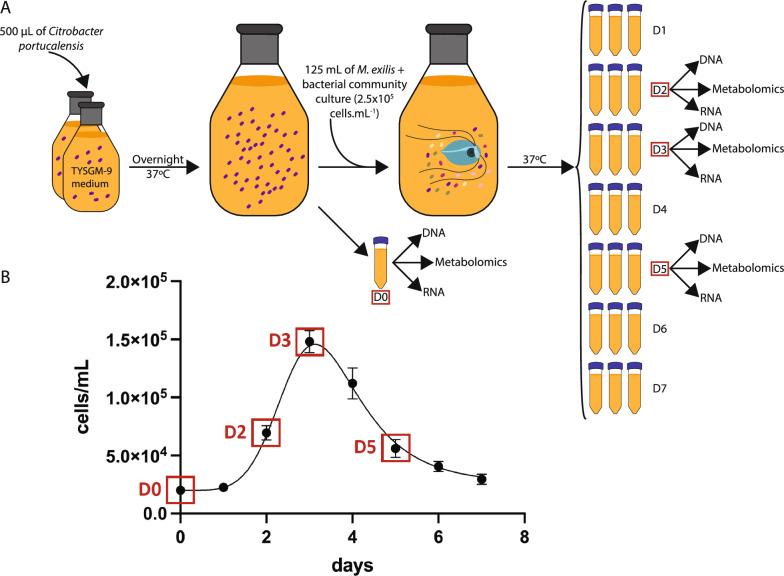
Monocercomonoides exilis is a model species of the amitochondrial eukaryotic group Oxymonadida, which makes it a suitable organism for studying the consequences of mitochondrial loss. Although M. exilis has an endobiotic lifestyle, it can be cultured in vitro in polyxenic conditions alongside an uncharacterized prokaryotic community, while attempts to create axenic cultures have not been successful. In this study, we used metagenomic sequencing, transcriptomics, and metabolomics to characterize the microbial consortium that supports the growth of M. exilis. We assembled genomes for 24 bacterial species and identified at least 30 species in total. M. exilis accounted for less than 1.5% of the DNA reads, while bacterial species dominated the sequence data and shifted in abundance over time. Our metabolic reconstruction and differential gene expression analyses show that the bacterial community relies on organic carbon oxidation, fermentation, and hydrogen production, but does not engage in methanogenesis. We observed rapid depletion of amino acids, nucleotides, glyceraldehyde, lactate, fatty acids, and alcohols in the medium, indicating a reliance on external nutrient recycling. The nitrogen cycle in this community is incomplete, with limited nitrogen fixation and no ammonia oxidation. Despite detailed metabolic profiling, we did not find any direct biochemical connections between M. exilis and the prokaryotes. Several bacterial species produce siderophores to assist themselves and others in the community in acquiring iron. However, M. exilis does not appear to benefit directly from siderophore-mediated iron transport and lacks known iron uptake pathways. This indicates that M. exilis may rely indirectly on the iron metabolism of other bacteria through phagocytosis. Additionally, some bacteria synthesize polyamines like spermidine and phosphatidylcholine, which M. exilis may need but cannot produce on its own. As the culture ages, M. exilis shows changes in gene expression consistent with starvation responses, including the upregulation of carbohydrate storage pathways and processes related to exocytosis. These findings provide new insights into microbial interactions within xenic cultures and emphasize the complex nature of maintaining amitochondriate eukaryotes in vitro.
微小单鞭滴虫是无线粒体真核生物毛滴虫目的一个模式物种,这使其成为研究线粒体丢失后果的合适生物体。尽管微小单鞭滴虫具有内共生生活方式,但它可以在体外与一个未鉴定的原核生物群落一起在多菌条件下培养,而创建无菌培养物的尝试尚未成功。在本研究中,我们使用宏基因组测序、转录组学和代谢组学来表征支持微小单鞭滴虫生长的微生物群落。我们组装了24种细菌的基因组,总共鉴定出至少30种。微小单鞭滴虫占DNA读数的比例不到1.5%,而细菌物种在序列数据中占主导地位,且丰度随时间变化。我们的代谢重建和差异基因表达分析表明,细菌群落依赖有机碳氧化、发酵和产氢,但不进行甲烷生成。我们观察到培养基中的氨基酸、核苷酸、甘油醛、乳酸、脂肪酸和醇迅速耗尽,表明依赖外部营养物质循环。这个群落中的氮循环不完整,固氮有限且没有氨氧化。尽管进行了详细的代谢分析,但我们没有发现微小单鞭滴虫与原核生物之间有任何直接的生化联系。几种细菌物种产生铁载体来帮助自身和群落中的其他物种获取铁。然而,微小单鞭滴虫似乎没有直接从铁载体介导的铁转运中受益,并且缺乏已知的铁摄取途径。这表明微小单鞭滴虫可能通过吞噬作用间接依赖其他细菌的铁代谢。此外,一些细菌合成多胺如亚精胺和磷脂酰胆碱,微小单鞭滴虫可能需要但自身无法产生。随着培养时间的延长,微小单鞭滴虫表现出与饥饿反应一致的基因表达变化,包括碳水化合物储存途径和与胞吐作用相关过程的上调。这些发现为多菌培养物中的微生物相互作用提供了新的见解,并强调了在体外维持无线粒体真核生物的复杂性。



 Zotero 插件