
抗干扰素-α自身抗体在重症COVID-19中的作用:对疫苗接种优先级的启示
The Role of Anti-Interferon-α Autoantibodies in Severe COVID-19: Implications for Vaccination Prioritization.
作者信息
Lim Xin Rong, Liu Shiyu, Howe Hwee Siew, Leong Khai Pang, Elangovan Elampirai, Huang Chiung-Hui, Kong Kok Ooi, Thong Bernard Yu Hor, Vasoo Shawn, Leung Bernard Pui Lam
机构信息
Department of Rheumatology, Allergy and Immunology, Tan Tock Seng Hospital, Singapore 308433, Singapore.
National Centre for Infectious Disease, Tan Tock Seng Hospital, Singapore 308442, Singapore.
出版信息
Vaccines (Basel). 2025 Jul 9;13(7):742. doi: 10.3390/vaccines13070742.
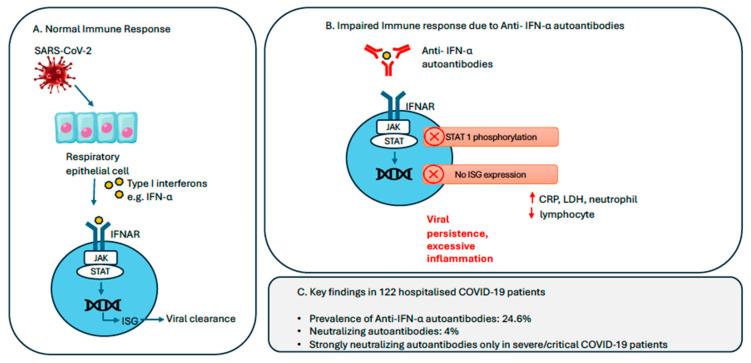
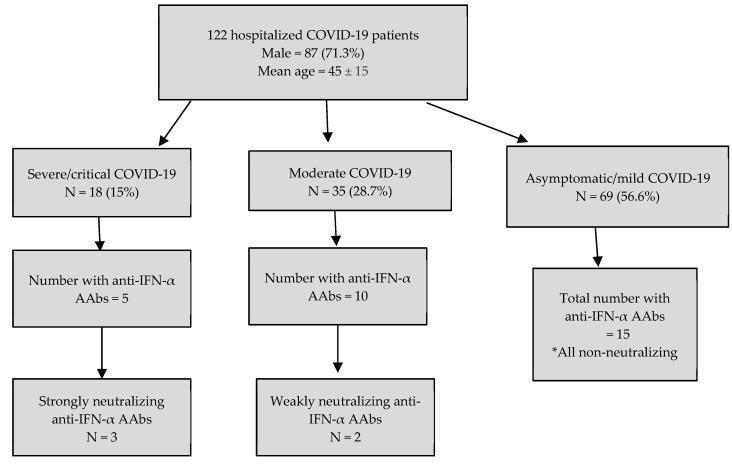
: Neutralizing autoantibodies against type I interferons, particularly interferon-alpha (IFN-α), have been implicated in severe COVID-19 outcomes. This study investigated the prevalence and functional significance of anti-IFN-α autoantibodies (AAbs) in hospitalized unvaccinated COVID-19 patients and their association with COVID-19 disease severity. : We retrospectively analyzed serum samples from 122 hospitalized COVID-19 patients (asymptomatic/mild: n = 69, moderate: n = 35, severe/critical: n = 18) and 32 healthy uninfected controls. Anti-IFN-α AAbs were quantified using a commercial enzyme-linked immunosorbent assay (ELISA) kit, with functional neutralization assessed via competitive ELISA and STAT1 phosphorylation inhibition. Statistical comparisons were performed using one-way ANOVA for parametric data and the Kruskal-Wallis test for non-parametric variables. : Anti-IFN-α AAbs were detected in 24.6% of COVID-19 patients, with all clinical subgroups showing significantly higher titers compared to healthy controls ( < 0.05). Although no significant differences in anti-IFN-α AAb levels were found between mild, moderate, and severe cases, patients with severe or critical COVID-19 had markedly higher mean titers (10,511.3 ng/mL) compared to non-severe (mild + moderate) cases (375.2 ng/mL, < 0.001). Strongly neutralizing anti-IFN-α AAbs, with high titers (>20,000 ng/mL) and the ability to inhibit STAT1 phosphorylation, were identified in three severe COVID-19 cases. Anti-IFN-α AAb levels correlated positively with CRP (r = 0.80, < 0.0001), LDH (r = 0.80, = 0.001), and neutrophil count (r = 0.52, = 0.003), and negatively with lymphocyte count (r = -0.59, = 0.0006). : Elevated and functionally neutralizing anti-IFN-α AAbs were associated with severe COVID-19. These findings support their role as a risk factor for poor outcomes and emphasize the importance of early COVID-19 vaccination. Screening may help identify high-risk individuals, particularly those unvaccinated or with immune vulnerabilities.
针对I型干扰素,尤其是干扰素-α(IFN-α)的中和自身抗体与严重的COVID-19预后有关。本研究调查了未接种疫苗的住院COVID-19患者中抗IFN-α自身抗体(AAbs)的患病率及其功能意义,以及它们与COVID-19疾病严重程度的关联。我们回顾性分析了122例住院COVID-19患者(无症状/轻症:n = 69,中症:n = 35,重症/危重症:n = 18)和32名健康未感染对照者的血清样本。使用商用酶联免疫吸附测定(ELISA)试剂盒对抗IFN-α AAbs进行定量,通过竞争性ELISA和STAT1磷酸化抑制评估功能中和作用。对于参数数据,使用单因素方差分析进行统计比较;对于非参数变量,使用Kruskal-Wallis检验。在24.6%的COVID-19患者中检测到抗IFN-α AAbs,所有临床亚组的滴度均显著高于健康对照(<0.05)。虽然在轻症、中症和重症病例之间未发现抗IFN-α AAb水平的显著差异,但与非重症(轻症+中症)病例(375.2 ng/mL)相比,重症或危重症COVID-19患者的平均滴度明显更高(10,511.3 ng/mL,<0.001)。在3例重症COVID-19病例中鉴定出具有高滴度(>20,000 ng/mL)且能够抑制STAT1磷酸化的强中和抗IFN-α AAbs。抗IFN-α AAb水平与CRP(r = 0.80,<0.0001)、LDH(r = 0.80,= 0.001)和中性粒细胞计数(r = 0.52,= 0.003)呈正相关,与淋巴细胞计数(r = -0.59,= 0.0006)呈负相关。升高且具有功能中和作用的抗IFN-α AAbs与重症COVID-19相关。这些发现支持它们作为不良预后危险因素的作用,并强调了早期接种COVID-19疫苗的重要性。筛查可能有助于识别高危个体,尤其是那些未接种疫苗或存在免疫缺陷的个体。

 Zotero 插件